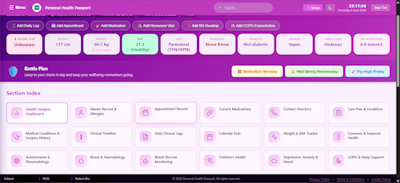
Section Index
🚨 Critical Alerts
Clinical alerts will appear here once saved in Section 1.
📊 Health Insights
A live view of your health trends, streaks, and AI-generated weekly observations.
🔥 My Logging Streak
🤖 AI Health Insights
📅 Upcoming — Next 30 Days
Master Record & Allergies
🆔 Patient Identification
Primary identification, diabetic/smoker status, and high-priority clinical warnings.
⚠️ Clinical Alerts
Contact Directory
📞 Clinical & Emergency Contacts
Direct contact details for specialist clinical teams and emergency family support.
| Name / Team | Role | Location | Phone |
|---|
🚨 Emergency Banner Defaults
Choose your emergency contacts which appears in the orange emergency bar at the top of every page.
💡 Understanding Your Contact Directory
Who to include and what each role means.
👥 Who to Include
- GP (General Practitioner) — your family doctor, usually the first point of contact for most health concerns
- Consultant — a senior hospital doctor who specialises in a particular area (e.g. gastroenterology, cardiology)
- Specialist Nurse — a nurse with advanced training in a specific condition (e.g. TPN nurse, stoma nurse, diabetes nurse)
- Homecare Team — nurses or carers who visit you at home to assist with clinical tasks
- Pharmacist — can advise on medications, interactions, and side effects
- Next of Kin (NOK) — your closest relative or chosen person, who may be contacted in an emergency
- Carer / Support Person — someone who assists with your daily care, paid or unpaid
- Social Worker — helps coordinate support services, housing, and benefits
🏥 Hospital Terms Explained
- Outpatient — an appointment at a hospital clinic where you attend and go home the same day
- Inpatient — when you are admitted to hospital and stay overnight
- Day case — a procedure or treatment at hospital that does not require an overnight stay
- Referral — when your GP or a doctor sends you to see another specialist
- MDT (Multi-Disciplinary Team) — a group of different healthcare professionals who discuss your care together
- Bleep / Pager number — an internal hospital contact number for reaching a specific clinician
✅ Tips for Your Contact Directory
- Always include an out-of-hours or emergency number for your most critical contacts
- Keep this section up to date — consultants and specialist nurses change
- Include your homecare company's 24-hour helpline if you receive homecare
- Add your nearest hospital's direct ward number if you are a frequent attender
Enteral Nutrition Regime
🥤 Enteral Nutrition Information
Enteral feed prescription, cycle timing, tube type, and clinical hardware inventory.
🔗 Active Lines, Tubes & Drains
Record all current access lines, feeding tubes, and drains. Add a row for each one.
| Type | Location | Date In | Date Removed | Notes |
|---|
💡 Information Hub
Add a line or tube above to see personalised information.
Line Infection History
🦠 Infection Record
TPN & Enteral AccessRecord of Pathogens, Exit-Site Infections, and Microbiology.
| Date | Access Point | Pathogen | Symptoms | Antibiotics |
|---|
🔒 Line Lock Log
A record of every line lock period — whether for a confirmed infection, a suspected infection, or a planned line rest. Saved entries are locked as read-only records. Use Edit to update or Delete to remove.
No line lock entries yet. Add the first entry above.
ℹ️ What is a Line Infection?
Central lines (Hickman, PICC, Portacath) bypass the skin — the body's natural barrier — giving bacteria a direct route into the bloodstream. Even with careful care, infections can happen and are a known risk of long-term IV access, not a sign of carelessness.
⚠️ Recognising the Signs — When to Get Help
- Redness, warmth, or swelling at the exit site or along the tunnel
- Any discharge or crusting around the line entry point
- Your dressing is lifting, wet, or soiled
- Low-grade temperature (37.5°C–38°C) without an obvious cause
- The line feels harder to flush than usual
- General feeling of being more unwell than normal
- Temperature of 38°C or above — especially during or after an infusion
- Rigors — sudden uncontrolled shaking or shivering
- Feeling faint, confused, or very rapidly unwell
- Rapid heart rate, difficulty breathing, or feeling clammy
- Severe pain or extensive redness tracking away from the exit site
🛡️ Prevention — Your Daily Line Care Checklist
- Wash hands with soap and water for at least 20 seconds before touching your line or any equipment
- Use alcohol hand gel after washing if available
- Never touch the line tip, bung, or connector without clean hands
- Ask anyone else handling your line to wash their hands first
- Swab the bung or needleless connector with a 70% alcohol wipe for 15 seconds before every access — then allow to dry fully (do not blow on it)
- Change bungs and caps according to your homecare schedule — never reuse
- Keep the end of the line clamped when not in use
- Never leave the line open to air
- Check your dressing daily — it should be clean, dry, and fully stuck down
- If the dressing is loose, wet, or visibly soiled, contact your homecare nurse for a change — do not leave it
- Never get the dressing wet in the shower — use a waterproof cover
- Do not pick at or peel back the edges
- Flush with saline before and after every infusion or medication, using a push-pause technique to create turbulence inside the line
- Always check the infusion bag and giving set for cloudiness, particles, or leaks before connecting
- Never rush a connection — take your time with each step
- Report any resistance or pain during flushing to your nurse
Care Plan & Escalation
📋 Care Plan Overview
Your overall care goals, coordinator, and plan review dates.
📝 Advance Care Decisions
Important decisions about your care preferences and treatment wishes.
🚨 Escalation Plan
Who to contact and in what order when something goes wrong. Saved entries lock as read-only records — use Edit to update or Delete to remove.
No escalation tiers yet — add your first contact above.
⚠️ Emergency Protocols
Condition-specific emergency instructions for first responders and carers.
💡 Understanding Your Care Plan
Plain-English explanations of the terms used in this section.
📋 Care Plan Terms
- Care Coordinator — the named person responsible for overseeing and coordinating all aspects of your care. Often a specialist nurse or key worker.
- Escalation Plan — a step-by-step guide of who to contact and when if your condition changes or worsens
- Phlebotomy — blood tests. The frequency tells you how often your blood needs to be checked.
- Sepsis Protocol — emergency instructions to follow if you show signs of serious infection. Sepsis is life-threatening and requires immediate action.
📝 Advance Care Decision Terms
- DNACPR (Do Not Attempt Cardiopulmonary Resuscitation) — a medical decision that CPR should not be attempted if your heart stops. This is a clinical decision made with you, not by you alone. It does not mean you will receive less care.
- Advance Care Directive — a document where you record your wishes about future medical treatment, in case you are unable to communicate them yourself
- Advance Decision to Refuse Treatment (ADRT) — a legally binding document where you refuse a specific treatment in advance
- Preferred Place of Care — where you would like to be cared for if your condition deteriorates (e.g. at home, in a hospice)
- LPA (Lasting Power of Attorney) — a legal arrangement where you appoint someone you trust to make decisions on your behalf if you lose the ability to do so. There are two types: Health & Welfare (medical decisions) and Property & Financial Affairs.
⚠️ Signs of Sepsis — Act Fast
If you have a central line, PICC, or any IV access, be aware of these warning signs:
- Temperature above 38°C or below 36°C
- Heart rate above 100 beats per minute
- Shivering, feeling very cold, or rigors (uncontrollable shaking)
- Confusion or feeling very unwell suddenly
- Redness, swelling, or discharge around a line site
If in doubt — stop the feed, call your homecare team or 999 immediately.
Current Medications
💊 Medication List
Record all current medications, dosages, and administration routes.
| Medication | Dose | Frequency | Route | Indication | Prescriber | Start Date | Review Date |
|---|
⚠️ Drug Allergies & Reactions
Record any known drug allergies or adverse reactions. This information is critical for prescribers.
| Drug / Substance | Reaction | Severity | Date Noted |
|---|
🌿 OTC Medications & Supplements
Over-the-counter medicines, vitamins, and supplements. These can interact with prescribed medications — always tell your doctor what you take.
| Name | Dose | Frequency | Reason for Taking |
|---|
💡 Medication Safety Information
Important guidance on medication safety, side effects, and interactions.
⚠️ Common Side Effects to Watch For
- Nausea / vomiting — common with antibiotics, iron, and metformin. Take with food where possible.
- Dizziness / drowsiness — common with opioids, antihistamines, and blood pressure medications. Avoid driving.
- Constipation — common with opioids and iron supplements. Ensure adequate fluid intake.
- Diarrhoea — common with antibiotics. Consider probiotics. Contact your GP if severe.
- Skin rash — may indicate allergy. Stop the medication and contact your GP or 111 immediately.
- Unusual bruising or bleeding — may indicate blood thinning. Contact your GP urgently.
- Mood changes — some medications (steroids, beta-blockers) can affect mood. Tell your doctor.
🔄 Drug Interaction Warnings
- Warfarin interacts with many antibiotics, aspirin, and herbal supplements (especially St John's Wort).
- Methotrexate interacts with NSAIDs (ibuprofen, naproxen) — can be dangerous.
- MAOIs interact with many common medications and foods — always check with your pharmacist.
- Grapefruit juice interacts with statins, some blood pressure medications, and immunosuppressants.
- Supplements — iron, calcium, and magnesium can reduce absorption of antibiotics and thyroid medications.
- Always tell every clinician and pharmacist all medications you take, including OTC and supplements.
✅ Medication Safety Tips
- Never stop a prescribed medication without speaking to your doctor first.
- Keep all medications in their original packaging with the label intact.
- Store medications as directed — some require refrigeration.
- Check expiry dates regularly and return expired medicines to a pharmacy.
- Never share your prescribed medication with anyone else.
- If you miss a dose, check the patient information leaflet — do not double up without advice.
Medical Conditions and Surgery History
📄 Brief Medical Summary
A short plain-English summary of your medical background. Written by you, for any clinician who needs to understand your history quickly.
🩺 Medical Conditions
A record of diagnosed medical conditions. Include the date of diagnosis and the treating hospital or consultant where known.
| Date | Condition / Diagnosis | Status | Consultant / Hospital | Notes |
|---|
🏥 Hospital Admissions
A record of hospital admissions. Include the date, reason for admission, the hospital, and the outcome or discharge summary where known.
| Date In | Date Out | Reason for Admission | Hospital / Ward | Outcome / Discharge | Notes |
|---|
💡 Why Medical History Matters
Understanding your medical history helps every clinician who cares for you make safer, better-informed decisions.
📋 What to Include
- All diagnosed conditions, even if currently well-managed or resolved
- All surgical procedures, including minor operations and endoscopies
- Hospital admissions and significant investigations (CT scans, MRIs, biopsies)
- Mental health diagnoses and episodes of care
- Previous reactions to anaesthetic or surgical complications
👨👩👧 Why Family History Matters
- Some conditions run in families — heart disease, diabetes, certain cancers, and autoimmune conditions
- Family history can guide screening decisions and preventive care
- Genetic conditions may affect treatment choices
- Even if a relative was never formally diagnosed, symptoms or cause of death can be relevant
💉 Immunisations & Complex Patients
- If you are on immunosuppressants, steroids, or biologics, some live vaccines may not be safe — always check with your doctor before having any vaccine
- Annual flu vaccine is recommended for most complex health conditions
- Pneumococcal vaccine is recommended if you are immunocompromised or have had your spleen removed
- COVID-19 boosters may be recommended more frequently for high-risk patients
Appointment Record
📅 Appointments
Log all upcoming and past outpatient appointments. Include the date, hospital or clinic, consultant name, and specialty so nothing gets missed.
| Date | Clinic / Specialist | Time | Location | Reason |
|---|
📆 Appointment Calendar
Click any date to see the full day summary — appointments, nurse visits, vitals, and notes.
💡 Making the Most of Your Appointments
Tips and guidance for getting the most out of every appointment.
✅ Before Your Appointment
- Write down your questions beforehand — it is easy to forget when you are in the room
- Bring a list of all your current medications, including OTC and supplements
- Bring this Health Passport — it gives clinicians an instant overview of your history
- If you have had any new symptoms, note when they started and how often they occur
- If possible, bring a trusted person with you for support and to help remember what is said
🏥 Appointment Types Explained
- New consultation — your first appointment with a specialist to discuss a new concern or referral
- Routine follow-up — a regular check-in to monitor your condition and review progress
- Test results review — an appointment specifically to discuss the results of blood tests, scans, or other investigations
- MDT (Multi-Disciplinary Team) meeting — a meeting where multiple specialists discuss your care together. You may or may not attend.
- Pre-operative assessment — checks carried out before a planned operation to make sure you are fit for surgery
💬 During Your Appointment
- Do not be afraid to ask your clinician to explain something again or in simpler terms — it is your right
- Ask what happens next — who does what, and by when
- If a new medication is prescribed, ask about side effects and interactions
- Ask for a copy of any letters or results — you are entitled to them
- If you disagree with a decision, you have the right to ask for a second opinion
📋 After Your Appointment
- Record the appointment in this section straight away while it is fresh
- Note any actions — yours and the clinician's
- If you were referred on, chase it up if you have not heard within the expected timeframe
- Update your medications section if anything was changed
Current Clinical Status
🗣️ What I Want You To Know
Write this in your own words. This is the first thing a clinician should read — the things you always have to repeat and are tired of explaining.
📋 Current Status
A snapshot of where things stand right now.
🔬 Active Investigations & Pending Procedures
Tests, scans, or procedures awaited, in progress, or with results pending. Saved entries lock as read-only records — use Edit to update or Delete to remove.
No investigations recorded yet. Add the first entry above.
⚠️ Current Concerns
Anything actively worrying you or your team right now. Saved entries lock as read-only records — use Edit to update or Delete to remove.
No concerns recorded yet. Add the first entry above.
📌 Key Clinical Dates
Important dates any clinician needs to know at a glance.
💡 About This Section
How to use this section and why it matters.
🗣️ The Most Important Card
"What I Want You To Know" is the first thing any clinician — including A&E doctors — should read. Write it as if you are talking directly to someone who has never met you and has 30 seconds to understand your situation. Be specific. Include the things you always have to repeat and the mistakes that have happened before because someone didn't know.
📋 Keep This Section Up To Date
Unlike Section 6 (your medical history, which rarely changes), this section should be updated regularly — after any hospital admission, when a new investigation starts, or when your situation changes. Think of it as the back cover of your passport: the summary a clinician reads before opening the book.
Homecare Nurse Visit Log
🏢 Homecare Provider
Your homecare company details — quick reference without needing to search your contacts.
🏠 Visit Log
Record each homecare nurse visit — date, times, nurse name, role, and tasks completed. Used to verify visit frequency and support continuity of care.
| Date | Arrived | Departed | Duration | Nurse Name | Role | Tasks Completed |
|---|
🩹 Line Dressing & Site Check
Log each dressing change and site swab. Important for detecting early signs of infection.
| Date | Dressing Replaced? | Swab Taken? | Notes |
|---|
🩸 Blood Draw Log
Record of blood samples taken during homecare visits.
| Date | Bloods Taken | Sent To |
|---|
📋 Nurse Notes
Notes from each visit — observations, concerns, or anything the nurse flagged.
| Date | Note |
|---|
📦 Stock Audit
Track supply levels checked during each visit so nothing runs out unexpectedly.
| Date | Stock Levels | Items Noted / Actions |
|---|
💡 About Homecare Visits
What homecare nurses do and why keeping this log matters.
🏠 What Is a Homecare Nurse?
A homecare nurse visits you at home to carry out clinical tasks that would otherwise require a hospital or clinic visit. For TPN patients this typically includes connecting and disconnecting your feed, changing your line dressing, taking blood samples, and checking your central line site for signs of infection. They are a crucial link between you and your clinical team.
📋 Why Log Your Visits?
- Provides a clear record for your clinical team of how often visits are happening
- Helps identify if visits are being missed or if frequency needs to change
- Creates an evidence trail if you need to raise a concern with your homecare provider
- Dressing and swab logs help detect patterns in line site problems before they become infections
- Stock audit records help prevent running out of critical supplies
⚠️ If a Nurse Doesn't Arrive
- Call your homecare provider's main number immediately — use the out-of-hours number if outside business hours
- If you are due a TPN connection and no nurse arrives, do not attempt to connect yourself without training — call your clinical team
- Keep a record of missed visits — this is important information for your care coordinator
Blood Glucose Monitoring
📈 BG Record
Log your blood glucose readings here. Enter the date, time, reading, and when it was taken (e.g. before or after a meal). Readings entered in the Daily Log are automatically added here — just save this section to keep them.
| Date | Time | BG (mmol/L) | Timing | Notes / Follow-up |
|---|
💡 Understanding Blood Glucose
Plain-English guidance on blood glucose monitoring — what the numbers mean and what to do.
🩸 What Is Blood Glucose?
Blood glucose (BG) is the amount of sugar in your blood, measured in millimoles per litre (mmol/L). Your body uses glucose as its main energy source. Keeping it within a healthy range is important — too high or too low can both cause serious problems.
👥 Who Needs to Monitor Blood Glucose?
- Type 1 diabetes — the body produces no insulin; monitoring is essential every day
- Type 2 diabetes — especially if on insulin or certain medications
- Steroid users — steroids (e.g. prednisolone, dexamethasone) can significantly raise blood glucose even in people without diabetes
- TPN / IV nutrition patients — TPN contains glucose which can cause glucose instability or steroid-like effects
- Cancer patients — some treatments and steroids used alongside chemotherapy affect glucose levels
- Anyone with a known glucose instability — including gestational diabetes or post-surgical glucose changes
📊 What Do the Numbers Mean?
- 4.0 – 5.9 mmol/L — normal fasting range for most people
- Under 7.8 mmol/L — normal up to 2 hours after eating
- Below 3.9 mmol/L — hypoglycaemia (low blood sugar) — treat immediately
- Above 10.0 mmol/L — hyperglycaemia (high blood sugar) — monitor closely and contact your team
- Above 12.0 mmol/L — escalate immediately to your clinical team or call 111
Your clinical team may give you different target ranges — always follow their specific advice.
⬇️ Low Blood Sugar (Hypo) — Act Fast
Symptoms: shaking, sweating, confusion, dizziness, feeling very hungry, pale skin, fast heartbeat.
- Take 15–20g of fast-acting carbohydrate — glucose tablets, a small glass of sugary drink, or 5 jelly babies
- Wait 15 minutes and recheck
- If still low, repeat — if unconscious or unable to swallow, call 999
⬆️ High Blood Sugar (Hyper)
Symptoms: thirst, frequent urination, tiredness, blurred vision, headache.
- Drink plenty of water
- Check if you have missed a medication or insulin dose
- If above 12.0 mmol/L or you feel very unwell — contact your clinical team or call 111
- If you are on a sliding scale or correction dose, follow your team's instructions
📈 Common Reasons for Fluctuations
- Illness or infection — glucose often rises when the body is fighting infection
- Steroids — even a short course can significantly raise levels
- Missed medication or insulin
- Changes to diet or feed rate
- Stress or poor sleep
- Starting or stopping TPN or enteral feed
Daily Clinical Logs
⚙️ Customise Your Daily Log ▼
📓 Daily Log
Daily clinical log for the current month. Enter each day's vitals and readings — the columns shown depend on which modules you have switched on above. Use the arrows to navigate between months. Save each month separately.
📖 What do these columns mean?
💡 Understanding Your Daily Log
The daily log is for any patient who needs to track their health over time — whatever your condition. You do not need to fill in every field every day. Even basic entries build a picture that helps you and your team.
📓 Why Keep a Daily Log?
A single reading tells you very little. A week of readings starts to show a pattern. A month of readings gives your clinical team something genuinely useful — they can see trends, spot early warning signs, and make better decisions about your care.
- Bring this log to every GP or clinic appointment — it saves time and answers questions before they are asked
- If you are admitted to hospital, a completed log gives the admitting team an instant picture of your recent health
- Patterns you might not notice day-to-day become obvious when you look at a month at a glance
- You do not need to fill in every column every day — even weight and temperature alone are valuable over time
⚙️ What the Optional Modules Are For
Switch on only the modules relevant to you. Each one adds extra columns to your daily log.
- Tube Feed / IV Nutrition — Connect and disconnect times, feed volume (ml), feed rate (ml/hr), and pump status for anyone receiving enteral (tube) or parenteral (IV) nutrition.
- Blood Glucose — For people with diabetes, on insulin, on steroids, or receiving IV/tube nutrition. Record readings in mmol/L.
- Pain Score — Rate your pain 1–10. 1 = barely noticeable, 10 = worst imaginable. Useful for any chronic pain condition or post-surgery recovery.
- Fluid Balance — Total fluid taken in (drinks, IV, tube feed) vs. total fluid out (urine, stoma, drains). Important for kidney conditions, heart failure, and IV nutrition patients.
- COPD / Respiratory — Peak flow in litres per minute, SpO2 saturation reading, and an inhaler puff counter. Auto-enabled when COPD is set in your profile.
- POTS / Dysautonomia — Side-by-side lying vs. standing heart rate comparison and a dizziness/syncope score (0–10). Auto-enabled if POTS is active in your Rare Diseases profile.
- Stoma Output — Consistency of output from your stoma (colostomy, ileostomy, or urostomy). High output or sudden changes should be reported to your team.
- Sleep — Hours slept. Poor sleep affects pain, mood, and recovery. Useful for anyone on medications that affect sleep, or with conditions like COPD or chronic pain.
- Nausea / Vomiting — Nausea score (0–10) and number of vomiting episodes. Relevant for chemotherapy, GI conditions, post-surgery recovery, and medication side effects.
- Urine Output — Volume of urine in ml. Low output can indicate dehydration or kidney problems. Important for anyone on IV fluids or with kidney or heart conditions.
- Bowel — Number of bowel movements and Bristol Stool Score. Useful for IBD, IBS, bowel cancer recovery, and anyone on medications that affect bowel habit.
💩 Bristol Stool Chart — Quick Reference
The Bristol Stool Chart is a clinical tool used by doctors and nurses to describe stool consistency. If you use the Bowel module, enter the type number (1–7) that best matches.
| Type | Description | What it means |
|---|---|---|
| Type 1 | Separate hard lumps, like nuts | Severe constipation |
| Type 2 | Lumpy, sausage-shaped | Constipation |
| Type 3 | Sausage shape with cracks | Normal |
| Type 4 | Smooth, soft sausage | Ideal |
| Type 5 | Soft blobs with clear edges | Lacking fibre |
| Type 6 | Fluffy, mushy, ragged edges | Mild diarrhoea |
| Type 7 | Entirely liquid, no solid pieces | Severe diarrhoea |
Types 3 and 4 are considered normal. Types 1–2 suggest constipation; types 6–7 suggest diarrhoea. Report persistent type 1–2 or 6–7 to your clinical team.
🚨 When to Contact Your Team
These are general thresholds — your team may give you different personal targets. Always follow their advice first.
- Temperature above 37.5°C (or 38°C — check your escalation plan) — may indicate infection
- Oxygen saturation below 94% — or below your personal baseline if you have a lung condition
- Weight gain of 2 kg or more in 48 hours — possible fluid retention, contact your team the same day
- Weight loss of more than 5% in 3 months without trying — report to your GP or dietitian
- Blood glucose outside your target range — persistent hypos or hypers both need review
- No urine output for 8+ hours — or significantly less than usual — may indicate dehydration or kidney problems
- Nausea or vomiting preventing eating or drinking — especially if you are on medications that must be taken with food
- Stoma: no output for 4–6 hours with abdominal pain — possible blockage, contact your stoma nurse or team
- Any reading that concerns you — trust your instincts. You know your own body. If something feels wrong, contact your team.
Stoma Care Log
👩⚕️ My Stoma Nurse
Your first point of contact for any stoma concerns, bag changes, skin issues, or product queries.
🩹 Bag Change Log
Log every bag change with a skin check, stoma appearance, output type, and any leak details.
| Date | Time | Skin Sore/Red? | Normal Pink? | Output Type | Leak? | Leak Reason |
|---|
💡 Information Hub
Living with a Stoma
General guidance for stoma care and bag management
A stoma is a surgically created opening on the abdomen that diverts the bowel or urinary tract to the outside of the body. The three most common types are a colostomy (from the colon), an ileostomy (from the small intestine, producing liquid output), and a urostomy (diverting urine). A stoma bag (pouch) is worn over the opening to collect output.
- Gather all supplies before you start: new bag, skin barrier/flange, scissors, soft wipes, warm water, and a disposal bag.
- Empty the bag fully before removing it — this reduces mess and makes removal easier.
- Gently peel the old bag from top to bottom, supporting the skin as you go. Never rip it off.
- Clean the skin around the stoma with warm water and a soft cloth or non-woven wipe. Avoid soap with moisturisers as it can prevent the new bag from sticking.
- Pat the skin completely dry — adhesion depends on dry, clean skin.
- Inspect the stoma (should be pink/red and moist) and the peristomal skin (should be intact and skin-coloured).
- Cut or mould the new flange to fit within 1–3 mm of the stoma edge to protect the skin without pressing on the stoma.
- Warm the adhesive flange in your hands for 30 seconds to improve adhesion, then apply from the bottom up, pressing firmly for 30–60 seconds.
- Dispose of the used bag sealed in a disposal bag — do not flush stoma bags down the toilet.
| What You See | What it Means | Action |
|---|---|---|
| Pink and moist stoma | Healthy — good blood supply | No action needed |
| Slight bleeding when cleaning | Normal — stoma tissue is delicate | Apply gentle pressure; settles quickly |
| Red, sore peristomal skin | Moisture-associated skin damage or poor flange fit | Review bag fit; use stoma powder on broken areas; contact stoma nurse |
| White/cream plaques on skin | Possible fungal (Candida) infection | Contact your stoma nurse for antifungal treatment |
| Purple/dark/black stoma | Reduced blood supply — serious | Contact clinical team urgently |
| Stoma retracting below skin | Retraction — bag may not seal well | Contact stoma nurse; convex bags may help |
| Type | Usual Stoma Type | Notes |
|---|---|---|
| Formed | Colostomy (descending/sigmoid) | Solid output, similar to normal stool — typically once or twice daily |
| Mushy | Colostomy (transverse) | Semi-solid; more variable frequency |
| Liquid | Ileostomy | Watery/porridge consistency; high volume. Monitor closely for dehydration — aim for 1–1.5 L/day output. If over 2 L/day, contact your team. |
- Bag too full: Empty when one-third full — never let it get more than half full.
- Poor flange fit: If the cut-out is too large, output contacts the skin and lifts the adhesive. Measure before every change.
- Sweating: Use a barrier wipe / film before applying the flange; consider a belt accessory for exercise.
- Creases or skin folds: Mouldable seals (rings or paste) fill uneven surfaces and prevent leaks at edges.
- Applying to damp skin: Always pat completely dry before applying the new bag.
- Stoma output during change: Consider timing bag changes when output is least (morning before breakfast for colostomies).
- The stoma turns dark purple, blue, or black — possible ischaemia
- No output for more than 4–6 hours and the abdomen is cramping or bloated — possible blockage
- Ileostomy output exceeds 2 litres in 24 hours — risk of dangerous dehydration
- Persistent bright red bleeding from inside the stoma (not surface ooze when cleaning)
- Signs of infection: fever, severe pain, swelling, or spreading redness around the stoma site
- The stoma appears to be prolapsing (protruding more than usual)
⚔️ Battle Plan
Living with a complex health condition is relentless — but so are you. The Battle Plan is your personal weekly ritual. Just pick one of your three power days, answer three simple questions, and record your win. No pressure. No perfection. Just showing up — and that alone is a victory.
| Week | Day | Goal | Grateful for | Notes | Win 🏆 |
|---|
💡 Click any entry to view full details. Entries are saved automatically when you click Save Entry above.
If you are struggling, please reach out. You do not have to face this alone. The services below may be able to help — and if one does not understand your situation, try another. Your experience is valid even when others don't have the words for it.
COPD & Sleep Support
💊 COPD & Respiratory Medications ● Live from Section 5
These are pulled live from your Section 5 Medications master list — filtered to inhaled and respiratory drugs. To add, edit or remove, go to Section 5. No double entry needed.
🩺 Which conditions apply to you?
Select all that apply — each condition will open its own panel below.
💡 Information Hub
Understanding COPD
Chronic Obstructive Pulmonary Disease — causes, stages, and what it means day to day
COPD is a long-term lung condition that causes airflow obstruction, making it harder to breathe out fully. It includes chronic bronchitis (persistent airway inflammation and mucus) and emphysema (damage to the air sacs). It is usually caused by long-term exposure to irritants — most commonly cigarette smoke, but also pollution, dust, and chemicals. COPD cannot be cured but it can be managed effectively.
CPAP (Continuous Positive Airway Pressure) delivers a steady stream of air via a mask to keep your airway open during sleep. It is prescribed for Obstructive Sleep Apnoea (OSA) — a condition where the throat repeatedly collapses during sleep, causing you to stop breathing briefly and wake partially. OSA and COPD often occur together (called overlap syndrome), which significantly increases health risks if untreated.
NIV / BiPAP is used in more advanced COPD where CO₂ builds up in the blood (hypercapnic respiratory failure). It uses two pressures — a higher pressure on breathing in (IPAP) and a lower one on breathing out (EPAP) — to support your breathing, especially overnight.
Even the best inhaler won't work if the technique is wrong. Common mistakes to avoid:
- Breathing in too fast (especially with MDIs — breathe in slowly and steadily)
- Not shaking the inhaler before use (where required)
- Forgetting to breathe out first before inhaling
- Not holding your breath for 5–10 seconds after inhaling
- Not rinsing your mouth after ICS inhalers (prevents oral thrush)
- Using a spacer with MDIs dramatically improves drug delivery — ask your GP if you don't have one
An exacerbation is a sustained worsening of your symptoms beyond normal day-to-day variation. Act early — waiting makes it harder to treat at home. Warning signs:
- Increased breathlessness beyond your usual level
- Sputum changing in colour (yellow, green, brown) or increasing in amount
- Wheezing more than usual
- Feeling generally unwell, feverish, or unusually tired
- Needing to use your reliever inhaler more often
🌿 Self-Management & Lifestyle
Breathe in slowly through your nose for 2 counts. Pucker your lips as if blowing out a candle. Breathe out slowly through pursed lips for 4 counts. Repeat. Slows breathing, reduces air trapping, and relieves breathlessness quickly.
Place one hand on your chest, one on your belly. Breathe in through your nose — your belly should rise, not your chest. Breathe out slowly through pursed lips. Strengthens the diaphragm and reduces the work of breathing.
- Forward lean (tripod position): Sit and lean forward slightly, resting hands on knees or a table. Opens the chest and lets the diaphragm move freely.
- Standing lean: Stand and lean forward with hands on a wall or stable surface at hip height.
- High side lying: In bed, lie on your side with head and shoulders raised on pillows. Avoids lying flat which can worsen breathlessness.
- Plan ahead — do demanding tasks when your energy is highest (usually mid-morning)
- Sit down for tasks you normally do standing (ironing, food prep, brushing teeth)
- Break tasks into smaller steps with rests in between
- Keep frequently used items within easy reach
- Use a wheeled trolley or bag to carry items rather than lifting
- Avoid rushing — hurrying dramatically increases oxygen demand
Exercise is one of the most effective treatments for COPD — it won't harm your lungs and will improve breathlessness over time. Pulmonary rehabilitation (PR) is an NHS programme of exercise and education specifically for people with COPD. Studies show PR reduces hospital admissions and dramatically improves quality of life. Ask your GP for a referral if you haven't attended.
For day-to-day activity: aim for short walks at a gentle pace, building up gradually. Even 10 minutes daily makes a difference. Carrying a small pulse oximeter and monitoring your SpO₂ during activity can help you find a safe level.
COPD increases the energy cost of breathing — you can burn significantly more calories just breathing than someone without the condition. Malnutrition worsens muscle weakness and makes breathlessness harder to manage.
- Eat small, frequent meals — a large meal pushes the diaphragm up and worsens breathlessness
- Avoid very gassy foods (beans, carbonated drinks) which can cause bloating and restrict breathing
- Choose calorie-dense snacks if weight loss is a concern (nuts, full-fat dairy, avocado)
- Stay well hydrated — it helps thin and clear mucus
- Rest before eating if you're breathless — breathlessness increases the effort of eating
- Cold air: Breathe through a scarf or buff in cold weather; breathe in through the nose to warm air before it reaches the lungs
- Infections: Get your annual flu jab and COVID booster; stay up to date with the pneumococcal vaccine; avoid crowded indoor spaces when respiratory viruses are circulating
- Smoke & pollution: Check local air quality (UK Air app / DEFRA); avoid outdoor exercise on high pollution days
- Indoor irritants: Aerosol sprays, strong cleaning products, paint fumes, open fires, and gas cookers can all worsen symptoms
- Stress: Anxiety tightens the chest and increases breathing rate — breathlessness can cause anxiety and anxiety can cause breathlessness. Pursed lip breathing and the tripod position can break this cycle.
- Getting used to the mask: Wear it for short periods during the day (e.g. watching TV) before using it overnight. Your brain needs time to accept the sensation.
- Mask leak: Try adjusting the headgear — over-tightening usually makes leaks worse. If the mask shape doesn't suit your face, ask your sleep clinic to try a different style.
- Dry mouth / throat: Increase humidifier temperature or level; make sure the heated tube (if fitted) is enabled; try a chin strap if your mouth falls open.
- Claustrophobia: Try a nasal pillow mask (smallest footprint). Use the ramp feature to start at low pressure and let it build gradually.
- Cleaning schedule: Mask cushion — rinse daily in warm soapy water, allow to air dry. Tubing — wash weekly. Humidifier chamber — wash weekly with white vinegar solution. Filter — check monthly.
- When to contact your sleep clinic: AHI consistently above 5 on your app, new or returning symptoms of OSA (snoring, witnessed apnoeas, morning headaches, excessive daytime sleepiness), mask no longer fitting after weight change, or device fault.
Women's Health
Women's Health Topics
Tick the topics relevant to you — a tab will appear for each one. Tick as many as you need.
Men's Health
📋 My Men's Health Topics
This page covers all aspects of men's health. Tick only the topics that are relevant to you — the section will expand with the right fields. You do not need to fill in every topic. Your choices are saved automatically with the Save button at the bottom of each card.
Physiotherapy
🏥 Therapist Details
Add a row for each physiotherapist — different conditions, clinics, or referrals can each have their own entry.
| Therapist Name | Job Title / Grade | Hospital / Clinic | Department | Phone | Condition / Referral Reason | Referral Date | Next Appointment |
|---|
💡 About Physiotherapy Referrals
Working with Your Physiotherapist
Understanding the referral and treatment pathway
Physiotherapy helps restore movement and function when someone is affected by injury, illness, or disability. NHS physiotherapists are degree-qualified healthcare professionals registered with the Health and Care Professions Council (HCPC). They use a range of techniques including exercise, manual therapy, education, and advice to support recovery and manage long-term conditions.
| Route | Notes |
|---|---|
| GP Referral | Most common route; GP assesses need and refers to outpatient physio |
| Consultant Referral | Often following surgery or specialist diagnosis |
| Self-Referral | Many NHS trusts accept direct self-referral for musculoskeletal conditions |
| A&E / In-patient | Physio input during a hospital admission; often continued as outpatient |
- Any relevant imaging reports (X-ray, MRI, CT)
- Current medication list
- Referral letter if you have one
- Comfortable clothing that allows access to the affected area
- A list of your symptoms — when they started, what makes them better or worse
- Be honest about your pain levels and how symptoms affect daily life
- Ask questions — understanding your condition helps with compliance
- Complete home exercises between sessions
- Report any changes or worsening symptoms promptly
🎯 Treatment Goals
Add a row per condition or treatment episode. Each therapist or referral can have its own goals.
| Condition / Episode | Short-Term Goals (0–6 wks) | Long-Term Goals (6 wks+) | Patient Priority | Planned Sessions | Review Date | Precautions / Notes |
|---|
💡 About Goal-Setting in Physiotherapy
SMART Goals in Rehabilitation
How goals are set and why they matter
| Letter | Meaning | Example |
|---|---|---|
| S | Specific | Walk to the end of the street |
| M | Measurable | 200 metres without stopping |
| A | Achievable | Realistic given current function |
| R | Relevant | Meaningful to the patient's life |
| T | Time-bound | Achieved within 4 weeks |
Research consistently shows that patients who set goals meaningful to their own lives — rather than purely clinical targets — have better engagement and outcomes. Your therapist will use these alongside clinical measures to tailor your treatment plan. Don't be afraid to say what matters most to you.
- VAS / NRS — Visual or Numeric Rating Scale for pain (0–10)
- PSFS — Patient-Specific Functional Scale
- DASH / QuickDASH — Disabilities of the Arm, Shoulder and Hand
- KOOS / HOOS — Knee / Hip injury and Osteoarthritis Outcome Score
- 6MWT — Six-Minute Walk Test for functional capacity
- Timed Up and Go (TUG) — Falls risk and mobility assessment
🏋️ Exercise Programme
Your prescribed home exercise programme. Add each exercise with sets, reps, and frequency.
| Exercise Name | Sets | Reps / Time | Frequency | Equipment | Status | Notes / Technique |
|---|
💡 Exercise Programme Guidance
Making the Most of Your Home Programme
Guidance on performing and progressing exercises safely
- Always warm up gently before starting exercises
- Perform exercises slowly and with control — do not rush repetitions
- Breathe steadily throughout; never hold your breath
- Some discomfort during exercise is normal; sharp or severe pain is not — stop if this occurs
- Consistency matters more than intensity: regular daily exercise beats occasional intensive sessions
| Term | Meaning |
|---|---|
| Rep (Repetition) | One complete movement of the exercise |
| Set | A group of repetitions performed together before resting |
| Hold | Maintaining a position for a set number of seconds |
| Frequency | How often per day or week the exercise should be performed |
Exercises are typically progressed when you can complete all sets and reps with good form and minimal discomfort. Your therapist will advise when and how to progress. Do not increase difficulty without guidance.
- Increase repetitions before increasing resistance
- Increase resistance or range of motion gradually
- Progress to more functional, weight-bearing exercises as tolerated
- Return to previous level if symptoms worsen
- You experience sharp, shooting, or severe pain during an exercise
- Symptoms significantly worsen after exercising and do not settle within 24 hours
- You develop swelling, redness, or heat around a joint
- You feel dizzy, faint, or short of breath during exercise
📋 Session Log
Record each physiotherapy session, treatment received, and your response.
| Date | Session # | Therapist | Treatment Given | Pain Before (0–10) | Pain After (0–10) | Response / Notes |
|---|
💡 Understanding Physiotherapy Sessions
Common Physiotherapy Treatments
What to expect and how to track your progress
| Treatment | Description |
|---|---|
| Manual Therapy | Hands-on joint mobilisation, manipulation, or soft tissue massage |
| Therapeutic Exercise | Supervised exercise to restore strength, range of motion, and function |
| Electrotherapy (TENS/Ultrasound) | Electrical or sound-wave modalities to reduce pain and promote healing |
| Hydrotherapy | Exercises performed in warm water to reduce load on joints |
| Acupuncture / Dry Needling | Fine needles inserted to relieve pain and muscle tension |
| Taping / Bracing | Kinesiology or rigid tape applied to support joints and alter movement |
| Education & Advice | Guidance on posture, activity modification, and self-management |
| Score | Description |
|---|---|
| 0 | No pain |
| 1–3 | Mild pain — noticeable but not limiting |
| 4–6 | Moderate pain — affecting some activities |
| 7–9 | Severe pain — significantly limiting |
| 10 | Worst imaginable pain |
- Record your pain score before and after each session to see trends over time
- Note any treatments that provided particular relief or caused a flare-up
- Share this log with your therapist — it helps them tailor subsequent sessions
- Record functional improvements, not just pain scores (e.g. "walked further today")
- Gradual reduction in pain scores between sessions
- Improved range of movement or strength
- Increased ability to perform daily activities
- Reduced reliance on pain medication
- Better sleep due to reduced pain
🗓️ Physiotherapy Monthly Log
Log each day's session, exercise, and pain levels. Navigate months with the arrows above. Save each month separately.
| Day | Appointment? | Exercises Done? | Pain Before (0–10) | Pain After (0–10) | Mood (1–10) | Notes |
|---|
Breaks & Fractures
🩻 Fracture & Break Log
A record of all fractures, breaks, and stress fractures. Include the bone affected, how the injury occurred, and the treatment provided.
| Date | Bone | Side | Mechanism of Injury | Treatment |
|---|
🔩 Hardware & Implants In Situ
Any surgical hardware (plates, screws, rods, pins, wires) that remains in the body. Important for MRI screening and future surgical planning.
| Date Inserted | Hardware Type | Location / Bone | Surgeon / Hospital | MRI Safe? |
|---|
📋 Healing & Follow-up Status
Current healing status and any ongoing follow-up for fractures.
| Bone | Side | Current Status | Next Review Date | Appt Time | Consultant / Team |
|---|
⚠️ Complications & Ongoing Issues
Record any complications arising from fractures, such as non-union, malunion, nerve damage, chronic pain, compartment syndrome, or osteoporosis diagnosis.
| Date Noted | Related Fracture | Complication / Issue | Management |
|---|
💡 Fractures & Bone Health — Information Hub
| Type | Description |
|---|---|
| Closed / Simple | Bone broken but skin intact |
| Open / Compound | Bone breaks through the skin — high infection risk; surgical emergency |
| Stress Fracture | Tiny crack from repetitive force; common in feet, shins, and runners |
| Pathological | Break caused by underlying bone disease (cancer, osteoporosis, infection) rather than trauma |
| Comminuted | Bone shattered into 3+ fragments; often requires surgery |
| Greenstick | Incomplete break; bone bends and cracks on one side — common in children |
| Treatment | When Used |
|---|---|
| Cast / splint | Stable, simple fractures — immobilises while bone heals (6–12 weeks typical) |
| ORIF (Open Reduction Internal Fixation) | Plates and screws inserted to hold bone fragments in position |
| Intramedullary nail | Metal rod inserted down the centre of long bones (femur, tibia) |
| External fixation | Frame outside the body holds bones in place — used for complex/contaminated fractures |
| Joint replacement | Femoral neck (hip) fractures in elderly — hemiarthroplasty or total hip replacement |
Osteoporosis causes bones to become weak and brittle — a fragility fracture is one caused by a force that would not normally break a healthy bone (e.g. a low-level fall). Common sites: vertebrae (spine), hip, and wrist. Around 1 in 2 women and 1 in 5 men over 50 will have an osteoporotic fracture.
Diagnosis: DEXA (dual-energy X-ray absorptiometry) scan measures bone density (T-score). T-score −1.0 to −2.5 = osteopenia; below −2.5 = osteoporosis. Treatment: Calcium (1,000–1,200 mg/day) + vitamin D (800–1,000 IU/day), bisphosphonates (alendronic acid — first-line), denosumab, romosozumab. Falls prevention and weight-bearing exercise are also important.
Most modern orthopaedic implants (titanium plates, IM nails, hip replacements) are MRI-conditional — safe under specific conditions. Always tell MRI staff about any implants before a scan. Bring any implant cards or surgical notes if possible. Some older stainless steel implants may not be MRI-safe. K-wires and external fixators are usually removed before MRI.
- Severe pain, swelling, or deformity after an injury — possible fracture
- Numbness, tingling, or loss of movement distal to an injury — possible nerve or vascular damage
- Increasing pain, heat, or redness around a healed fracture site — possible infection or non-union
- Back pain after a fall in someone with osteoporosis — possible vertebral fracture
📝 Additional Notes
Any additional information — bone density results, fall risk assessments, calcium/vitamin D supplementation, or relevant family history.
🧠 Mental Health & Crisis Support
🆘 In Crisis? Get Help Now
If you or someone else is in immediate danger, call 999. For urgent mental health support, use one of the services below — they are free, confidential, and available 24 hours a day.
📋 My Mental Health Profile
Your personal mental health record — for your clinical team, and for anyone supporting you. Fill in what is relevant to you.
🆘 My Personal Crisis Plan
A crisis plan written in your own words. The most useful document you can give a clinician or trusted person when you are not able to explain things yourself.
⚠️ Recognising Warning Signs
Early warning signs that you or someone you know may be struggling and need support:
Emotional signs
- Persistent low mood or hopelessness
- Feeling like a burden to others
- Intense anxiety or panic attacks
- Talking about wanting to die or not be here
- Feeling trapped or in unbearable pain
- Sudden calmness after a period of depression (may indicate a decision has been made)
Behavioural signs
- Withdrawing from friends, family, or activities
- Giving away valued possessions
- Increased alcohol or drug use
- Neglecting personal hygiene or self-care
- Sleeping much more or much less than usual
- Researching methods of self-harm or suicide
- Saying goodbye or writing farewell messages
Physical signs
- Unexplained injuries
- Significant weight loss or gain
- Chronic fatigue with no medical cause
- Neglecting medical treatment
🌿 Coping Strategies & Grounding Techniques
5-4-3-2-1 Grounding
Bring yourself back to the present moment by naming:
- 5 things you can see
- 4 things you can touch
- 3 things you can hear
- 2 things you can smell
- 1 thing you can taste
Box Breathing
Reduces anxiety within minutes. Repeat 4 times:
- Breathe in for 4 counts
- Hold for 4 counts
- Breathe out for 4 counts
- Hold for 4 counts
Distraction Toolkit
Things to try when urges feel overwhelming:
- Call or text a trusted person
- Hold ice cubes in your hands
- Go for a brisk walk
- Put on music and sing along
- Write down what you're feeling
- Watch a familiar comforting TV show
- Make a hot drink and sit with it
Self-Compassion Reminder
You are not weak for struggling — living with a chronic health condition is genuinely hard. It is okay to not be okay. You do not have to face this alone. Reaching out is a sign of strength, not failure.
📖 Mental Health & Chronic Illness
Living with a long-term condition significantly increases the risk of depression and anxiety. Understanding the link can help you seek the right support.
The link between physical and mental health
People living with chronic illness are 2–3 times more likely to experience depression or anxiety than the general population. Pain, fatigue, loss of independence, and uncertainty about the future all take a toll on mental wellbeing. This is a normal, recognised response — not a personal failing.
NHS mental health support
- Talk to your GP — they can refer you to talking therapies (CBT, counselling) or review medication
- IAPT / NHS Talking Therapies — self-refer online at nhs.uk/mental-health/talking-therapies for free CBT and counselling
- Community Mental Health Team (CMHT) — specialist support for more complex needs, via GP referral
- Your hospital team — many specialist centres have a psychologist or liaison psychiatry service you can be referred to
Medication and mental health
Some medications used in long-term condition management can affect mood (e.g. corticosteroids, certain immunosuppressants). If you notice a change in your mood after starting or changing a medication, tell your doctor — do not stop medication without medical advice.
Suicide & self-harm — what to know
- Thoughts of suicide or self-harm are more common than people realise — having them does not make you dangerous or "mad"
- Telling someone about suicidal thoughts does not make them more likely to act on them — it reduces risk
- If you are having thoughts of ending your life, please call Samaritans (116 123) or NHS 111 option 2 now
- If there is immediate risk of harm, call 999 or go to your nearest A&E
🔗 Further Support & Resources
Cancer Care Record
📋 My Cancer Type — Additional Detail
Tick the cancer types that apply to you — a tab will appear for each one. The Core Record tab is always present.
Weight & BMI Tracker
📋 Current Monitoring Plan
This section is for anyone whose weight needs monitoring — whether you are trying to gain, stop losing, manage fluid, or track treatment effects. Fill in what applies to you.
Click Archive This Plan when this monitoring period ends — whether you reached your goal, your situation changed, or your team started a new plan. It saves everything to history and clears the form for a fresh start.
📚 Plan History
A record of past monitoring periods. Automatically populated when you archive a plan.
| Started | Ended | Start Weight | End Weight | Target | Reason | Outcome / Notes |
|---|
⚖️ Weight Log
Record your weight at each monitoring point. Try to weigh yourself at the same time of day, on the same scales. BMI is auto-calculated from your height in Master Record.
| Date | Weight (kg) | BMI | Trend | Context | Notes |
|---|
📊 Trend Summary
A quick snapshot of your current monitoring period. Click Refresh after adding entries.
💡 Understanding Weight Monitoring
Weight changes mean different things for different people. This section is for everyone.
⚖️ Weight Is Not Just About Diet
For many patients, weight changes are not within their control — they happen because of illness, surgery, treatment, or the body's response to a condition. This is not a lifestyle tracker. It is a clinical tool.
- Unintended weight loss — common after surgery, with bowel conditions, cancer, TPN dependency, or when eating becomes difficult or impossible. The goal may be to stop losing, not to lose more.
- Fluid retention (oedema) — the body holding excess water. Common in heart failure, kidney disease, liver disease, and steroid use. Weight can rise by several kg in 24–48 hours — this is not fat, it is fluid.
- Steroid weight — corticosteroids cause fluid retention and fat redistribution. Weight gain on steroids is expected and is not a reflection of diet or lifestyle.
- Cancer treatment — chemotherapy, radiotherapy, and immunotherapy all affect weight in different ways. Some patients gain fluid weight; others lose weight rapidly due to reduced appetite or absorption problems.
- Eating disorder recovery — for some patients, weight restoration is a clinical goal. Monitoring should be done in partnership with your team, not obsessively.
🚨 When to Contact Your Team
- You gain more than 2 kg in 48 hours — possible fluid retention, contact your team the same day
- You lose more than 5% of your body weight in 3 months without trying
- Your legs, ankles, or abdomen are swelling alongside weight gain
- You are unable to eat or drink and your weight is falling
- You are on a nutrition plan and not meeting your weight target
- Any unexpected or unexplained weight change that concerns you
📏 BMI — Useful but Limited
BMI (Body Mass Index) = weight (kg) ÷ height (m)². Ranges: under 18.5 = underweight, 18.5–24.9 = healthy, 25–29.9 = overweight, 30+ = obese. However — BMI does not account for muscle mass, fluid retention, bone density, or the effect of medical conditions. A patient on TPN with a "normal" BMI may still be clinically malnourished. Always discuss your weight with your clinical team — never rely on BMI alone.
💡 Tips for Accurate Readings
- Weigh yourself at the same time each day — ideally morning, after going to the toilet, before eating
- Use the same scales each time
- Wear similar clothing (or none)
- Note anything unusual that day — illness, a large meal, a medical procedure — in the Notes column
- Day-to-day fluctuations of 0.5–1 kg are normal — look for trends over weeks, not daily changes
Diabetes Management
Diagnosis
Insulin & Devices
Leave blank if not applicable to your treatment.
Oral & Injectable Medications (non-insulin)
| Medication | Dose | Frequency | Purpose | Notes |
|---|
ℹ️ Understanding Diabetes — Information Hub
Type 1 vs Type 2 vs Other Types
Type 1 is an autoimmune condition where the immune system destroys the insulin-producing beta cells in the pancreas. It can start at any age. Insulin is always required for life — it is not caused by diet or lifestyle.
Type 2 is where the body either doesn't make enough insulin or doesn't respond to it properly (insulin resistance). It's the most common type and is often managed with diet, tablets, or injections. Some people with Type 2 need insulin over time.
Type 1.5 / LADA (Latent Autoimmune Diabetes in Adults) is a slow-onset autoimmune diabetes often mistaken for Type 2. People with LADA usually need insulin within a few years of diagnosis.
MODY (Maturity Onset Diabetes of the Young) is a rare genetic form that runs in families. It may be managed without insulin and often responds well to specific medications.
Gestational diabetes develops during pregnancy and usually resolves after birth, but significantly raises lifetime risk of Type 2.
What is HbA1c and why does it matter?
HbA1c measures your average blood glucose over the previous 2–3 months. It reflects how well your diabetes is controlled overall and helps predict long-term complication risk.
- Below 48 mmol/mol (6.5%) — target for most people with Type 2 on tablets
- 48–53 mmol/mol (6.5–7%) — typical target for Type 1 and insulin-treated Type 2
- 53–64 mmol/mol (7–8%) — may be acceptable if hypo risk is a concern
- Above 75 mmol/mol (9%) — significantly raised; increases risk of complications
HbA1c is checked every 3 months when newly diagnosed or adjusting treatment, and every 6–12 months once stable.
Time in Range (TIR)
If you use a continuous glucose monitor (CGM such as Libre or Dexcom), your device measures the percentage of time your glucose stays within your target range (usually 3.9–10.0 mmol/L). A TIR of 70% or above is the general target. TIR gives a more complete picture than HbA1c alone.
Hypo symptoms and the Rule of 15
A hypo (hypoglycaemic episode) means blood glucose is too low — usually below 4.0 mmol/L. Symptoms: shakiness, sweating, palpitations, confusion, dizziness, pale skin, feeling anxious or irritable. Severe hypos can cause unconsciousness.
The Rule of 15: Take 15g of fast-acting carbohydrates (3 glucose tablets, 150ml Lucozade, 200ml orange juice or a small carton). Wait 15 minutes and recheck. If still below 4.0, repeat. Once recovered, have a longer-acting snack (e.g. a biscuit or sandwich) to prevent a repeat dip.
Impaired hypo awareness: Some people stop feeling early hypo symptoms after many years of diabetes. If you think this applies to you, speak to your diabetes team — a DAFNE course or sensor use can help restore awareness.
When to call 999 / go to A&E immediately
- Someone is unconscious or cannot swallow — never give food or drink; use GlucaGen or Baqsimi and call 999
- GlucaGen or Baqsimi has been given — always call 999 even if the person recovers
- DKA signs (Type 1 / LADA): deep or rapid breathing, fruity/acetone breath, vomiting, stomach pain, confusion, BG above 11 + ketones above 3.0 mmol/L → A&E immediately
- HHS signs (Type 2): very high BG (often >30), extreme thirst, confusion, drowsiness — without significant ketones → A&E
- Any episode of prolonged severe hypoglycaemia or loss of consciousness
Sick day rules
- Never stop insulin when unwell — even if you are not eating, your body still needs background insulin
- Check BG every 2–4 hours and test for ketones if on Type 1/LADA regimen
- Stay hydrated — sip water or sugar-free fluids frequently
- Contact your DSN or diabetes team if: BG stays persistently high, you cannot keep fluids down, ketones are rising above 1.5, or you feel very unwell
- SGLT2 inhibitors (e.g. empagliflozin, dapagliflozin, canagliflozin) should usually be paused when unwell and before surgery — called "sick day rules for flozins" — confirm with your team
Annual review — what to expect
Every person with diabetes should receive an annual review including: HbA1c, blood pressure, cholesterol (lipids), kidney function (eGFR and urine ACR), foot check, eye screening (retinal photography), BMI, and a review of medications and vaccinations. Make sure yours is being done — use the Annual Review Tracker in this section to log dates and results.
DVLA rules for drivers on insulin
- You must notify the DVLA if you are treated with insulin — this is a legal requirement
- Check BG before every drive and every 2 hours on journeys over 2 hours
- Do not drive if BG is below 5.0 mmol/L — treat and wait at least 45 minutes after full recovery
- Always carry fast-acting glucose within reach in the vehicle
- Impaired hypo awareness may mean you are not permitted to drive — discuss with your team
- Failure to notify the DVLA is a legal offence and can invalidate your insurance
Useful resources
- Diabetes UK — support, information, helpline
- JDRF UK — Type 1 diabetes charity
- NHS — Diabetes overview
- NHS Sick Day Rules (Type 1)
- DVLA — Diabetes and driving
Heart Conditions
My Heart Diagnosis
Anticoagulation & Antiplatelet Therapy
Cardiac Medications
| Medication | Dose | Frequency | Reason | Started | Notes |
|---|
ℹ️ Understanding Heart Conditions — Information Hub
Key Terms Explained
- EF (Ejection Fraction) — the percentage of blood the heart pumps out with each beat. A normal EF is above 55%. Below 40% is classified as reduced (HFrEF). Your echo report will include this figure.
- NYHA Class — the New York Heart Association classification of heart failure severity, from Class I (no symptoms with ordinary activity) to Class IV (symptoms at rest).
- HFrEF — Heart Failure with Reduced Ejection Fraction. The heart muscle is weak and pumps less blood than normal.
- HFpEF — Heart Failure with Preserved Ejection Fraction. The heart pumps normally but the muscle is stiff, so less blood fills between beats.
- AF (Atrial Fibrillation) — an irregular, often fast heart rhythm caused by chaotic electrical signals in the upper chambers of the heart. It significantly increases stroke risk, which is why anticoagulation is usually recommended.
- SVT (Supraventricular Tachycardia) — episodes of fast heart rate originating above the ventricles. Usually not dangerous but can be very uncomfortable.
- VT (Ventricular Tachycardia) — a fast rhythm originating in the lower chambers. Can be life-threatening if sustained.
- NT-proBNP / BNP — blood markers released when the heart is under strain. Raised levels indicate heart failure or worsening cardiac function. Used to diagnose and monitor heart failure.
- MACE (Major Adverse Cardiovascular Events) — a term used in research and clinical notes to describe heart attack, stroke, or cardiovascular death.
- LVAD (Left Ventricular Assist Device) — a mechanical pump implanted in the chest to help the weakened left ventricle pump blood. Used in advanced heart failure.
- CRT (Cardiac Resynchronisation Therapy) — a special pacemaker that coordinates the beating of both ventricles, used in certain types of heart failure to improve pumping efficiency.
🚨 When to call 999 / go to A&E
- Chest pain lasting more than 15 minutes not relieved by GTN spray — could be a heart attack. Call 999 immediately. Do not drive yourself.
- Suspected heart attack signs: central crushing chest pain, pain spreading to arm/jaw/back, sweating, breathlessness, nausea, sudden cold clammy skin.
- Sustained ventricular tachycardia (VT) — fast racing heartbeat with dizziness, near-collapse, or loss of consciousness.
- Acute heart failure: sudden severe breathlessness lying flat, unable to speak in sentences, pink frothy sputum (coughing up pink/white foam) — call 999.
- Syncope (collapse / fainting) with known VT, WPW, or Long QT — always call 999.
- New AF with haemodynamic compromise — fast AF causing very low blood pressure, severe breathlessness, or chest pain — A&E immediately.
- ICD shock — if your defibrillator fires, always contact your cardiac team or go to A&E, even if you feel fine afterwards.
Managing Your Heart Condition Day-to-Day
Take your medications every day. Many cardiac medications (such as beta-blockers, ACE inhibitors, and anticoagulants) must not be stopped suddenly without medical advice. Missing doses can destabilise your heart rhythm or increase clot risk.
Salt and fluid restriction in heart failure: If you have heart failure, your team may advise limiting salt to <2g per day and fluid intake to 1.5–2 litres per day. This reduces the workload on the heart and helps prevent fluid build-up (oedema).
Daily weighing (heart failure): Weigh yourself at the same time each morning, after emptying your bladder and before eating. A weight gain of 2kg (about 4.5 lbs) in 48 hours or 3kg in a week usually means fluid is building up — contact your heart failure nurse or GP promptly.
Home blood pressure monitoring: Record readings at the same time daily (morning before medications is best). Take three readings and use the average. Share your readings with your cardiology team at each appointment.
Exercise and cardiac rehab: Cardiac rehabilitation is one of the most effective treatments after a heart attack, heart failure diagnosis, or cardiac procedure. If you have not been offered it, ask your GP or cardiologist. Phase 3 supervised exercise is usually done in a gym or hospital setting with trained staff.
DVLA rules after MI or ICD: You must not drive for at least 4 weeks after a heart attack (1 week if no intervention and no symptoms or complications). If you have an ICD implanted, you may not drive for 6 months (unless implanted for primary prevention, in which case 1 week applies). You must notify the DVLA. Failure to do so can invalidate your insurance and is a legal offence. Always confirm with your cardiologist before returning to driving.
Useful Resources
- British Heart Foundation (bhf.org.uk) — information, support, helpline (0300 330 3311)
- NHS — Heart failure overview and self-management
- Arrhythmia Alliance (heartrhythmcharity.org.uk) — heart rhythm disorders support
- AF Association (atrialfibrillation.org.uk) — AF-specific resources and patient stories
- Pumping Marvellous Foundation — heart failure patient charity, peer support and information
Kidney & Renal Health
Kidney Diagnosis
Kidney Transplant (if applicable)
Fluid & Dietary Restrictions
ℹ️ Kidney & Renal Health — Information Hub
Understanding Kidney Disease
Your two kidneys filter around 200 litres of blood every day, removing waste products (like creatinine and urea) in your urine. When the kidneys are damaged, waste builds up in the blood. Chronic Kidney Disease (CKD) means the kidneys have been damaged or working at reduced capacity for 3 months or more. It is graded in stages (1–5) based on how well the kidneys are filtering (eGFR). Most people with early CKD have no symptoms — it is often found on routine blood tests.
Acute Kidney Injury (AKI) is a sudden drop in kidney function — often triggered by dehydration, infection, medication, or a blockage. With prompt treatment most AKI is reversible, but repeated AKI can accelerate CKD progression.
Key Terms Explained
- eGFR (Estimated Glomerular Filtration Rate): A blood test result (in ml/min/1.73m²) that estimates how well your kidneys are filtering. Normal is above 90. It is used to stage CKD and track progression over time.
- Creatinine: A waste product produced by muscles and filtered by the kidneys. A rising creatinine usually means the kidneys are working less well. Normal range varies by age, sex, and muscle mass.
- ACR (Albumin:Creatinine Ratio): A urine test measuring how much protein (albumin) is leaking into the urine. Healthy kidneys keep protein in the blood. Higher ACR indicates more kidney damage and is used alongside eGFR to stage CKD.
- Kt/V: A measure of dialysis adequacy — how much waste is removed per session. A Kt/V of 1.2 or above is the NHS target for haemodialysis.
- AVF (Arteriovenous Fistula): A surgically created connection between an artery and vein in the arm, used for dialysis access. It is the preferred access type — it lasts longer and has fewer infection risks than a central line.
- ADPKD: Autosomal Dominant Polycystic Kidney Disease — an inherited condition where cysts grow in the kidneys, gradually reducing their function.
- AKI vs CKD: AKI is a sudden (acute) drop in kidney function — often reversible. CKD is a long-term (chronic) reduction that progresses slowly over years.
- Nephrotic syndrome: Heavy protein loss in urine causing swelling (oedema), low blood protein, and high cholesterol. Caused by glomerular (filter) damage.
- Nephritic syndrome: Blood and protein in urine, hypertension, and reduced GFR — caused by inflammation of the kidney filters (glomerulonephritis).
CKD Stages at a Glance
| Stage | eGFR (ml/min/1.73m²) | What it means |
|---|---|---|
| 1 | ≥90 | Kidney damage with normal or near-normal function |
| 2 | 60–89 | Mild reduction in function |
| 3a | 45–59 | Mild to moderate reduction |
| 3b | 30–44 | Moderate to severe reduction |
| 4 | 15–29 | Severe reduction — plan for dialysis/transplant |
| 5 | <15 | Kidney failure — dialysis or transplant needed |
🚨 When to Call 999 / Go to A&E
- Sudden severe reduction in urine output — passing very little or no urine could indicate AKI or obstruction.
- Severe swelling (face, hands, lungs) — sudden worsening oedema, especially breathlessness, may indicate fluid overload.
- Chest pain with fluid overload — could indicate pulmonary oedema (fluid on the lungs), a medical emergency.
- Confusion or seizure — severe uraemia (waste product build-up) can cause altered consciousness.
- Dialysis access emergency — a blocked, infected, or bleeding fistula or dialysis line needs urgent assessment.
- Signs of peritonitis (PD patients) — cloudy PD fluid, severe abdominal pain, fever — go to A&E immediately.
Living Well with Kidney Disease
- Fluid and diet: Follow your team's fluid, potassium, phosphate, and sodium restrictions carefully — these directly affect your kidney function and safety.
- Blood pressure: Keeping BP well-controlled is one of the most effective ways to slow CKD progression. Take antihypertensive medications as prescribed.
- Avoid NSAIDs: Ibuprofen, naproxen, and other NSAIDs (anti-inflammatories) can worsen kidney function significantly. Always check with your team before taking any new medication.
- Contrast dye caution: Tell any imaging department you have CKD before any CT or MRI with contrast — some contrast agents can damage kidneys.
- Vaccinations: CKD and immunosuppressed patients (transplant) should keep vaccinations up to date, including annual flu and COVID-19 vaccines.
- Urgent review: If you develop a fever, vomiting, diarrhoea, or are unable to take your medications, contact your kidney team — dehydration and infection can rapidly worsen kidney function.
Useful Resources
- Kidney Care UK: kidneycareuk.org — patient support, information, and helpline.
- Kidney Research UK: kidneyresearchuk.org — research news and patient resources.
- NHS CKD Information: nhs.uk/conditions/kidney-disease
- National Kidney Federation: kidney.org.uk — peer support and information for kidney patients.
- PKD Charity: pkdcharity.org.uk — dedicated support for polycystic kidney disease patients.
Stroke & Neurological Health
Primary Neurological Diagnosis
Additional Neurological Conditions Log
| Condition | Date Diagnosed | Status | Notes |
|---|
ℹ️ Stroke & Neurological Health — Information Hub
Understanding Stroke & Neurological Conditions
The nervous system — the brain, spinal cord, and nerves — controls everything your body does. Neurological conditions can range from a one-off event (like a stroke or TIA) to long-term progressive conditions (like MS, Parkinson's, or MND). Each type affects people differently. Many people live well with neurological conditions when they have the right support, medication, and rehabilitation in place.
Stroke happens when the blood supply to part of the brain is cut off — either by a blockage (ischaemic stroke, about 85% of strokes) or by a bleed (haemorrhagic stroke, about 15%). Brain cells begin to die within minutes, which is why speed of treatment is critical. TIA (Transient Ischaemic Attack) causes the same warning symptoms but they resolve within 24 hours — it is a serious warning sign that a full stroke may follow and requires urgent assessment.
Key Terms Explained
- TIA (Transient Ischaemic Attack): Often called a "mini-stroke". Stroke-like symptoms that resolve within 24 hours. It is a medical emergency — the risk of a full stroke is highest in the hours and days following a TIA. Call 999 or go to A&E immediately.
- FAST: The NHS stroke recognition acronym — Face drooping, Arm weakness, Speech difficulty, Time to call 999. Symptoms can also include sudden vision loss, sudden severe headache, and sudden loss of balance.
- Thrombolysis: A clot-busting drug (alteplase or tenecteplase) given by IV drip to dissolve a clot in an ischaemic stroke. Must be given within 4.5 hours of symptom onset. Time is brain.
- Thrombectomy: A procedure where a catheter is passed through a blood vessel to physically remove a large clot causing a stroke. Can be done up to 24 hours after onset in selected patients. Highly effective when eligible.
- mRS (Modified Rankin Scale): A 0–6 scale measuring disability after stroke. 0 = no symptoms; 5 = severe disability; 6 = death. Used to measure recovery and in clinical decisions.
- Barthel Index: A 0–100 scale measuring functional independence in daily activities (eating, bathing, dressing, mobility). Higher = more independent.
- Aphasia: Difficulty producing or understanding language — caused by damage to language areas of the brain. Expressive aphasia = difficulty speaking. Receptive aphasia = difficulty understanding. Does not affect intelligence.
- Dysarthria: Slurred or unclear speech caused by weakness of the muscles used for speech. Different from aphasia — the person knows what they want to say but has difficulty producing the sounds.
- Dysphagia: Difficulty swallowing — a common complication after stroke. A swallowing assessment by SALT is essential. Untreated dysphagia can lead to aspiration pneumonia.
- RRMS (Relapsing-Remitting MS): The most common form of MS — periods of new or worsening symptoms (relapses) followed by partial or full recovery (remission).
- PPMS (Primary Progressive MS): A gradual worsening of symptoms from the start, without clear relapses and remissions.
- Focal seizure: A seizure that starts in one area of the brain. The person may remain conscious (aware) or lose consciousness (impaired awareness). Can cause unusual sensations, movements, or behaviours in one part of the body.
🚨 FAST — Act Immediately
Call 999 immediately if you notice any of these signs — in yourself or anyone else:
- Face: Has their face drooped on one side? Can they smile? Is one eye or corner of the mouth drooping?
- Arms: Can they raise both arms and keep them up? Is one arm weak or numb?
- Speech: Is their speech slurred, garbled, or are they unable to speak or understand what you're saying?
- Time: Call 999 immediately. Do not wait to see if symptoms improve. Do not drive to A&E — call an ambulance.
Also call 999 for:
- Sudden severe headache — the worst headache of your life, especially if sudden onset ("thunderclap"). Can indicate subarachnoid haemorrhage.
- Sudden vision loss — complete loss of vision in one eye, or loss of half the visual field.
- Sudden loss of balance or coordination — especially with other FAST symptoms.
- A first seizure or a prolonged seizure lasting more than 5 minutes — call 999. Status epilepticus (seizure lasting more than 30 minutes, or seizures without recovery between them) is a medical emergency.
- New or worsening neurological symptoms in a known patient — sudden severe worsening in MS, Parkinson's, or other neurological conditions warrants urgent review.
After a Stroke — What to Expect
First hours: Time is brain. The faster treatment starts, the better the outcome. In the first hours, the priority is identifying stroke type (CT scan), starting thrombolysis if eligible, and stabilising the patient on a specialist stroke unit.
Early rehabilitation: Stroke rehab begins as soon as the patient is medically stable — often within 24–48 hours. Early supported discharge to continue rehab at home is now standard practice for many stroke patients and leads to better outcomes than remaining in hospital.
Secondary prevention: After a stroke, preventing a second one is the priority. This usually involves antiplatelet or anticoagulant therapy, a statin, blood pressure treatment, and lifestyle changes. Stopping these medications without medical advice significantly increases the risk of a second stroke.
Recovery timeline: Most recovery happens in the first 3–6 months, but improvement can continue for years. The brain's ability to reorganise itself (neuroplasticity) means that with sustained effort and rehabilitation, many people continue to make gains long after the acute event.
Epilepsy — Safe Living Tips
- Take your medication every day at the same time. Missing doses is the most common cause of breakthrough seizures. Never stop anti-epileptic drugs without medical advice — this can trigger status epilepticus.
- Bathing safely: Take showers rather than baths where possible. If you have uncontrolled seizures and must use a bath, never lock the door, keep the water shallow, and ensure someone knows you are bathing.
- Driving rules: In the UK, you must stop driving and notify the DVLA if you have a seizure while conscious. You can usually reapply after 12 months seizure-free. The rules are different for sleep-only seizures — check with your neurologist and the DVLA.
- Keep a seizure diary: Record every seizure — date, time, duration, type, and any possible trigger. This is one of the most useful tools for your epilepsy team when reviewing your medication.
- Rescue medication: If prescribed, know how and when to use your rescue medication (e.g. Midazolam buccal liquid, rectal diazepam). Ensure your family or carers know too.
Useful Resources
- Stroke Association: stroke.org.uk — information, local support groups, and helpline (0303 3033 100).
- Different Strokes: differentstrokes.co.uk — support for younger stroke survivors.
- MS Society: mssociety.org.uk — information, helpline, and local branches for people with MS.
- Parkinson's UK: parkinsons.org.uk — support, information, and local groups for Parkinson's patients and carers.
- Epilepsy Action: epilepsy.org.uk — comprehensive epilepsy information and helpline (0808 800 5050).
- Headway: headway.org.uk — support for people affected by brain injury, including stroke.
- MND Association: mndassociation.org — support and information for people living with motor neurone disease.
Liver Health
Liver Diagnosis
Alcohol History (if relevant)
Liver Transplant (if applicable)
ℹ️ Liver Health — Information Hub
Understanding Liver Disease
- Fatty liver (NAFLD/MASLD) Fat accumulates in liver cells. Often linked to obesity, diabetes, or high alcohol intake. Can progress to inflammation (NASH) and then cirrhosis.
- Hepatitis Inflammation of the liver — caused by viruses (B, C), alcohol, autoimmune disease, or medications. Chronic hepatitis can lead to scarring over many years.
- Cirrhosis Severe scarring of the liver where normal tissue is replaced by fibrous scar tissue. The liver still functions at first (compensated) but may fail to cope (decompensated).
- Liver failure The liver can no longer perform its essential functions. Can be acute (sudden) or the end stage of chronic disease. May require transplant assessment.
Key Terms Explained
- ALT / AST Liver enzymes — raised levels suggest liver cell damage or inflammation.
- ALP / GGT Enzymes indicating bile duct problems or liver disease. GGT is also raised by alcohol.
- Bilirubin A breakdown product of red blood cells. High levels cause jaundice (yellow skin/eyes).
- Albumin A protein made by the liver. Low albumin suggests the liver is struggling to function.
- INR (Prothrombin time) Measures blood clotting. A raised INR means clotting is impaired — a sign of poor liver function.
- MELD score A scoring system (6–40) that predicts 3-month survival in liver disease. Higher = more severe. Used to prioritise transplant lists.
- Child-Pugh score Another scoring system (A/B/C) for cirrhosis severity, based on bilirubin, albumin, INR, ascites, and encephalopathy.
- FibroScan An ultrasound-based scan that measures liver stiffness (kPa). Higher values suggest more fibrosis/cirrhosis. Non-invasive alternative to biopsy.
- Varices Enlarged veins in the oesophagus or stomach caused by high blood pressure in the liver (portal hypertension). Can bleed suddenly and severely.
- Ascites Fluid building up in the abdomen due to portal hypertension and low albumin. Causes abdominal bloating and discomfort.
- Hepatic encephalopathy (HE) Confusion or drowsiness caused by toxins (e.g. ammonia) building up when the liver cannot clear them. Can range from subtle (covert) to severe (coma).
- SVR (Sustained Virological Response) In Hepatitis C, this means the virus is undetectable 12 weeks after completing treatment — effectively cured.
- TIPSS A stent inserted through the liver to join two blood vessels, reducing portal pressure. Used for refractory ascites or variceal bleeding.
🚨 When to Go to A&E or Call 999
- Vomiting blood — bright red or "coffee ground" vomit. Could be a variceal bleed — call 999 immediately.
- Black, tarry stools (melaena) — this is blood that has passed through the gut. A&E urgently.
- Sudden severe confusion, agitation, or unresponsiveness — may be grade 3–4 hepatic encephalopathy.
- Severe abdominal pain — especially if abdomen is tense or rigid. Could indicate spontaneous bacterial peritonitis (SBP).
- Rapidly developing jaundice — yellowing of skin and eyes that gets worse quickly.
- Fever with ascites — possible infected ascites (SBP), which is life-threatening without prompt antibiotics.
Living with Liver Disease
- Alcohol abstinence — for alcohol-related liver disease, stopping alcohol completely gives the liver the best chance to recover and can significantly slow progression.
- Diet — if you have cirrhosis with ascites, a low-salt diet helps reduce fluid build-up. Adequate protein is important to prevent muscle wasting — do not restrict protein without dietitian advice.
- Medications — avoid NSAIDs (ibuprofen, naproxen) as they can cause kidney failure and GI bleeding in cirrhosis. Always check with your hepatologist before starting new medications.
- Paracetamol — low doses are generally safer than NSAIDs for liver patients, but do not exceed 2g/day in cirrhosis.
- Monitoring — regular LFTs and AFP surveillance (every 6 months in cirrhosis) to screen for liver cancer. Attend all hepatology appointments.
- Vaccination — Hepatitis A and B vaccines are recommended for all patients with chronic liver disease.
Useful Resources
- British Liver Trust — britishlivertrust.org.uk — information, support groups, Be Loud for Liver campaign.
- Liver4Life — peer support for people living with liver disease.
- Hepatitis C Trust — hepctrust.org.uk — Hepatitis C testing, treatment access, patient stories.
- PBC Foundation — pbcfoundation.org.uk — support for Primary Biliary Cholangitis patients.
- PSC Support — pscsupport.org.uk — support for Primary Sclerosing Cholangitis patients.
- NHS Liver Disease — nhs.uk/conditions/liver-disease
🚨 Allergies & Anaphylaxis
Allergy Overview
Allergy Log
| Allergen Type | Specific Allergen | Severity | Reaction Type | Confirmed By | Date Confirmed | Notes |
|---|
Reaction History
| Date | Allergen / Trigger | Severity | Treatment Given | Hospital Admission | Notes |
|---|
About Allergies & Anaphylaxis
Allergy vs. Intolerance — what is the difference?
- Allergy — involves the immune system. Even a tiny amount of the allergen can trigger symptoms, including anaphylaxis.
- Intolerance — does NOT involve the immune system (e.g. lactose intolerance). Usually causes digestive discomfort rather than life-threatening reactions. Cannot cause anaphylaxis.
Anaphylaxis — call 999 immediately if you notice:
- Throat tightening or swelling — difficulty swallowing or speaking
- Breathing difficulty — wheezing, gasping, or feeling like you cannot breathe
- Severe drop in blood pressure — dizziness, collapse, or loss of consciousness
- Rapid or weak pulse
- Pale or blue skin
- Any of the above following exposure to a known allergen — do not wait to see if it improves
How to use an EpiPen — 3 steps
- Pull off the blue safety cap. Do not put your thumb over the orange end.
- Press the orange tip firmly against your outer thigh — it can be used through clothing. Hold for 10 seconds.
- Remove and massage the area for 10 seconds — then call 999 immediately. Always go to hospital even if you feel better. A second dose can be given after 5 minutes if symptoms return.
Antihistamines vs. Adrenaline
- Antihistamines (e.g. Cetirizine, Chlorphenamine) — treat mild to moderate reactions. They work slowly and cannot stop anaphylaxis.
- Adrenaline (EpiPen) — the only first-line treatment for anaphylaxis. Acts within minutes. Always use first if anaphylaxis is suspected — antihistamines come second.
- Steroids — given to reduce the risk of a delayed (biphasic) reaction. Hospital staff will decide when to use them.
NHS Allergy Services
Your GP can refer you to an NHS allergy clinic for skin prick testing, blood tests (specific IgE / RAST), and oral food challenges to identify triggers. Ask for a referral if you have had an anaphylactic reaction or carry an EpiPen.
Useful Organisations
- Anaphylaxis UK — anaphylaxis.org.uk — leading UK charity for people at risk of anaphylaxis. Free resources, helpline, and EpiPen training materials.
- Allergy UK — allergyuk.org — allergy helpline, factsheets, and support for all allergy types including food, drug, insect, and environmental.
- NHS — Allergies overview — nhs.uk/conditions/allergies
🤝 Carer Information
Named Carers
Additional Carers
| Name | Relationship | Phone | Role / When they cover | Notes |
|---|
ℹ️ Carer Information — What You Need to Know
- Unpaid carer — a family member or friend who provides support without payment. There are around 5.7 million unpaid carers in England. They are not the same as paid care workers.
- Paid carer / personal assistant (PA) — a care worker employed through a care agency or directly by the patient (often via Direct Payments). PAs are employed by the patient themselves.
- Carer's Assessment — carers aged 18+ have a legal right to a Carer's Assessment from their local council. This looks at the carer's own wellbeing, needs, and what support they might need. It is free and separate from any assessment of the patient. Ask your GP or local council to refer for one.
- Carer's Allowance — a weekly payment for carers who provide at least 35 hours of care per week and earn under the threshold. It is worth checking eligibility even if the carer is also receiving other benefits. Check at gov.uk/carers-allowance.
- Carer's Passport (NHS) — some NHS trusts offer a Carer's Passport, which allows carers to stay with the patient in hospital beyond normal visiting hours, use staff facilities, and be involved in care decisions. Ask the ward team if one is available.
- Respite care — a planned break for the carer while the patient receives care from another source. Respite can be funded by the local council (via a Carer's Assessment), a charity, or arranged privately. Without regular respite, carer burnout is a serious risk.
- Emergency planning — what happens if your carer is suddenly unwell or unavailable? Having a named emergency backup carer and an emergency respite contact means you are not left without support in a crisis. Share this information with your GP and social worker.
- Carer's own health — carers are more likely to experience depression, anxiety, and physical health problems. Encourage your carer to stay registered with a GP, have their own health checks, and access support services in their own right.
- Direct Payments — if you are eligible for local authority care funding, you can choose to receive Direct Payments instead of a council-arranged service. This means you manage the money yourself and can employ a PA of your choice. Your social worker can advise.
- Carers UK — free advice, information, and peer support for carers. Helpline: 0808 808 7777. Website: carersuk.org
- Local carers centres — most areas have a local carers centre offering one-to-one support, training, emergency funds, and wellbeing activities for carers. Search carersuk.org/find-support to find your local service.
🕊️ End of Life & DNACPR
Preferred Place of Death
Advance Care Plan (ACP)
Lasting Power of Attorney (LPA)
ℹ️ End of Life Planning — What You Need to Know
- DNACPR (Do Not Attempt Cardiopulmonary Resuscitation) — a medical decision, recorded by a doctor, that CPR should not be attempted if your heart stops or you stop breathing. It is not a general withdrawal of care — all other treatments continue normally. A pink A4 form kept somewhere visible at home (e.g. on the fridge) means emergency services can see it quickly.
- ReSPECT (Recommended Summary Plan for Emergency Care and Treatment) — the modern replacement for DNACPR used by most NHS trusts. It records your priorities, preferences, and what emergency treatments are recommended — covering far more than CPR alone. Ask your GP or consultant about completing one.
- Advance Care Plan (ACP) — a written record of your wishes, values, and preferences for future care. Not legally binding, but carries significant moral weight with clinicians. Should be shared with your GP, family, and care team and kept somewhere accessible.
- ADRT (Advance Decision to Refuse Treatment) — a legally binding document allowing you to refuse specific treatments (including CPR, ventilation, or clinically assisted nutrition) in advance, even if you later lose the ability to communicate. For life-sustaining treatment refusals, it must be in writing, signed, and witnessed. Templates available free from Compassion in Dying (compassionindying.org.uk).
- LPA — Health & Welfare (Lasting Power of Attorney) — allows a named person (your "attorney") to make decisions about your health and personal welfare if you lose mental capacity. Can only be used once you lack capacity (unlike Property & Financial LPA). Must be registered with the Office of the Public Guardian (OPG) before it can be used — registration takes several months, so don't delay.
- LPA — Property & Financial — a separate LPA covering finances, bank accounts, property, and bills. Can be used while you still have capacity if you choose. Register both LPAs at gov.uk/lasting-power-attorney.
- Preferred Place of Death — documenting where you wish to die (home, hospice, care home, hospital). Most people wish to die at home; having this documented significantly increases the likelihood your wishes will be respected. Tell your GP, district nurse, and family.
- Palliative care vs. end of life care — palliative care supports anyone with a life-limiting illness at any stage and focuses on quality of life and symptom control. End of life care specifically refers to the last months, weeks, or days. You can access palliative care long before you reach end of life.
- Organ donation — England moved to an opt-out (deemed consent) system in 2020 (Max and Keira's Law). If you have not opted out, you are considered to have agreed to donate. However, your family's views are still taken into account. Register your decision (opt in, opt out, or note limitations) at organdonation.nhs.uk.
- When to have these conversations — ideally when you are well, not in a crisis. Your GP, consultant, or palliative care team can help. Hospices offer advance care planning support for anyone with a serious illness — you do not need to be imminently dying to access this.
- Compassion in Dying — free ADRT and advance care plan templates, plus a helpline (0800 999 2434). Website: compassionindying.org.uk
- Dying Matters — resources for talking about death, dying, and bereavement. Website: dyingmatters.org
- Office of the Public Guardian — register LPAs, check an attorney's authority, report concerns. Website: gov.uk/opg
🧠 Counselling & Therapy
Therapist Details
Crisis Support Contacts
ℹ️ Counselling & Therapy — What You Need to Know
- CBT (Cognitive Behavioural Therapy) — explores the link between thoughts, feelings, and behaviours, and helps you develop practical strategies to challenge unhelpful patterns. NICE-recommended for depression, anxiety, OCD, PTSD, and many other conditions. Usually 6–20 structured sessions.
- DBT (Dialectical Behaviour Therapy) — combines CBT with mindfulness and skills training in distress tolerance, emotional regulation, and interpersonal effectiveness. Originally developed for borderline personality disorder (BPD/EUPD) but also used for self-harm, eating disorders, and intense emotional dysregulation.
- EMDR (Eye Movement Desensitisation & Reprocessing) — uses bilateral stimulation (eye movements, tapping, or audio tones) while recalling distressing memories, helping the brain process trauma differently. NICE-recommended for PTSD and complex trauma. Does not require you to talk in detail about what happened.
- CAT (Cognitive Analytic Therapy) — explores patterns developed in early relationships that affect current thoughts, feelings, and behaviour. Typically 16–24 sessions; includes a written "reformulation letter" describing your patterns and goals.
- Psychodynamic / psychoanalytic therapy — based on the idea that unresolved past experiences, often outside conscious awareness, affect present feelings and relationships. Focuses on insight and the therapeutic relationship as a vehicle for change. Can be open-ended or time-limited.
- Person-centred counselling — the therapist provides unconditional positive regard, empathy, and honesty, creating a safe space for natural growth and self-understanding. Less structured than CBT; suitable for a wide range of difficulties.
- ACT (Acceptance and Commitment Therapy) — mindfulness-based; focuses on accepting difficult thoughts and feelings rather than fighting them, and committing to actions aligned with your values. Increasingly used for chronic illness, pain, and health anxiety.
- MBCT (Mindfulness-Based Cognitive Therapy) — combines CBT with mindfulness meditation. NICE-recommended for preventing relapse in recurrent depression. Usually delivered as an 8-week group programme.
- Schema therapy — targets deep-rooted patterns ("schemas") from childhood that drive current difficulties. Often used for long-standing personality difficulties and complex trauma.
- IAPT / NHS Talking Therapies — the NHS free psychological therapies service. You can self-refer without a GP referral in most areas. Offers CBT, guided self-help, group therapy, and counselling. Wait times vary by area. Self-refer at: nhs.uk/mental-health/talking-therapies-medicine-treatments/talking-therapies-and-counselling/nhs-talking-therapies
- PHQ-9 (Patient Health Questionnaire) — a 9-item questionnaire measuring depression severity. Scored 0–27: 0–4 minimal, 5–9 mild, 10–14 moderate, 15–19 moderately severe, 20–27 severe. Used at the start of and throughout therapy to track progress.
- GAD-7 (Generalised Anxiety Disorder scale) — a 7-item questionnaire measuring anxiety severity. Scored 0–21: 0–4 minimal, 5–9 mild, 10–14 moderate, 15–21 severe. Widely used in NHS settings.
- CORE-10 — a 10-item measure of general psychological distress including depression, anxiety, trauma, and risk. Often used by counselling services and IAPT.
- What to expect from a first session — usually an assessment: your background, current difficulties, and what you hope to achieve. You don't have to talk about everything immediately. It's okay to ask about the therapist's training, approach, and experience. If it doesn't feel like a good fit, it's okay to try someone different.
- Finding a therapist — NHS (free via IAPT, self-refer); charitable sector (MIND, local counselling services — often low-cost at £10–30/session); private (typically £50–120/session). Always check that a private therapist is registered with BACP (British Association for Counselling and Psychotherapy), UKCP, or BPS. Find a registered therapist at bacp.co.uk/therapist-finder.
- Mind — mental health charity offering local services, online support, and information. mind.org.uk | Infoline: 0300 123 3393
- Samaritans — free, 24/7 emotional support for anyone in distress. Call 116 123 (free, any time). samaritans.org
🤧 Common & Seasonal Health
Episode Log
Record each illness episode so you can spot patterns and report accurately to your GP — for example, if you keep getting the same infection repeatedly.
| Date Started | Illness / Condition | Severity | Duration | How Managed | Recovery | Notes |
|---|
Acute Medication Notes
Use this space to note any antibiotics, antivirals, or other acute medicines you have taken for recent illnesses — including the reason, dose, and dates. This helps you report accurately at GP or hospital appointments.
Quick Help Guide — What to Do When You Are Unwell
Use this guide when you are unsure whether to call 999, NHS 111, or see your GP. When in doubt — always seek help. It is always better to ask.
- Difficulty breathing or not breathing
- Chest pain or pressure
- Collapse or loss of consciousness
- Seizure / fit (new or prolonged)
- Suspected stroke (face drooping, arm weak, speech slurred — FAST test)
- Anaphylaxis or severe allergic reaction
- Non-blanching rash with fever (meningitis)
- Thunderclap headache
- Severe dehydration + cannot keep fluids down
- Signs of sepsis
- Illness that worries you but is not life-threatening
- Symptoms not improving as expected
- Unsure whether you need A&E or a GP
- You need a same-day appointment and cannot get one
- You need advice about medication
- Out-of-hours GP advice
- Mental health crisis (option 2 in most areas)
- Dental pain — 111 can book an emergency dentist
- Illness lasting longer than expected
- Recurring infections or illnesses
- Symptoms that keep coming back
- Unusual symptoms you cannot explain
- New UTI if you are male
- Mouth ulcer lasting over 3 weeks
- Headaches becoming more frequent or severe
- Prescription needed (e.g. antibiotics, antivirals)
🫁 Respiratory Health
🩺 My Respiratory Conditions
Tick all conditions that apply — each selected condition will appear as a tab with its own dedicated tracking fields.
My Respiratory Diagnosis
ℹ️ Information Hub — Respiratory Health
What is Asthma? Asthma is a common lung condition where the airways become inflamed and narrow, causing wheezing, breathlessness, chest tightness, and coughing. Around 5.4 million people in the UK have asthma. It is usually managed with inhalers and can be very well controlled with the right treatment.
What is Bronchiectasis? Bronchiectasis is a condition where the airways become permanently widened and damaged. This makes it harder to clear mucus, which can pool and cause repeated infections. It is managed with airway clearance physiotherapy, antibiotics during infections, and sometimes long-term antibiotics.
What is ILD / IPF? Interstitial Lung Disease (ILD) is a group of conditions that cause scarring (fibrosis) in the lung tissue. Idiopathic Pulmonary Fibrosis (IPF) is the most common and serious type. It causes progressive breathlessness that worsens over time. Anti-fibrotic medications (pirfenidone, nintedanib) can slow progression.
What is Sarcoidosis? Sarcoidosis causes small clumps of inflammatory cells (granulomas) to form in body tissues — most commonly the lungs. It is often self-limiting and may not need treatment, but in some people it becomes chronic and requires steroids.
- FEV1 — Forced Expiratory Volume in 1 second. How much air you can breathe out in one second. A lower FEV1 means narrowed or obstructed airways.
- FVC — Forced Vital Capacity. Total air you can breathe out after a full breath in. Used alongside FEV1 to diagnose obstructive vs restrictive patterns.
- FEV1/FVC Ratio — Below 0.70 suggests obstructive disease (e.g. asthma, COPD). Normal = 0.75–0.80.
- Peak Flow — A quick test of how fast you can breathe out. Measured in L/min. Your personal best is your own normal — use it as the baseline for your action plan.
- Reversibility — If peak flow or FEV1 improves significantly after a bronchodilator (reliever inhaler), that suggests asthma rather than COPD.
- Exacerbation — A flare-up when symptoms significantly worsen from your normal. Often triggered by infections, allergens, or cold air.
- Peak flow is below 33% of personal best
- You cannot complete a full sentence
- Lips, fingernails or skin are turning blue (cyanosis)
- Reliever inhaler is not working after two doses
- You are exhausted from the effort of breathing
- Peak flow is between 33–50% of personal best
- Symptoms are gradually worsening over several days
- A course of oral steroids does not seem to be working
- You are waking at night with breathlessness or wheeze
Useful links:
🔗 Asthma UK — asthma.org.uk
🔗 British Lung Foundation / Asthma + Lung UK — blf.org.uk
🔗 NHS — Asthma
🔗 NHS — Bronchiectasis
🍽️ Digestive & GI Health
🩺 My GI Conditions
Tick all conditions that apply — conditions with dedicated panels will appear as tabs with their own tracking fields.
Also applies to (recorded in general fields above):
My GI Diagnosis
Surgical History (GI)
ℹ️ Information Hub — Digestive & GI Health
What is IBD? Inflammatory Bowel Disease (IBD) is a term for two chronic conditions that cause inflammation of the gut — Crohn's Disease and Ulcerative Colitis. Crohn's can affect any part of the digestive tract from mouth to anus. Ulcerative Colitis affects the colon (large bowel) only. Both cause symptoms including diarrhoea, abdominal pain, fatigue, and weight loss. IBD is not the same as IBS.
What is IBS? Irritable Bowel Syndrome (IBS) is a common functional gut disorder — meaning the gut works differently but there is no inflammation or damage visible on tests. Symptoms include abdominal cramps, bloating, diarrhoea, constipation, or alternating between them. It can be managed with diet, stress reduction, and medication but is not life-threatening.
What is Coeliac Disease? Coeliac disease is an autoimmune condition where eating gluten (a protein in wheat, barley, and rye) causes the immune system to attack the lining of the small bowel. This damages the villi (tiny finger-like projections that absorb nutrients), leading to malabsorption. A lifelong strict gluten-free diet is the only treatment.
What is GORD? Gastro-Oesophageal Reflux Disease occurs when stomach acid regularly travels back up into the oesophagus (food pipe), causing heartburn, regurgitation, and discomfort. Long-term untreated GORD can lead to Barrett's Oesophagus — a change in the lining of the oesophagus that slightly increases cancer risk and requires surveillance endoscopy.
What is Chronic Pancreatitis? Chronic pancreatitis is ongoing inflammation of the pancreas that causes permanent damage over time. It can lead to enzyme insufficiency (meaning food is not properly digested), chronic pain, and eventually diabetes. Common causes include excess alcohol and gallstones.
- Calprotectin — A stool test that measures inflammation in the gut. Raised levels suggest IBD rather than IBS. Results above 50–200 µg/g are significant.
- CRP — C-Reactive Protein. A blood marker of inflammation. Raised in IBD flares and infections.
- Endoscopy (OGD) — A camera test looking at the oesophagus, stomach, and duodenum (upper GI tract).
- Colonoscopy — A camera test looking at the entire large bowel and terminal ileum. Used to diagnose and monitor IBD.
- Stricture — A narrowing of the bowel caused by scarring (in Crohn's). Can cause blockages and may need surgery or balloon dilation.
- Fistula — An abnormal channel between the bowel and another organ or the skin surface. More common in Crohn's disease.
- Remission — When symptoms are absent or minimal and inflammation is controlled. The goal of all IBD treatment.
- Flare — A period when IBD becomes active and symptoms worsen. May need increased treatment.
- Significant rectal bleeding with dizziness or collapse
- Severe abdominal pain with a rigid or board-like abdomen (could indicate perforation)
- Signs of sepsis: high fever, shaking, rapid heart rate, confusion
- Significant fresh rectal bleeding (more than small amounts)
- You are unable to eat or drink due to nausea or pain
- Fever with diarrhoea — could be C. difficile or infection
- A course of oral steroids is not controlling symptoms after 72 hours
- You have lost more than 5% of your body weight during a flare
Useful links:
🔗 Crohn's & Colitis UK — crohnsandcolitis.org.uk
🔗 IBS Network — theibsnetwork.org
🔗 Coeliac UK — coeliac.org.uk
🔗 Guts UK — gutscharity.org.uk
🔗 NHS — Crohn's Disease
🔗 NHS — Ulcerative Colitis
🦴 Musculoskeletal & Pain
My MSK Diagnosis
Investigations & Imaging
ℹ️ Information Hub — Musculoskeletal & Pain
What is Osteoarthritis? Osteoarthritis (OA) is the most common form of arthritis in the UK, affecting over 8 million people. It occurs when the protective cartilage covering the ends of bones breaks down over time, causing pain, stiffness, and swelling. It most commonly affects the knees, hips, and hands. There is no cure, but symptoms can be managed with exercise, weight management, analgesia, and joint replacement when needed.
What is Fibromyalgia? Fibromyalgia is a long-term condition causing widespread musculoskeletal pain, fatigue, sleep problems, and cognitive difficulties ("fibro fog"). It is thought to involve central sensitisation — where the brain and nervous system amplify pain signals. There is no structural damage visible on scans or blood tests, which can make diagnosis frustrating. Treatment focuses on physical activity, sleep hygiene, and sometimes medication such as amitriptyline, duloxetine, or pregabalin.
What is CRPS? Complex Regional Pain Syndrome (CRPS) is a rare but very distressing condition involving disproportionate, persistent pain — usually in a limb — following an injury or procedure. The affected area may appear red or purple, be extremely sensitive to touch, or show changes in temperature or sweating. Early specialist intervention gives the best outcomes.
What is Neuropathic Pain? Neuropathic pain results from damage to or dysfunction of the nervous system rather than tissue injury. It is typically described as burning, shooting, stabbing, or tingling. It responds better to medications like gabapentin, pregabalin, amitriptyline, and duloxetine than to standard painkillers.
- DMARD — Disease-Modifying Anti-Rheumatic Drug. Medications such as methotrexate or hydroxychloroquine that slow the progression of inflammatory arthritis rather than just relieving symptoms.
- NSAID — Non-Steroidal Anti-Inflammatory Drug (e.g. ibuprofen, naproxen). Reduces inflammation and pain but can affect kidneys and stomach with long-term use — a PPI is often prescribed alongside.
- Nociceptive pain — Pain arising from actual tissue damage (e.g. a fracture or inflamed joint). Usually dull, aching, or throbbing.
- Neuropathic pain — Pain arising from nerve damage or dysfunction. Burning, shooting, tingling, or electric-shock-like quality.
- Nociplastic pain — Pain arising from altered nociception without clear evidence of tissue damage or nerve injury. Central sensitisation is involved. Seen in fibromyalgia and CRPS.
- Flare — A period when pain and other symptoms significantly worsen from baseline. Can last days to weeks.
- Remission — A period of reduced or minimal symptoms. Goal of inflammatory arthritis treatment.
- Sudden severe back pain with weakness in both legs, loss of bladder or bowel control, or numbness in the groin/saddle area — this may be Cauda Equina Syndrome, which is a surgical emergency
- A joint is hot, red, swollen, and you have a fever — this may be septic arthritis, which can destroy a joint within 24–48 hours if untreated
- Back pain with unexplained weight loss, night sweats, or history of cancer
- Sudden worsening of a previously stable condition
- A joint becomes acutely more swollen and painful than usual (could be a crystal arthritis flare such as gout or pseudogout)
Useful links:
🔗 Versus Arthritis — versusarthritis.org
🔗 Fibromyalgia Action UK — fmauk.org
🔗 Pain UK — painuk.org
🔗 BackCare — backcare.org.uk
🔗 NHS — Osteoarthritis
🔗 NHS — Fibromyalgia
🧴 Skin Conditions
🩺 My Skin Conditions
Tick all conditions that apply — each selected condition will appear as a tab with its own dedicated tracking fields.
My Skin Diagnosis
ℹ️ Information Hub — Skin Conditions
What is Psoriasis? Psoriasis is a common immune-mediated condition affecting approximately 2% of the UK population. It causes skin cells to multiply up to 10 times faster than normal, leading to raised, scaly plaques — most commonly on the scalp, elbows, knees, and lower back. It is not contagious. Around 1 in 3 people with psoriasis also develop psoriatic arthritis, which causes joint pain and stiffness.
What is Atopic Eczema? Atopic eczema (atopic dermatitis) is a chronic inflammatory skin condition caused by a combination of immune hypersensitivity and a defective skin barrier. This allows moisture to escape and irritants to penetrate. It causes dry, itchy, inflamed skin and often follows a flare-remission cycle. Common triggers include soaps, detergents, fabrics, heat, stress, and certain foods. Emollients (moisturisers) are the cornerstone of treatment.
What is Hidradenitis Suppurativa (HS)? HS is a chronic, painful inflammatory condition of the apocrine glands (found in areas of skin-to-skin contact such as the armpits, groin, and buttocks). It causes recurrent abscesses, boils, and nodules that can tunnel under the skin (sinus tracts). It is frequently misdiagnosed or delayed for years. Hurley staging (I–III) describes severity. Treatment ranges from antibiotics and biologics to surgery.
What is Rosacea? Rosacea is a common chronic condition causing facial redness, flushing, visible blood vessels, and sometimes papules and pustules (which can resemble acne). It is not caused by bacteria and does not respond to typical acne treatments. Common triggers include sunlight, alcohol, spicy food, hot drinks, and temperature extremes. There is no cure but symptoms can be managed with topical treatments, oral antibiotics, and lifestyle adjustments.
What is Vitiligo? Vitiligo is an autoimmune condition where the immune system destroys melanocytes — the cells that produce skin pigment — resulting in white patches on the skin. It can affect any area of the body including the face, hands, and genitals. It is associated with other autoimmune conditions, particularly thyroid disease. Treatment options include topical steroids, calcineurin inhibitors, phototherapy, and newer JAK inhibitor creams.
- PASI score — Psoriasis Area and Severity Index. A score from 0–72 measuring extent and severity of psoriasis. A PASI of 10 or more is generally considered moderate-to-severe and may qualify for systemic treatment or biologics.
- DLQI — Dermatology Life Quality Index. A 10-question tool measuring how much skin disease is affecting your quality of life. Used to justify systemic treatments on the NHS.
- Hurley stage — Classification system for HS severity (I = mild, II = moderate, III = severe/widespread).
- Emollient — A moisturiser that soothes and hydrates the skin. Applied frequently, especially after washing. The thicker the better — creams and ointments are generally more effective than lotions.
- Topical steroid potency — Classified from mild (hydrocortisone 1%) to very potent (clobetasol propionate / Dermovate). Use the weakest that controls your symptoms. Very potent steroids should not be used on the face, groin, or armpits.
- Biologic — An injectable medication that targets specific parts of the immune system. Used for moderate-to-severe psoriasis, HS, and atopic eczema when other treatments have failed. Requires regular monitoring.
- Phototherapy — Controlled exposure to ultraviolet light (UVB or PUVA) under medical supervision. Usually given 2–3 times per week for 6–10 weeks. Effective for psoriasis, eczema, and vitiligo.
- Rapidly spreading red, hot skin covering a large area of the body — this may be erythroderma (erythrodermic psoriasis or eczema), a medical emergency involving fluid loss, hypothermia, and infection risk
- Spreading redness, warmth, swelling, and streaking from a wound with fever — this suggests cellulitis spreading rapidly and may need IV antibiotics
- A skin lesion is changing rapidly in size, shape, or colour — especially if irregular, bleeding, or not healing
- An HS abscess is very large, not responding to antibiotics, or causing systemic symptoms such as fever
- Your usual treatments are no longer controlling your symptoms
Useful links:
🔗 Skin Support — skinsupport.org.uk
🔗 Psoriasis Association — psoriasis-association.org.uk
🔗 National Eczema Society — eczema.org
🔗 HS Hope — hshope.org
🔗 NHS — Psoriasis
🔗 NHS — Atopic Eczema
👁️ Eye & ENT / Sensory Health
📋 My Sensory Health Topics
Tick the topics that apply to you — the relevant detail cards will expand below. You do not need to fill in every topic.
My Diagnosis
ℹ️ Information Hub — Eye & ENT / Sensory Health
- Sudden painless loss of vision or a curtain/shadow moving across your vision — this may be a retinal detachment, which is a sight-threatening emergency
- Sudden onset of many new floaters together with flashes of light — urgent eye assessment needed; may indicate a posterior vitreous detachment with retinal tear
- Painful red eye with blurred vision and seeing haloes around lights — this may be acute angle-closure glaucoma, which can cause permanent blindness within hours if untreated
- Sudden profound hearing loss in one ear (especially if it happens overnight or very rapidly) — sudden sensorineural hearing loss is a medical emergency; steroids within 72 hours significantly improve recovery
- Sudden facial weakness or drooping on one side — this may be Bell's Palsy (same-day steroid treatment improves outcome) or, crucially, a stroke. Use FAST: Face drooping, Arm weakness, Speech problems, Time to call 999
What is Glaucoma? Glaucoma is a group of eye conditions where the optic nerve (which connects your eye to your brain) becomes damaged, usually due to raised pressure inside the eye (IOP). It is often called the "silent thief of sight" because most people have no symptoms until significant damage has occurred. It is managed with eye drops to lower pressure, laser treatment, or surgery. Once lost, peripheral vision cannot be restored — which is why regular monitoring is essential.
What is AMD (Age-related Macular Degeneration)? AMD affects the macula — the central part of the retina responsible for sharp, detailed vision. Dry AMD progresses slowly; wet AMD is faster and needs urgent anti-VEGF injections (typically monthly or every few weeks) to prevent rapid sight loss. AMD does not cause complete blindness but can make reading, driving, and recognising faces very difficult. The Amsler grid is a simple self-monitoring tool — a grid of lines that should appear straight and evenly spaced; any new distortion or missing patches should be reported urgently.
What is BPPV? Benign Paroxysmal Positional Vertigo is the most common cause of vertigo. Tiny calcium crystals (otoliths) become displaced from one part of the inner ear into the balance canals, causing intense but brief spinning when you change head position. It is harmless but very distressing. The Epley manoeuvre — a series of guided head movements — repositions the crystals and resolves most cases rapidly. It can be done by a physiotherapist or GP.
What is Menière's Disease? Menière's Disease is caused by excess fluid (endolymph) in the inner ear, causing unpredictable attacks of intense vertigo (lasting 20 minutes to several hours), hearing loss, tinnitus, and a feeling of fullness in the ear. It tends to improve over time but can significantly affect quality of life. Betahistine is the most commonly prescribed medication. A low-salt diet, reducing caffeine, and managing stress can help reduce attack frequency.
What is Tinnitus? Tinnitus is the perception of noise (ringing, buzzing, whooshing, hissing) in one or both ears without an external source. It is extremely common and often associated with hearing loss. It is rarely a sign of a serious condition but can be very distressing. Management includes sound therapy, cognitive behavioural therapy (CBT), hearing aids, and tinnitus retraining therapy. Pulsatile tinnitus (beating in time with your pulse) should always be investigated promptly.
What is Bell's Palsy? Bell's Palsy is a sudden, usually one-sided weakness or paralysis of the facial muscles caused by inflammation of the facial nerve. It typically reaches its worst point within 48–72 hours. Prednisolone (steroids) started within 72 hours of onset significantly improve recovery. Eye care is crucial if the eyelid cannot close fully — lubricating eye drops and an eye patch at night prevent corneal damage. Most people recover fully within 3–6 months, though some have residual weakness.
- IOP (Intraocular Pressure) — the pressure inside the eye. Normal range is roughly 10–21 mmHg. High IOP damages the optic nerve over time. Measured in clinic with a tonometer or air-puff machine.
- Visual acuity — the sharpness of your vision. 6/6 is normal; 6/60 means you see at 6 metres what a person with normal vision sees at 60 metres. Driving in the UK requires at least 6/12 vision.
- OCT scan — Optical Coherence Tomography. A painless, non-contact scan that produces detailed cross-sectional images of the retina and optic nerve, used to monitor AMD and glaucoma.
- Visual field test (perimetry) — measures how much you can see to the sides without moving your eyes. Used to detect and monitor glaucoma damage.
- Anti-VEGF injections — injections into the eye (intravitreal) that block the protein responsible for abnormal blood vessel growth in wet AMD. Given as day-case procedures, usually monthly initially.
- Pure tone audiogram (PTA) — the standard hearing test. You press a button when you hear tones played at different pitches and volumes. Results are plotted on an audiogram and classified as normal, mild, moderate, severe, or profound loss.
- Tympanometry — measures how well your eardrum moves in response to air pressure. Detects fluid behind the eardrum (glue ear), perforations, and Eustachian tube dysfunction.
- BAHA — Bone-Anchored Hearing Aid. A surgically implanted device that transmits sound through bone directly to the inner ear, used when conventional hearing aids are unsuitable.
- Synkinesis (Bell's Palsy) — involuntary simultaneous movement of facial muscles, such as the eye closing when smiling. Can occur as a complication of nerve regeneration after Bell's Palsy.
- Your vision suddenly becomes worse than your usual baseline
- You notice new floaters or flashes (even without vision loss) — especially if you are short-sighted or have had previous retinal problems
- A hearing aid or cochlear implant stops working and you are becoming isolated
- Tinnitus is suddenly much louder or has changed character, especially in one ear only
- You develop a severe attack of vertigo with new hearing loss — this may indicate a Menière's flare needing treatment
- Your eye is not closing properly after Bell's Palsy — corneal damage can develop quickly without lubrication
Useful links:
🔗 RNIB (Royal National Institute of Blind People) — rnib.org.uk
🔗 Macular Society — macularsociety.org
🔗 Glaucoma UK — glaucoma.uk
🔗 Action on Hearing Loss — actiononhearingloss.org.uk
🔗 Tinnitus UK — tinnitus.org.uk
🔗 Ménière's Society — menieres.org.uk
🔗 NHS — Glaucoma
🔗 NHS — Age-related Macular Degeneration
🔗 NHS — Menière's Disease
🔗 NHS — Bell's Palsy
🧬 Autoimmune & Rheumatology
Condition-Specific Details
Which conditions apply to you? Select all that apply.
My Diagnosis
Inflammatory Markers & Antibodies
ℹ️ Information Hub — Autoimmune & Rheumatology
- Sudden loss of vision — may indicate GCA-related arteritis or uveitis; this is a same-day sight-threatening emergency
- High fever + severe joint pain + rash — may indicate a systemic flare, septic arthritis, or infection
- Chest pain or sudden breathlessness not otherwise explained — cardiac or pulmonary involvement (pericarditis, PAH, ILD)
- Cauda equina symptoms — bladder/bowel dysfunction, saddle numbness, or rapidly progressive leg weakness; spinal disease emergency
- Hot, red, extremely swollen single joint — suspect septic arthritis; can destroy a joint within 24–48 hours if untreated
What is Rheumatoid Arthritis (RA)? RA is a chronic autoimmune condition in which the immune system mistakenly attacks the lining of the joints (synovium), causing inflammation, pain, swelling, and stiffness — most commonly in the hands, wrists, and feet. Without treatment it can cause progressive joint damage. It is managed with DMARDs (e.g. methotrexate), biologics, and JAK inhibitors. Early treatment is key to preventing damage and achieving remission.
What is Sjögren's Syndrome? Sjögren's is an autoimmune condition where the immune system attacks the moisture-producing glands. The hallmark symptoms are severely dry eyes and dry mouth. It can also affect the joints, skin, kidneys, nerves, and lungs. It may occur alone (primary) or alongside another autoimmune condition such as RA or lupus (secondary).
What is Scleroderma (Systemic Sclerosis)? Systemic sclerosis is a rare autoimmune condition causing abnormal collagen production leading to thickening and hardening of the skin, and potentially involving internal organs including the lungs, heart, kidneys, and gut. Limited cutaneous scleroderma (CREST) tends to progress more slowly; diffuse cutaneous scleroderma can affect major organs more rapidly.
What is Polymyalgia Rheumatica (PMR)? PMR is an inflammatory condition causing aching and stiffness in the shoulders, neck, and hips, almost always in people over 50. It responds dramatically to prednisolone (steroid). Around 15–20% of people with PMR also develop Giant Cell Arteritis (GCA) — inflammation of the large arteries — which can cause sudden permanent vision loss if untreated.
What is Sarcoidosis? Sarcoidosis is an inflammatory condition where clusters of immune cells (granulomas) form in the organs, most commonly the lungs and lymph nodes. It can also affect the skin, eyes, heart, and nervous system. Many cases resolve on their own; others require prednisolone or second-line immunosuppressive therapy.
- DAS28 — Disease Activity Score in 28 joints. Measures RA disease activity using joint counts, ESR/CRP, and patient's global assessment. Remission = score below 2.6.
- RF & anti-CCP — Blood tests used to confirm RA. Anti-CCP is more specific; positive results indicate seropositive RA, which tends to be more aggressive.
- DMARDs — Disease-Modifying Anti-Rheumatic Drugs. Medications such as methotrexate, hydroxychloroquine, and leflunomide that slow or halt disease progression rather than just managing pain.
- Biologics — Targeted injectable or intravenous therapies that block specific inflammatory pathways (e.g. adalimumab blocks TNF; tocilizumab blocks IL-6; rituximab depletes B-cells).
- JAK inhibitors — Oral targeted therapies (e.g. baricitinib, upadacitinib, tofacitinib) that block the JAK-STAT signalling pathway. A newer class alternative to biologics.
- Uveitis — Inflammation inside the eye; a complication of AS, RA, Sjögren's, Behçet's, and sarcoidosis. Requires same-day ophthalmology assessment to prevent sight loss.
- Raynaud's phenomenon — Vasospasm of small blood vessels causing fingers and toes to turn white then blue then red in cold or stress. Very common in scleroderma and Sjögren's.
- HLA-B27 — A genetic marker on white blood cells found in approximately 90% of people with ankylosing spondylitis. Its presence supports diagnosis but is not conclusive alone.
- ANA — Antinuclear Antibody; a general autoimmune marker. Positive in lupus, Sjögren's, scleroderma, and other connective tissue diseases — but also in healthy people at low titres.
- Methotrexate / leflunomide — monthly blood tests (FBC, LFTs, U&Es) while on treatment
- Biologics — pre-screening for TB (Mantoux / IGRA) and hepatitis B/C before starting; avoid live vaccines while on treatment; report fevers promptly as infection risk is elevated
- Hydroxychloroquine (Plaquenil) — annual eye check (colour vision / OCT retinal screen) for retinal toxicity, especially after 5 years of use
- Long-term steroids — DEXA scan for osteoporosis, bone protection medication, blood glucose monitoring (steroid-induced diabetes risk)
- JAK inhibitors — increased infection risk; MHRA advise caution in those over 65, smokers, or with cardiovascular risk factors
Useful links:
🔗 NRAS (National Rheumatoid Arthritis Society) — nras.org.uk
🔗 Versus Arthritis — versusarthritis.org
🔗 LUPUS UK — lupusuk.org.uk
🔗 Sarcoidosis UK — sarcoidosisuk.org
🔗 Scleroderma & Raynaud's UK — sruk.co.uk
🔗 NHS — Rheumatoid Arthritis
🔗 NHS — Polymyalgia Rheumatica
💉 Blood & Haematology
My Diagnosis
🔴 Key Safety Information (for clinicians)
My Haematology Team
ℹ️ Information Hub — Blood & Haematology
- Severe bleeding that will not stop — especially internal bleeding, heavy haematuria (blood in urine), or gastrointestinal bleeding with dizziness or collapse
- Sickle cell crisis with severe pain that cannot be managed at home — a vaso-occlusive crisis requires hospital-level analgesia and IV fluids
- Acute chest syndrome in sickle cell — chest pain + breathlessness + fever: this is life-threatening and must be treated as an emergency
- Signs of stroke — Face drooping, Arm weakness, Speech difficulty, Time to call 999 (FAST)
- Fever ≥38°C with known neutropenia — this is a haematological emergency; infection can deteriorate within hours in an immunocompromised patient
- Platelet count <10 with active bleeding in known ITP — risk of serious haemorrhage
- Signs of haemolysis — very dark (cola-coloured) urine, sudden pallor, jaundice, and collapse may indicate an acute haemolytic reaction or aplastic crisis
- Transfusion reaction during or shortly after a blood transfusion — severe chills, back pain, rapid fall in BP, or dark urine: stop the transfusion and call for immediate help
What are haematological conditions? Haematology covers disorders of the blood — including the red blood cells that carry oxygen, the white blood cells that fight infection, the platelets that help blood clot, and the plasma proteins (clotting factors) that prevent or enable bleeding. Conditions range from common anaemias to rare inherited disorders such as haemophilia and sickle cell disease, through to blood cancers such as leukaemia, lymphoma, and myeloma.
Sickle cell disease: An inherited condition where red blood cells become rigid and sickle-shaped, blocking small blood vessels and causing severe pain (vaso-occlusive crises), organ damage, anaemia, and increased infection risk. Management includes hydroxycarbamide (hydroxyurea) to reduce crises, penicillin prophylaxis (especially in childhood or after splenectomy), pneumococcal and meningococcal vaccinations, pain management, and in some cases exchange transfusions or stem cell transplant. Anyone with sickle cell presenting with chest pain, breathlessness, or fever needs immediate hospital assessment — acute chest syndrome can be fatal.
Haemophilia A & B: Inherited bleeding disorders caused by deficiency of clotting factor VIII (haemophilia A) or factor IX (haemophilia B). Factor level determines severity — severe (<1%) means spontaneous bleeding into joints and muscles; mild (5–40%) means bleeding only after trauma or surgery. Treatment is factor replacement either on-demand (when bleeding occurs) or as prophylaxis (regular infusions to prevent bleeding). Emicizumab (Hemlibra) is a subcutaneous option for haemophilia A that mimics the function of factor VIII. Inhibitors (antibodies that neutralise factor replacement) are the most serious complication and require specialist management.
Iron-deficiency anaemia vs B12/folate vs anaemia of chronic disease: These are different conditions requiring different treatments. Iron-deficiency anaemia (low ferritin, low serum iron) is treated with iron — oral first, then IV infusion (e.g. Ferinject) if tolerated poorly or if rapid correction is needed. B12 deficiency (often pernicious anaemia or dietary) is treated with B12 injections (hydroxocobalamin) every 2–3 months; oral supplements do not work if absorption is the problem. Folate deficiency is treated with oral folic acid 5mg daily. Anaemia of chronic disease results from long-term inflammation (e.g. RA, CKD, cancer) suppressing red cell production — treating the underlying disease is the primary goal.
ITP (Immune Thrombocytopenia): The immune system attacks and destroys platelets, leading to a low platelet count and increased bleeding risk. Many patients with mild or moderate ITP need no treatment — treatment is based on the platelet count, bleeding symptoms, and lifestyle. Options include prednisolone, IVIG, anti-D immunoglobulin, rituximab, and thrombopoietin receptor agonists (eltrombopag / romiplostim) that stimulate the bone marrow to make more platelets. Splenectomy is less commonly used than previously. A platelet count below 10 (×10⁹/L) with any bleeding is a medical emergency.
Anticoagulation — INR and DOACs: Warfarin requires regular INR blood tests to ensure it is working within the target range — too low means blood is not thin enough (clot risk), too high means bleeding risk. Many patients now use DOACs (direct oral anticoagulants) such as apixaban, rivaroxaban, edoxaban, or dabigatran — these do not require routine INR monitoring but have fewer dietary interactions than warfarin. Some patients with mechanical heart valves or antiphospholipid syndrome must remain on warfarin as DOACs are not licensed for these indications. Always tell any treating clinician you are anticoagulated before any procedure.
- Hb (Haemoglobin) — measures the oxygen-carrying protein in red blood cells. Normal roughly 120–170 g/L depending on sex; below 80 often requires transfusion consideration.
- Ferritin — the main iron storage protein; low ferritin confirms iron deficiency. High ferritin can indicate inflammation, liver disease, or iron overload (haemochromatosis).
- Reticulocytes — immature red blood cells; a high count means the bone marrow is working hard (e.g. haemolysis or post-bleed); a low count despite anaemia suggests the marrow is not responding (aplasia, B12 deficiency).
- LDH (Lactate dehydrogenase) — raised in haemolysis, lymphoma, and myeloma. A useful marker of disease activity and cell breakdown.
- APTT / PT — clotting tests. APTT is prolonged in haemophilia A & B (and with heparin). PT/INR is prolonged with warfarin or vitamin K deficiency or liver disease.
- D-dimer — a breakdown product of blood clots. High D-dimer can indicate DVT or PE, but also infection, pregnancy, inflammation — it must be interpreted in clinical context.
- Hydroxyurea (hydroxycarbamide) — used in sickle cell disease and PV to reduce sickling, red cell production, and thrombotic events. Requires regular FBC monitoring as it suppresses the bone marrow.
- Exchange transfusion — in sickle cell, replacing sickle red cells with normal donor red cells via an apheresis machine to rapidly reduce the proportion of HbSS cells. Used in acute chest syndrome, stroke, and before major surgery.
- Always carry your blood group card — especially if you have alloantibodies; cross-matching takes longer and the transfusion lab must be warned
- Sickle cell patients — stay well hydrated, avoid cold, avoid high altitudes or unpressurised aircraft, and ensure you are up to date with pneumococcal, meningococcal, and Hib vaccinations; carry a sickle cell card
- Anticoagulated patients — tell every dentist, surgeon, or anaesthetist before any procedure; many will need to pause your anticoagulant or bridge with LMWH
- Haemophilia patients — carry your haemophilia card with your factor level, inhibitor status, and emergency treatment protocol; any joint bleed should be treated promptly with factor to prevent long-term joint damage
- Iron overload — patients on regular transfusions (e.g. thalassaemia, MDS) accumulate iron in the liver and heart over time; iron chelation therapy (deferoxamine, deferasirox, deferiprone) is used to remove excess iron; ferritin and liver MRI monitor iron burden
Useful links:
🔗 Sickle Cell Society — sicklecellsociety.org
🔗 The Haemophilia Society — haemophilia.org.uk
🔗 Blood Cancer UK — bloodcancer.org.uk
🔗 ITP Support Association — itpsupport.org.uk
🔗 UK Thalassaemia Society — ukts.org
🔗 NHS — Sickle Cell Disease
🔗 NHS — Haemophilia
🔗 NHS — Iron Deficiency Anaemia
🧩 Mental Health Expansion
Which conditions apply to you?
ℹ️ Mental Health Expansion — Information Hub
What this section covers
S40 is for the full picture of your mental health beyond crisis planning (which is in S20 — Mental Health & Crisis). It covers the conditions that shape your daily life and that clinical staff need to understand when treating you for anything — not just mental health appointments. Filling in the "what clinicians should know" fields in each panel means any doctor, nurse, or paramedic reading your QR code can immediately understand your needs and adapt their approach.
- Eating disorders: Heart palpitations or fainting, refeeding concerns, severe malnutrition, refusal to eat combined with severe distress — go to A&E or call 999 if collapsed
- Addiction — alcohol withdrawal: Seizure risk after 48 hours of stopping if dependent — call 999 or go to A&E urgently
- Addiction — opioid overdose: Slow or stopped breathing, blue lips, unresponsive — call 999 immediately. Use naloxone if available
- Addiction — benzodiazepine withdrawal: Severe withdrawal can be life-threatening — do not stop suddenly without medical supervision
- Mental health crisis: Suicidal ideation with intent or plan — call 999 or go to A&E. Acute psychosis — contact your crisis team or call 999
Eating Disorders Explained
Eating disorders are serious mental and physical health conditions — not lifestyle choices or phases. Anorexia nervosa (AN) involves restricting food intake to a dangerous degree, driven by intense fear of weight gain and distorted body image. Bulimia nervosa (BN) involves cycles of bingeing and purging. Binge eating disorder (BED) involves recurrent episodes of eating large amounts without purging. ARFID (Avoidant/Restrictive Food Intake Disorder) involves avoidance of food based on sensory properties or fear of choking or vomiting — not about weight. All can cause serious physical complications including cardiac arrhythmias, electrolyte imbalances, bone density loss, and malnutrition. Specialist eating disorder teams should be contacted before any clinical decisions about feeding, weight, or nutrition.
Addiction & Recovery
Addiction is a health condition — not a moral failing or lack of willpower. It involves changes to brain chemistry and reward pathways. Harm reduction (reducing risks rather than requiring abstinence) is a valid and evidence-based approach. Naloxone reverses opioid overdose — it is safe and anyone can administer it. Recovery is non-linear; relapse is a common part of the process and does not mean treatment has failed. For clinical staff: alcohol and benzodiazepine withdrawal can be medically dangerous. Never abruptly stop a patient's prescribed substitute medication (e.g. methadone). Always check for drug interactions with pain management.
PTSD & Trauma
PTSD is a response to traumatic experience. The brain becomes stuck in survival mode — triggering intense fear responses to reminders of the trauma (flashbacks, nightmares, hypervigilance). Complex PTSD (C-PTSD) develops after prolonged or repeated trauma and also involves difficulties with emotional regulation, identity, and relationships. EMDR (Eye Movement Desensitisation and Reprocessing) is a first-line NHS-recommended therapy — it uses bilateral stimulation while processing traumatic memories, reducing their emotional charge. For clinical staff: certain sights, sounds, procedures, and environments can trigger trauma responses. Read the triggers fields before any procedure. A calm, predictable, unhurried approach makes an enormous difference.
ADHD — Attention Deficit Hyperactivity Disorder
ADHD is a neurodevelopmental condition affecting executive function — the brain's ability to plan, organise, focus, regulate emotions, and manage time. It is not about being naughty or lazy. Stimulant medications (methylphenidate, lisdexamfetamine) are controlled drugs — prescribers need to be aware of this during admissions. Masking (hiding difficulties to appear neurotypical) is exhausting and common, especially in women — many women receive their diagnosis in adulthood. Written instructions, extra time, and clear explanations help. ADHD frequently co-occurs with anxiety, depression, ASD, and sleep disorders.
Autism / ASD — Autism Spectrum Disorder
Autism is a neurodevelopmental difference — not a disease or disorder to be cured. Autistic people process sensory information, social interaction, and communication differently. Many autistic people have significant strengths alongside their challenges. The term "Asperger syndrome" is no longer used diagnostically but some people still identify with it. For clinical staff: sensory environments (bright lights, loud noise, physical touch, strong smells) can cause significant distress. Clear, direct, jargon-free communication is essential. Give one instruction at a time. Allow extra time. The communication and sensory fields in this section should be read before any consultation or procedure. A meltdown is not a behaviour problem — it is a neurological overload response.
Useful Links
🔗 Beat Eating Disorders — beateatingdisorders.org.uk
🔗 Turning Point — turning-point.co.uk
🔗 Mind — mind.org.uk
🔗 PTSD UK — ptsduk.org
🔗 ADHD UK — adhduk.co.uk
🔗 National Autistic Society — autism.org.uk
🔗 Samaritans: 116 123 (free, 24/7)
🧠 Depression, Anxiety & Mood
Which conditions apply to you?
ℹ️ Depression, Anxiety & Mood — Information Hub
About this section
This section helps you build a full picture of your mental health — beyond the crisis plan in S20. Recording your medications, care team, and relapse plan in one place means any clinician can read your QR code and instantly understand your needs.
- Hearing voices commanding harm
- Active suicidal plan
- Manic episode with severe risk behaviour
- First episode psychosis
- Severe self-harm
- Unable to keep yourself safe
Call 999, go to A&E, or contact your crisis team immediately.
Depression
Depression is more than feeling sad — it can affect sleep, appetite, concentration, energy, and the will to live. PHQ-9 is a standard 9-question score used by GPs and clinicians: 0–4 minimal, 5–9 mild, 10–14 moderate, 15–19 moderately severe, 20–27 severe. NHS-recommended treatments include talking therapy (CBT, IPT), antidepressants (SSRIs first line), and for severe treatment-resistant depression, ECT.
Anxiety & Panic
Generalised Anxiety Disorder (GAD) is persistent, excessive worry across many areas of life. Panic Disorder involves sudden intense episodes of fear with physical symptoms (racing heart, breathlessness, dizziness). GAD-7 is the standard score: 5–9 mild, 10–14 moderate, 15+ severe. Breathing techniques (4-7-8, box breathing) and grounding (5-4-3-2-1 senses) can help in the moment. CBT is the first-line therapy; SSRIs/SNRIs are the first-line medication.
Bipolar Disorder
Bipolar involves episodes of low mood (depression) and high mood (mania or hypomania). Bipolar I includes full manic episodes; Bipolar II involves hypomania (less severe). Keeping a mood diary is essential — patterns and triggers become visible. Lithium remains the gold-standard mood stabiliser but requires regular blood monitoring (lithium levels, kidney function, thyroid function).
OCD
OCD is not about being tidy — it is a disorder where intrusive, distressing thoughts (obsessions) drive repetitive behaviours or mental acts (compulsions) aimed at reducing anxiety. ERP (Exposure and Response Prevention) is the first-line NHS therapy — gradually facing feared situations without performing compulsions. SSRIs (often at higher doses than for depression) are first-line medication.
BPD / EUPD
Borderline Personality Disorder (also called Emotionally Unstable Personality Disorder) involves intense, rapidly shifting emotions, difficulty with relationships, fear of abandonment, and often self-harm or suicidal feelings. It is highly stigmatised — but DBT (Dialectical Behaviour Therapy) is an effective evidence-based treatment. Recovery is absolutely possible. For clinical staff: a calm, validating, consistent approach makes an enormous difference.
Schizophrenia / Psychosis
Psychosis involves a break from shared reality — hallucinations (hearing/seeing things others don't), delusions (firmly held false beliefs), or disorganised thinking. Early intervention dramatically improves outcomes. Positive symptoms are things added (voices, beliefs); negative symptoms are things lost (motivation, emotion, energy). Antipsychotic medications and depot/LAI injections are standard treatment.
Useful Links
🔗 Mind — mind.org.uk
🔗 Rethink Mental Illness — rethink.org
🔗 PAPYRUS (suicide prevention) — papyrus-uk.org
🔗 Bipolar UK — bipolaruk.org
🔗 OCD-UK — ocduk.org
🔗 Samaritans: 116 123 (free, 24/7)
🧩 Dementia & Memory
Which condition(s) apply?
ℹ️ Dementia & Memory — Information Hub
What is dementia?
Dementia is an umbrella term — not a single disease. It describes a group of conditions that cause progressive decline in memory, thinking, and the ability to manage daily life. There are over 850,000 people living with dementia in the UK, and many different underlying causes.
Alzheimer's Disease
The most common type of dementia (around 60% of cases). Caused by abnormal protein deposits (amyloid plaques and tau tangles) in the brain. It is progressive and currently has no cure — but cholinesterase inhibitors (donepezil, rivastigmine, galantamine) and memantine can slow symptom progression in some people.
Vascular Dementia
Caused by reduced blood flow to the brain — often after strokes or due to small vessel disease. Managing blood pressure, cholesterol, diabetes, and stopping smoking are vital to slow progression. Often co-exists with Alzheimer's (mixed dementia).
Lewy Body Dementia (DLB)
Caused by abnormal protein deposits (Lewy bodies) in the brain. Visual hallucinations are a core feature (not a sign of psychiatric illness), along with fluctuating cognition and Parkinsonism. ANTIPSYCHOTIC DANGER: People with DLB can have severe, life-threatening reactions to common antipsychotic medications. Always make sure this is documented prominently in medical records.
Frontotemporal Dementia (FTD)
Affects the frontal and temporal lobes — causing changes in personality, behaviour, or language before memory is affected. Often starts at a younger age (40s–60s) and is frequently misdiagnosed as depression, psychiatric illness, or a mid-life crisis. Some forms have a strong genetic link.
Mild Cognitive Impairment (MCI)
A noticeable change in memory or thinking that is greater than normal ageing but does not yet meet criteria for dementia. Not everyone with MCI goes on to develop dementia. Lifestyle factors — exercise, Mediterranean diet, good sleep, hearing aids if needed, social engagement, treating depression — all matter.
Driving and Dementia
By law in the UK, a diagnosis of dementia must be reported to the DVLA. The DVLA will decide whether driving can continue (often with annual review). Not telling them can invalidate your insurance and lead to prosecution.
Lasting Power of Attorney (LPA)
An LPA lets a trusted person make decisions on your behalf if you lose capacity. There are two types — Health & Welfare and Property & Financial. It can only be set up while the person still has mental capacity to consent — so apply as early as possible after diagnosis.
Useful Links
🔗 Alzheimer's Society — alzheimers.org.uk
🔗 Dementia UK — dementiauk.org
🔗 Admiral Nurses — dementiauk.org/admiral-nurses
🔗 Carers UK — carersuk.org
🦋 Thyroid & Endocrine
Which condition(s) apply to you?
ℹ️ Thyroid & Endocrine — Information Hub
About this section
This section covers thyroid conditions, adrenal conditions, and pituitary disorders. Keeping your bloods, scans, and medications in one place means any clinician — A&E, GP, surgeon, anaesthetist — has the full picture immediately.
- Adrenal crisis (Addison's): vomiting / collapse / unable to take steroids → CALL 999 immediately. Use emergency hydrocortisone injection if available.
- Severe hypoglycaemia
- Thyroid storm: high fever + racing heart + confusion → CALL 999
- Pituitary apoplexy: sudden severe headache + visual change in known pituitary tumour → A&E urgently
Hypothyroidism
An underactive thyroid produces too little thyroid hormone — leading to tiredness, weight gain, feeling cold, dry skin, hair thinning, and slow thinking. Treatment is straightforward — daily levothyroxine. Take on an empty stomach, 30–60 minutes before food, with water only. Do not take with calcium or iron supplements within 4 hours. TSH target is usually 0.4–4.0 mU/L but is individualised. Hashimoto's is the autoimmune form, confirmed by positive TPO antibodies.
Hyperthyroidism / Graves'
An overactive thyroid produces too much hormone — causing weight loss, racing heart, sweating, tremor, anxiety, and heat intolerance. Graves' disease is the autoimmune form (TRAb-positive). It can cause Graves' eye disease (exophthalmos / thyroid eye disease) — seek ophthalmology review urgently if eyes become painful or vision changes. Treatments: carbimazole (or PTU), radioactive iodine (RAI), or thyroidectomy.
Addison's Disease
Adrenal glands fail to produce cortisol and aldosterone. Adrenal crisis is life-threatening. Sick day rules: when ill, injured, or having any procedure — double your usual hydrocortisone dose. If vomiting or unable to keep tablets down, use your emergency hydrocortisone injection and call 999. Always carry your steroid emergency card and wear a Medic Alert. Make sure family/carers know how to give an emergency injection.
Cushing's Syndrome
Too much cortisol — either from a pituitary or adrenal tumour, ectopic ACTH source, or long-term steroid use. Symptoms: rapid weight gain (face, neck, abdomen), purple stretch marks, easy bruising, proximal muscle weakness, high blood pressure, mood changes. Diagnosis involves 24h urinary cortisol, late-night salivary cortisol, and dexamethasone suppression test. Treatment depends on cause — often surgery, sometimes medical (metyrapone, ketoconazole, osilodrostat).
Pituitary Conditions
The pituitary gland controls many other hormone systems. Acromegaly (excess growth hormone in adults) causes enlarged hands/feet/jaw, sweating, joint pain. Prolactinoma causes galactorrhoea, menstrual disruption, infertility, low libido — treated with cabergoline. Hypopituitarism requires replacement of one or more pituitary hormones (cortisol, thyroid, sex hormones, growth hormone, ADH).
Diabetes Insipidus
Despite the name, this is not related to diabetes mellitus — it's a problem with the antidiuretic hormone (ADH). The kidneys cannot retain water properly, causing huge urine volumes (5+ litres/day) and intense thirst. Central DI responds to desmopressin (DDAVP). Nephrogenic DI is treated by addressing the cause and dietary changes. Dehydration risk is high — always make sure clinicians know about your DI before fluid restriction or surgery.
Useful Links
🔗 British Thyroid Foundation — btf-thyroid.org.uk
🔗 Addison's Disease Self-Help Group — addisons.org.uk
🔗 Pituitary Foundation — pituitary.org.uk
🤕 Migraine & Headache
Which condition(s) apply?
ℹ️ Migraine & Headache — Information Hub
Migraine — more than a headache
Migraine is a neurological disease — not just a bad headache. Attacks typically have three or four phases: prodrome (warning signs hours before — mood changes, food cravings, neck stiffness), aura (in around a third of people), headache (often one-sided, throbbing, with nausea and sensitivity to light/sound), and postdrome (the migraine 'hangover'). Attacks can be disabling.
Aura and stroke / TIA
Migraine aura usually develops gradually over 5–20 minutes and lasts under an hour. If you have sudden new neurological symptoms without a prior history of aura, this could be a stroke or TIA and needs urgent assessment. If symptoms come on suddenly or include severe weakness or speech problems, call 999.
Cluster headache
Often described as the most painful condition known to medicine — sometimes called 'suicide headache'. Attacks are short (15–180 minutes) but extremely severe, on one side of the head around the eye, with eye-watering, nasal congestion, and restlessness. High-flow oxygen and triptan injection or nasal spray are the first-line treatments — tablets are usually too slow.
Medication Overuse Headache (MOH) — the painkiller trap
Taking any painkiller or triptan on 10 or more days per month can cause headaches to become chronic. The medications that gave relief start to drive the next headache. The only treatment is to come off the overused medication, usually with GP or specialist support. Headaches often get worse before they get better — but the long-term outcome is good.
Preventative vs acute treatment
Acute medication (triptans, NSAIDs, paracetamol) is taken to stop an individual attack. Preventative medication (propranolol, topiramate, amitriptyline, candesartan, CGRP injections, Botox) is taken every day to reduce how often attacks happen. Preventatives need 8–12 weeks before you know if they're working — don't stop too early.
Keeping a headache diary
Record: date, time it started, duration, severity (1–10), aura, triggers (sleep, food, stress, period, weather), what medication you took, and whether it worked. A 3-month diary makes neurology appointments dramatically more useful and helps identify patterns.
- Sudden 'worst ever' headache (thunderclap headache)
- Headache after head injury
- Headache with fever and stiff neck (possible meningitis)
- New neurological symptoms — weakness, speech problems, persistent vision loss
- Headache with seizures or new confusion
Useful Links
🔗 The Migraine Trust — migrainetrust.org
🔗 OUCH UK (Organisation for the Understanding of Cluster Headache) — ouchuk.org
🔗 NHS Migraine Guide — nhs.uk
😴 CFS/ME, Long COVID & Fatigue
Which condition(s) apply?
Energy Management
ℹ️ CFS/ME & Long COVID — Information Hub
What is CFS/ME?
Myalgic Encephalomyelitis / Chronic Fatigue Syndrome (ME/CFS) is a serious, long-term illness that affects many body systems. The 2021 NICE guidelines define it as a complex, multi-system illness characterised by post-exertional malaise (PEM), unrefreshing sleep, cognitive difficulties, and orthostatic intolerance — all lasting at least 6 weeks in adults. Severity ranges from mild (able to do light tasks with significant adaptations) to very severe (bedbound and dependent on care).
Post-Exertional Malaise (PEM) — the key feature
PEM is a worsening of all symptoms after physical, cognitive, or emotional effort — often delayed by 12–48 hours. It is not ordinary tiredness. Even minimal exertion can trigger a crash lasting days, weeks, or longer. Pacing — staying within your energy limits — is the core management strategy. Graded Exercise Therapy (GET) is no longer recommended by NICE 2021 for ME/CFS.
Severity levels (NICE 2021)
Mild: reduced activity, still mobile, may work with significant adaptations. Moderate: significantly reduced mobility, may be housebound for some periods. Severe: mainly housebound, severe cognitive impairment. Very severe: bedbound, needs care for all daily activities.
What is Long COVID?
Long COVID (also called Post-COVID Syndrome) is defined by NICE as symptoms lasting more than 12 weeks after COVID-19 infection that are not explained by an alternative diagnosis. Common symptoms include fatigue, breathlessness, brain fog, chest tightness, palpitations, joint pain, and sleep disturbance. A long COVID clinic can provide multidisciplinary assessment.
What is FND?
Functional Neurological Disorder (FND) describes neurological symptoms (motor, sensory, seizures) that are not caused by a structural neurological disease but by a change in how the brain functions. It is real, not "made up", and can be just as disabling. Physiotherapy and specialist psychological support are the main treatments.
When to seek urgent help
Contact your GP urgently if you develop: chest pain; breathlessness that is new or worsening rapidly; sudden unexplained weight loss; severe or persistent headache; new swollen glands; any symptom that is very different from your usual pattern. PEM alone does not require emergency care — rest, pace, and follow your care plan.
- Severe chest pain or difficulty breathing at rest
- Sudden new neurological change — weakness on one side, speech difficulty, facial drooping
- Loss of consciousness
Useful Links
🔗 ME Association — meassociation.org.uk
🔗 Action for ME — actionforme.org.uk
🔗 Long COVID SOS — longcovidsos.org
🔗 FND Hope International — fndhope.org
🔗 NHS CFS/ME Guide — nhs.uk
🔴 HIV & Immunology
Which condition(s) apply?
HIV Status
ℹ️ HIV & Immunology — Information Hub
HIV today — a very different picture
Thanks to modern antiretroviral therapy (ART), most people living with HIV in the UK who are diagnosed and on treatment have a near-normal life expectancy. HIV is now a manageable long-term condition, not a life-limiting illness for most people. Getting and staying on effective ART is the most important thing you can do.
U=U — Undetectable = Untransmittable
If your viral load is undetectable (usually <50 copies/ml) and stays that way, you cannot pass HIV on through sex. This is one of the most important facts in modern HIV care. It is supported by robust clinical evidence and endorsed by Public Health England, NHS England, and BHIVA.
ART drug classes — plain English
NRTIs (nucleoside reverse transcriptase inhibitors) — block the enzyme HIV uses to copy itself. Examples: emtricitabine, tenofovir, abacavir, lamivudine. NNRTIs — also block reverse transcriptase but at a different point. Examples: efavirenz, rilpivirine, doravirine. PIs (protease inhibitors) — block assembly of new HIV particles. Examples: darunavir. INSTIs (integrase inhibitors) — prevent HIV DNA from inserting itself into your cells. Examples: dolutegravir, bictegravir, raltegravir. Most modern regimens use an INSTI-based combination in one or two tablets daily.
PrEP and PEP
PrEP is taken by HIV-negative people before potential exposure to prevent HIV. It is highly effective when taken as prescribed (daily or event-based). In England, PrEP is available free through sexual health clinics. PEP is an emergency treatment started within 72 hours (ideally within 24 hours) after potential exposure — e.g. condom failure or needlestick. PEP must be started as soon as possible. Go to A&E or a sexual health clinic immediately.
CD4 count and viral load — what the numbers mean
CD4 count measures immune system strength. Normal range: 500–1,500 cells/mm³. Below 200 is associated with higher risk of opportunistic infections. Viral load measures how much HIV is in your blood. On effective ART, this should reach undetectable (<50 copies/ml). A detectable viral load may indicate a missed dose, resistance, or medication issues — speak to your HIV team.
Opportunistic infections
When the immune system is weakened (particularly when CD4 is below 200), infections that healthy immune systems control easily can become serious. The most common include PCP pneumonia, CMV, toxoplasmosis, and cryptococcal meningitis. Preventive (prophylactic) medications dramatically reduce risk. Most opportunistic infections are uncommon in people on effective ART with good CD4 counts.
Privacy and disclosure — your rights
Your HIV status is confidential medical information. Healthcare staff are bound by strict confidentiality rules and cannot disclose it without your consent (except in very limited circumstances related to serious risk to an identifiable person). You do not have to tell your employer. You are protected by the Equality Act 2010.
- Fever above 38°C with CD4 count below 200 — could be PCP or other opportunistic infection
- Severe headache with neck stiffness and fever (possible cryptococcal meningitis)
- Sudden unexplained weight loss of more than 10% in one month
- Any new neurological symptom (weakness, confusion, visual change)
- Breathlessness at rest or rapidly worsening breathlessness
CALL 999 for: high fever with severe confusion or breathlessness; any sudden neurological change; suspected meningitis.
Useful Links
🔗 Terrence Higgins Trust — tht.org.uk
🔗 NAM / aidsmap — aidsmap.com
🔗 HIV i-Base — i-base.info
🔗 BHIVA Patient Information — bhiva.org
🔗 NHS HIV Guide — nhs.uk
✈️ Travel Health
Which travel health conditions apply?
Travel Health Overview
Travel Vaccination Log
| Date given | Vaccine | Brand / batch | Dose # | Site | Administered by | Next due | Notes |
|---|
ℹ️ Travel Health — Information Hub
Why travel health matters for complex patients
Travelling with a chronic or complex condition requires more preparation than a standard travel health check. Immunosuppressed patients, those on long-term medications, or patients dependent on clinical equipment (such as infusion pumps or feeding tubes) need personalised advice from their GP or travel clinic. Always book a pre-travel appointment at least 6–8 weeks before departure.
Malaria — know your risk
Malaria is a life-threatening infection spread by the Anopheles mosquito, mainly in sub-Saharan Africa, South Asia, and parts of South America. The most dangerous form is Plasmodium falciparum (most common in Africa). Symptoms appear 7–18 days after a bite and include: high fever, rigors (uncontrollable shaking), headache, muscle pain, and vomiting. If you develop fever within 3 months of returning from a malaria area, go to A&E immediately and tell them where you travelled. Antimalarials do not give 100% protection — always combine with bite prevention (DEET repellent, long sleeves, mosquito nets). Patients who are asplenic (no spleen) are at very high risk and must take prophylaxis.
Yellow Fever — vaccination and certificate
Yellow fever is a viral haemorrhagic fever spread by mosquitoes in parts of tropical Africa and South America. Many countries require proof of vaccination (an International Certificate of Vaccination, or yellow card) to enter. The vaccine is a live attenuated virus and is contraindicated in: the immunocompromised, those with thymus disorders, infants under 9 months, and those with severe egg allergy. If you cannot receive the vaccine, your travel clinic can issue a medical exemption certificate — though some countries may still refuse entry. The vaccine is now considered to give lifelong protection (one dose).
Altitude Sickness — AMS, HACE, and HAPE explained
Acute Mountain Sickness (AMS) is the mildest form: headache, nausea, dizziness, fatigue, poor sleep. It occurs at altitudes above about 2,500 metres and usually resolves with acclimatisation (resting and not climbing higher). HACE (High Altitude Cerebral Oedema) is severe AMS where the brain swells — symptoms include confusion, loss of coordination (ataxia), drowsiness, and loss of consciousness. HAPE (High Altitude Pulmonary Oedema) causes the lungs to fill with fluid — breathlessness at rest, pink frothy sputum, rapid deterioration. Both HACE and HAPE are life-threatening emergencies requiring immediate descent. Acetazolamide (Diamox) can prevent and treat AMS — it requires a prescription and is not suitable for people with sulfa allergy.
- Confusion, disorientation, or inability to walk a straight line (HACE)
- Breathlessness at rest or coughing up pink or frothy sputum (HAPE)
- Severe, worsening headache not relieved by paracetamol
- Loss of consciousness
Do not wait for morning. Descend at night if necessary. Descent is the treatment.
Traveller's Diarrhoea
The most common travel illness. Usually caused by bacteria (E. coli, Campylobacter, Salmonella) or viruses. Key management: stay well hydrated using oral rehydration salts (ORS). Loperamide reduces frequency but does not treat the cause. Seek medical help if: blood or mucus in stool, high fever (>38.5°C), symptoms lasting more than 72 hours, or inability to keep fluids down. Standby antibiotics (ciprofloxacin or azithromycin) may be prescribed by your GP for high-risk travellers or those going to remote areas. Azithromycin is preferred for travel to South and South-East Asia due to quinolone-resistant Campylobacter.
Lyme Disease — tick awareness
Lyme disease is caused by Borrelia burgdorferi, spread by the bite of infected ticks. It is found in forested areas of Europe, North America, and parts of Asia. The classic sign is the erythema migrans rash — a spreading red rash (often with a pale centre) appearing 3–30 days after a bite. Not everyone gets the rash. Removing a tick within 24 hours significantly reduces the risk of transmission. Use fine-tipped tweezers, grip the tick close to the skin, and pull upward steadily — do not twist or squeeze the body. After removal, seek GP advice, especially if you feel unwell or notice a rash. Lyme disease is usually treated successfully with doxycycline or amoxicillin if caught early.
Seeking urgent help abroad
For any serious illness abroad: contact your travel insurance helpline first — they can locate approved hospitals and arrange medical repatriation if needed. The UK Government website (gov.uk/foreign-travel-advice) has country-specific emergency numbers. The British Embassy or Consulate can provide a list of local English-speaking doctors. A GHIC (Global Health Insurance Card) entitles you to state healthcare in EEA countries and Switzerland at the same rate as a local — it does not cover repatriation or private care.
Useful Links
🔗 NHS FitForTravel — fitfortravel.nhs.uk
🔗 NaTHNaC Travel Health Pro — travelhealthpro.org.uk
🔗 MASTA Travel Health — masta-travel-health.com
🔗 UK Government Travel Advice — gov.uk
🔗 NHS Malaria — nhs.uk
💙 Vascular & Lymphatic
Which conditions apply to you?
Primary Diagnosis
Vascular Team
ℹ️ Vascular & Lymphatic — Information Hub
What is the vascular and lymphatic system?
Your vascular system is the network of arteries (carrying oxygen-rich blood from the heart to the body) and veins (carrying blood back). Your lymphatic system runs alongside it — a network of vessels and nodes that drain excess fluid from tissues, filter waste, and support your immune system. Problems in either system cause swelling, pain, poor circulation, or difficulty healing.
Lymphoedema
Lymphoedema is chronic swelling caused by damage to or blockage of the lymphatic system. It can affect any limb, the trunk, face, or genitals. Primary lymphoedema has no known external cause (often genetic). Secondary lymphoedema results from damage — most commonly from cancer surgery (especially breast cancer with axillary node clearance), radiotherapy, or infection. It is a lifelong condition but can be very effectively managed. The two main treatments are: compression garments (worn daily to prevent fluid accumulating) and Manual Lymph Drainage (MLD) — a specialist massage technique that moves fluid along the lymphatic vessels. Decongestive Lymphatic Therapy (DLT) combines both with exercise and skin care. ⚠️ Red flag: if a swollen limb becomes hot, red, and painful — especially with fever — this is likely cellulitis. Call 111 or go to A&E. Patients with lymphoedema are at high risk of serious cellulitis and may need IV antibiotics.
Peripheral Artery Disease (PAD)
PAD occurs when atherosclerosis (fatty plaques) narrows the arteries supplying blood to the legs. The classic symptom is claudication — a cramping pain in the calf (or thigh or buttock) that comes on after walking a set distance and relieves with rest, like a muscle demanding more blood than the narrowed artery can provide. The ABPI (Ankle Brachial Pressure Index) is a simple non-invasive test comparing ankle to arm blood pressure. A normal ABPI is 0.9–1.3; below 0.9 indicates PAD; below 0.5 indicates severe disease. Key risk factors are smoking, diabetes, high blood pressure, and high cholesterol — managing these slows progression significantly. 🚨 999 emergency: sudden severe leg pain with a cold, pale, numb, or pulseless limb = acute limb ischaemia. This is a vascular emergency — call 999 immediately.
DVT and Pulmonary Embolism
A DVT (Deep Vein Thrombosis) is a blood clot in a deep vein, usually the leg. Symptoms include: calf swelling, pain, redness, and warmth in one leg. A dangerous complication is a pulmonary embolism (PE) — a clot breaking off and travelling to the lungs. DVTs are treated with anticoagulant medicines (blood thinners) such as rivaroxaban, apixaban, or warfarin. Post-Thrombotic Syndrome (PTS) is a long-term complication — aching, swelling, and skin changes in the affected leg — managed with compression stockings. 🚨 Seek urgent help: calf pain + swelling in one leg = call 111. Sudden breathlessness, chest pain, coughing blood, or fast heart rate = call 999 immediately — may be a PE.
Postural Hypotension (Orthostatic Hypotension)
Postural hypotension (OH) is a significant drop in blood pressure when you stand up — causing dizziness, light-headedness, blurred vision, or fainting. It is confirmed when the systolic BP drops by 20 mmHg (or diastolic by 10 mmHg) within 3 minutes of standing. Practical tips: rise slowly from sitting or lying, pause on the edge of the bed before standing, avoid hot environments after meals, wear compression stockings, stay well hydrated, and avoid long periods of standing still. Medications such as fludrocortisone or midodrine may be prescribed. Some regular medications (antihypertensives, diuretics, antidepressants) can cause or worsen OH — discuss with your GP before stopping anything.
Varicose Veins & Chronic Venous Insufficiency (CVI)
Varicose veins are enlarged, twisted veins — most common in the legs — caused by damaged valves that allow blood to pool. CVI is a chronic condition where leg veins fail to pump blood efficiently back to the heart, leading to swelling, aching, skin changes (pigmentation, eczema, lipodermatosclerosis), and in severe cases, venous leg ulcers. Compression stockings are the cornerstone of treatment. For varicose veins, procedural options include foam sclerotherapy, endovenous laser treatment (EVLT), radiofrequency ablation (RFA), or surgery. ⚠️ If a varicose vein bleeds: lie down, elevate the leg, and apply firm pressure with a clean cloth. Call 111 if bleeding does not stop within 10 minutes.
Useful Links
🔗 Lymphoedema Support Network — lymphoedema.org
🔗 Legs Matter (leg ulcers & venous conditions) — legsmatter.org
🔗 Circulation Foundation — circulationfoundation.org.uk
🔗 NHS PAD — nhs.uk
🔗 NHS DVT — nhs.uk
📆 Calendar Hub
🧬 Rare & Complex Diseases
📋 My Conditions
Tick the conditions that apply to you. Only ticked panels will expand below. Each panel saves with the main Save button.
🌐 Rare Disease Organisations & Support
Living with a rare or complex condition can be isolating — many GPs have never seen your condition, diagnosis journeys average 4–5 years, and specialist services are often far away. These organisations exist specifically to help.
Named Patient / Compassionate Use: If a treatment is not yet licensed in the UK, your specialist can apply for named patient supply directly from the manufacturer while NHS funding decisions are pending.
NICE Highly Specialised Technologies (HST): NICE evaluates treatments for ultra-rare conditions through a separate HST pathway. If your condition has a NICE HST appraisal, your specialist centre can prescribe the treatment on the NHS.
Individual Funding Requests (IFR): If a treatment is available but your ICB won't fund it, your clinician can submit an IFR to your Integrated Care Board making a clinical case for exceptional funding. Patient organisations can provide supporting evidence.
Patient Summary & Export
📋 Choose Report Range
Select the period to include in the summary. The report will contain vital information, logs, medications, allergies, and clinical alerts — formatted for handover to a GP or hospital.
📱 QR Code
Generates a QR code containing patient data as a compact plain-text payload. Scan with any QR reader. Data is self-contained — no server required.
Emergency only: name, NHS no., DOB, allergies, sepsis protocol, emergency contacts.
+ Vitals: above + TPN regime, medications, current month log.
Full passport: all sections (large QR — best printed at A5+).
📖 User Guide
⚠️ Important — Please Read
The Personal Health Passport is a patient-held information tool — not a medical device, clinical system, or substitute for professional medical advice.
- All information entered in this passport is provided by the patient and is self-reported. It has not been clinically verified, validated, or approved by any medical professional.
- This passport is designed to support clinical conversations — not to replace them. Clinicians should always verify critical information (medications, allergies, diagnoses) against NHS records before acting on it.
- The information hubs and guides in this app are provided for general educational purposes only. They do not constitute medical advice and should not be used to self-diagnose or self-treat.
- In a medical emergency, call 999 immediately. Do not rely solely on this passport in a life-threatening situation.
- The accuracy of this passport depends entirely on the patient keeping it up to date. Information may be incomplete, out of date, or contain errors.
- This application is not regulated as a medical device under UK MDR 2002 or EU MDR 2017.
By using this passport you acknowledge that it is a personal record-keeping tool and you take responsibility for the accuracy of the information you enter. If you are unsure about any aspect of your health, always seek advice from a qualified healthcare professional.
About This Guide
This passport is yours — filled in by you, at home, in your own words. It gives doctors, nurses, and paramedics an instant picture of your health when you can't speak for yourself or when you're seen by someone who doesn't know you. Use this guide to understand what each section is asking for and why it matters.
🚀 Getting Started
- 1 — Run the Setup Wizard Tap the ⚙️ Setup button on the Section Index. The wizard guides you through your personal details, emergency contacts, medications, and lets you switch on only the sections relevant to your conditions. It saves as you go.
- 2 — Master Record (Section 1) The most important section. Your name, date of birth, NHS number, allergies, and blood group. This is the first thing any clinician looks at. Even if you only complete one section, make it this one.
- 3 — Medications (Section 5) List every medication you take — name, dose, and frequency. This single section can prevent dangerous prescribing errors every time you see a new clinician.
- 4 — Contact Directory (Section 2) Add your GP, next of kin, and any specialist nurses or consultants. Set your emergency contacts in the orange banner at the top of every page.
- 5 — Care Plan (Section 4) Write a brief escalation plan — what to do if your condition worsens. Even a few sentences can save critical time in a crisis.
- 6 — Add your condition sections Back in the Section Index, tap ⚙️ Update My Conditions (or run Setup again) to switch on sections for your specific conditions — diabetes, stoma, COPD, cancer, mental health, rare diseases, and more. Only what you need will appear in your navigation.
- 7 — Generate your QR code Once your key sections are filled in, go to Patient Summary & Export. Choose a preset (Emergency, GP, Hospital, or Full) and tap Generate QR. Print it and carry it with you — any clinician can scan it.
- Keeping it up to date Review your passport after every admission, medication change, or new diagnosis. Use Daily Logs and Calendar Hub for regular lightweight entries. If your health situation changes significantly, run Setup again to add or remove sections.
⚙️ Setup Wizard
- Step 1 — Welcome A brief overview of what the wizard covers. Press Next to begin.
- Step 2 — Your Details Fills in your Master Record — name, date of birth, NHS number, address, height, weight, blood type, diet, and other personal details. This is the most important step and the one clinicians look at first.
- Step 3 — Your Team & Medications Add your emergency contacts, GP, and specialist nurses. Enter your current medications. Record any important clinical alerts (e.g. mental health triggers, admission notes).
- Step 4 — Specialist Care Are you on enteral nutrition (tube feed or TPN/HPN)? Do you receive homecare nurse visits? Say Yes to the relevant options — this adds the nutrition and homecare sections to your navigation.
- Step 5 — Medical Conditions Part 1 A grid of 11 common medical conditions. Tap Yes on each one that applies to you: Diabetes · Blood Glucose · Heart Conditions · Kidney & Renal · Liver Health · Stroke & Neurological · Cancer Care · Respiratory Health · Digestive & GI · Depression/Anxiety/Mood · Thyroid & Endocrine. Each Yes unlocks the matching section.
- Step 6 — Medical Conditions Part 2 A grid of 12 more specialist conditions: Allergies & Anaphylaxis · COPD & Sleep Support · Musculoskeletal & Pain · Skin Conditions · Eye & ENT / Sensory · Autoimmune & Rheumatology · Blood & Haematology · Rare & Complex Diseases · Dementia & Memory · Migraine & Headache · CFS/ME & Long COVID · HIV & Immunology.
- Step 7 — Support & Wellbeing A grid of 9 support-related sections: Mental Health & Crisis · Mental Health Expansion · Wellbeing & Battle Plan · Stoma Care · Physiotherapy · Breaks & Fractures · Carer Information · End of Life & DNACPR · Counselling & Therapy.
- Step 8 — All Done! Your preferences are saved and your navigation updates immediately. Only the sections you said Yes to will appear — everything else stays hidden until you need it.
- Re-running the wizard If you receive a new diagnosis or your situation changes, re-run the wizard to add new sections. Existing data in completed sections is never overwritten.
- Skipping steps You can skip any step and come back later. Use ⚙️ Update my conditions in the sidebar at any time to open the wizard again.
⚠️ Disclaimer & Important Information
- Patient-held record only — This passport is a personal information tool. All data entered is self-reported by the patient. It has not been clinically verified, validated, or approved by any medical professional or healthcare organisation.
- Not a substitute for medical advice — Nothing in this passport constitutes medical advice. The information hubs and guides are provided for general educational purposes only. Always consult a qualified healthcare professional about your health.
- For clinicians — verify before acting — Information in this passport should be used as a starting point for clinical conversations, not as a definitive record. Always verify critical information (medications, allergies, diagnoses) against NHS records before making clinical decisions.
- In an emergency — call 999 — Do not rely solely on this passport in a life-threatening emergency. Call 999 immediately. This passport is a communication aid, not a treatment guide.
- Accuracy is your responsibility — The usefulness of this passport depends entirely on keeping it up to date. Incomplete or out-of-date information can be misleading. Review it regularly, especially after medication changes, admissions, or new diagnoses.
- Data security — Your passport data is stored securely. However, the QR code and printed export contain real health information — treat them as confidential medical documents. Do not share them publicly or leave printed copies unattended.
- Not a regulated medical device — This application is not regulated as a medical device under UK MDR 2002, EU MDR 2017, or any other medical device regulation.
- No liability — The creators of this passport accept no liability for clinical decisions made on the basis of information entered here, or for any errors or omissions in the content of information hubs or guides.
Health Insights Dashboard
- Quick Stat Pills — Four summary boxes at the top showing your most recent blood pressure, heart rate, blood glucose, and current weight. These are pulled from your latest Daily Log entry (S11) automatically.
- Logging Streak & Week Progress — Tracks how many days in a row you have logged and marks each day of the current week. The flame icon shows your streak; the dots (M–S) show which days this week you have logged.
- Charts — Six charts display your recent data: vitals (BP, heart rate, O2%), weight trend, blood glucose, mood and sleep, symptoms, and fluid intake. Use the 7d / 14d / 30d / 90d buttons to change the time range. Click the expand icon to view any chart full-screen.
- AI Weekly Observations — Client-side insight cards generated from your logged data. These are not medical advice — they are pattern observations to help you spot trends and prepare questions for your next appointment. A note on privacy: all analysis happens on your device; no data is sent to any AI service.
- Upcoming Appointments — Pulls your next upcoming appointments directly from your Appointments section (S7).
- Data sources — The dashboard reads from: Daily Clinical Logs (S11), Blood Glucose (S10), Weight Log (S22), Appointments (S7), and Hospital Admissions in S6. No data is saved specifically for the dashboard — it is always live.
Section 1 — Master Record & Allergies
- Full name / Date of birth / NHS numberYour NHS number is the 10-digit number on your appointment letters, prescriptions, or your GP's records. It uniquely identifies you across all NHS services.
- Primary diagnosisYour main condition — the one that is managed most actively. For example: "Intestinal Failure", "Crohn's Disease", "Type 1 Diabetes". Use the name your hospital team uses.
- Known allergiesList anything that has caused a bad reaction — medicines, foods, latex, dressings, contrast dye. Include what the reaction was (e.g. "Penicillin — anaphylaxis", "Elastoplast — skin blistering"). If you have no known allergies, write "NKDA" (No Known Drug Allergies).
- Blood groupFound on a blood donor card, a hospital letter, or you can ask your GP. Not everyone knows this — leave it blank if unsure and a clinician can check.
- Consultant / Named nurseThe specialist doctor or nurse who leads your care. Found on your clinic letters — usually says "Dear [your name], I reviewed you today in the clinic of Mr/Dr…"
Section 2 — Contact Directory
- GP (General Practitioner)Your family doctor — your first point of contact for most non-emergency health matters. Include the surgery name and phone number, not just the GP's name.
- Next of kinThe person to contact if you are incapacitated. This should be someone who knows your wishes and your medical history.
- Specialist nurse / CNSCNS stands for Clinical Nurse Specialist. Many long-term conditions have a dedicated CNS who knows you well and can advise on your care between hospital appointments.
- Homecare companyIf you receive nutrition, medication, or equipment at home through a company (e.g. Nutricia, Calea, Baxter), include their 24-hour helpline — not just the office number.
- Out-of-hours / Emergency contactsSome hospitals have a specialist on-call line for complex patients. Ask your CNS or consultant if one exists for your condition — it's worth including here.
Section 3a — Enteral / TPN Nutrition
- TPN (Total Parenteral Nutrition)Nutrition given directly into your bloodstream through a central line. "Parenteral" means bypassing the gut. Used when the gut cannot absorb nutrition normally.
- Enteral nutritionNutrition delivered through a tube into the stomach or small bowel (e.g. via an NG tube, PEG, or RIG). "Enteral" means via the gut.
- NG tube (Nasogastric)A thin tube passed through your nose, down your throat, and into your stomach. Used for short-term feeding.
- PEG / RIGA tube inserted through the abdominal wall directly into the stomach (PEG) or intestine (RIG). Used for longer-term feeding.
- Hickman line / PICC line / PortTypes of central venous catheters used to deliver TPN. A Hickman line exits the chest; a PICC enters via the arm; a port sits under the skin. Record which type you have and which vein it is in.
- RegimeYour prescribed nutrition schedule — how many bags, how many hours per day, and at what rate (ml/hr). This is set by your dietitian and should not be changed without medical advice.
- Additives / VitaminsExtra supplements added to your TPN bags — such as vitamins, trace elements, or electrolytes. Your pharmacist or dietitian can tell you what's in your bags.
Section 3b — Line Infection History
- CLABSICentral Line-Associated Bloodstream Infection — an infection that enters the blood via a central line. Symptoms include fever, chills, and feeling suddenly unwell.
- Organism / PathogenThe bug (bacterium or fungus) that caused the infection. Found on your blood culture results, e.g. "Staphylococcus epidermidis", "Candida albicans".
- Antibiotic / Antifungal usedThe medicine used to treat the infection. Knowing this helps doctors see patterns — for example if the same bug keeps returning or if you've become resistant to a particular antibiotic.
- Line salvaged or removedWhether your line was saved (treated in place) or had to be removed and replaced. Some infections require removal; others can be treated without removing the line.
- Date of infectionApproximate dates are fine if you don't know exactly. Your hospital discharge letters will have the details.
Section 4 — Care Plan & Escalation
- Escalation planA step-by-step guide for what to do if your condition worsens. For example: "If temperature rises above 38°C, call the TPN helpline first. If no answer within 30 minutes, go to A&E." Agree this with your clinical team.
- Baseline observationsYour "normal" readings — blood pressure, heart rate, temperature, oxygen levels. What's normal for you may be different from average, so recording your baseline helps clinicians spot when something is wrong.
- DNACPR / DNARDo Not Attempt Cardiopulmonary Resuscitation. This is a formal medical decision — not something to fill in yourself. If you have one in place, note that it exists and where the form is kept.
- Hospital admission triggersSymptoms or situations that mean you should go straight to hospital rather than waiting. Agreed with your team — e.g. "Any rigors (uncontrollable shaking) = go to A&E immediately."
- Preferred hospitalThe hospital where your records are held and your specialist team works. In an emergency it may not be possible, but paramedics will try to take you there if they can.
Section 5 — Current Medications
- Generic name vs brand nameMost medicines have two names. The generic name is the actual drug (e.g. "paracetamol"); the brand name is the manufacturer's name (e.g. "Panadol"). Use the generic name if you know it — it's recognised everywhere.
- DoseHow much you take each time — e.g. "500mg", "10 units". This is on your prescription or the medicine label.
- FrequencyHow often you take it — e.g. "twice daily", "at night", "with meals", "as needed".
- RouteHow you take it — by mouth (oral), injection, IV (intravenous), under the tongue (sublingual), topically (on skin), inhaled, etc.
- Prescribed byWhich clinician prescribed it — your GP, consultant, or another specialist. Useful when a new doctor wants to know who to contact about a medication.
- Critical / time-sensitive medicinesSome medicines must not be missed or delayed — for example steroids, insulin, anti-epileptics, immunosuppressants. Flag these clearly.
Section 6 — Medical History & Surgery
- Diagnosis dateWhen your condition was first confirmed — not when symptoms started. Approximate years are fine (e.g. "2018").
- Surgical proceduresList all operations, including the type and year. For example: "Laparotomy with bowel resection — 2019, Royal London Hospital." Surgeons need to know what's been done before to plan safely.
- Bowel resectionSurgical removal of a section of the bowel. Important to record how much and which part was removed, as this affects nutrition and absorption.
- Short bowel syndromeA condition that occurs when not enough functioning small bowel remains to absorb adequate nutrition. Often results from multiple resections.
- Significant hospitalisationsMajor admissions that resulted in changes to your care, diagnosis, or surgery. You don't need to list routine check-ups.
- Family historyConditions that run in your family — particularly inherited conditions like Familial Adenomatous Polyposis (FAP) or hereditary bowel conditions.
Section 7 — Appointment Record
- Clinic typeThe type of appointment — e.g. "Gastroenterology outpatient", "Dietitian review", "Nurse-led TPN clinic", "Radiology follow-up".
- Outcome / ActionsWhat was decided at the appointment — changes to your plan, referrals made, tests ordered. Use your clinic letters as the source — they summarise what was discussed.
- Follow-up intervalHow long until your next review — "3 months", "6 months", "as needed". If you don't know, it will be on your clinic letter.
- Referrals madeIf your consultant referred you to another specialist, note it here so you can track whether the appointment has been booked.
Section 8 — Current Clinical Status
- What I Want You To KnowWrite this in your own words, as if speaking directly to a doctor who has never met you and has 30 seconds to understand your situation. Include the things you always have to repeat and any mistakes that have happened because someone didn't know your history.
- Current Care SettingWhere you are currently being cared for — home, hospital, hospice, or recently discharged. This helps a clinician understand your current situation at a glance.
- Active InvestigationsTests, scans, or procedures that are currently awaited, in progress, or recently completed with results pending. Include the type, what it is for, and its current status.
- Current ConcernsSymptoms or issues that are actively being monitored or investigated by your team. These are things that haven't been resolved yet.
- Key Clinical DatesImportant one-off dates — when your condition was first diagnosed, when treatment started, most recent surgery. Quick reference for any clinician.
Section 9 — Homecare Nurse Visit Log
- Homecare providerThe company or NHS service that arranges your home nursing visits. Examples include Nutricia, Calea, B.Braun, or the NHS Community Nursing Service. Record the provider name and your key contact at the top of this section.
- Homecare nurseA qualified nurse who visits your home to deliver clinical care. They may be employed by a homecare company or by the NHS.
- Tasks completedThe care carried out during the visit — for example dressing change, blood draw, observations, medication administration, wound care, or stoma support. Select from the dropdown or add a note.
- Blood draw / bloods takenTaking blood samples at home for laboratory testing — so you don't need to travel to hospital or a GP surgery for routine monitoring.
- ObservationsBasic health checks recorded during the visit — blood pressure, heart rate, temperature, oxygen levels, weight. These form a baseline to detect changes over time.
- Issues notedAny concerns raised by the nurse — for example redness at a wound or line site, unexpected readings, or symptoms you reported. These should be followed up with your clinical team.
- Blood draw results logUse the separate Blood Draw Results card to record the actual results when they come back from the lab. Results are not always available on the day of the visit.
Section 10 — Blood Glucose Monitoring
- Blood glucose (BG)The amount of sugar (glucose) in your blood at a given moment. Measured in mmol/L in the UK. A normal fasting level is roughly 4–7 mmol/L, but your target range may be different — always go by what your clinical team advises.
- Hypoglycaemia (hypo)Blood glucose that is too low — usually below 4 mmol/L. Symptoms include shaking, sweating, confusion, and feeling faint. Treat immediately with fast-acting sugar (e.g. glucose tablets, Lucozade, fruit juice) and follow your team's hypo plan.
- Hyperglycaemia (hyper)Blood glucose that is too high. Symptoms can include thirst, frequent urination, tiredness, and blurred vision. Persistent or severe hypers need medical attention.
- HbA1cA blood test (taken in a lab, not at home) that shows your average blood sugar over the past 2–3 months. Measured as a percentage or mmol/mol. Used to assess long-term glucose control.
- Target rangeThe blood glucose range your clinical team wants you to stay within. This varies by condition and treatment — your diabetes team, GP, or specialist will set your personal target.
- When to testYour team will advise on timing. Common testing points include before meals, 2 hours after meals, before bed, during or after IV or tube nutrition, after exercise, or if you feel unwell.
- Steroid-related glucose changesCorticosteroids (such as prednisolone or dexamethasone) often raise blood glucose significantly, even in people without diabetes. If you are on steroids, your glucose monitoring may need to be more frequent.
Section 11 — Daily Clinical Logs
- Customise Your LogOpen the Customise panel at the top of the page and tick the modules relevant to your conditions. Core vitals (BP, heart rate, oxygen, temperature, weight, mood) are always shown. Optional modules add extra columns.
- OutputIn a medical context, "output" means fluid leaving your body — urine, stoma output, wound drainage, vomit. Recording this helps detect dehydration or blockages.
- Stoma outputThe consistency of waste passing through your stoma. Select from the dropdown — Liquid, Watery, Loose, Semi-formed, Formed, Blood noted, Mucus noted, or No output. Changes in consistency or no output with pain should be reported to your team.
- Bristol Stool ScoreA number from 1–7 describing stool consistency. Types 3–4 are normal. Types 1–2 mean constipation; types 6–7 mean diarrhoea. See the info hub on this page for the full chart.
- WeightDaily or regular weight measurements help detect fluid retention (sudden weight gain) or fluid loss. Try to weigh yourself at the same time each day, in similar clothing.
- TemperatureYour body temperature. A reading above 37.5°C (or 38°C, depending on your team's advice) can be a sign of infection and may trigger your escalation plan.
- Peak flowA measure of how fast you can breathe out — used to monitor asthma and COPD. Measured in litres per minute (L/min). Your team will give you a personal target range.
- Tube Feed / IV Nutrition timingWhen your feed connected and disconnected — helps your team correlate symptoms with feeding times.
📖 Full Medical Abbreviations & Jargon Reference
Daily Log Codes
- Start / End — The times your TPN or feed infusion began and finished, in 24-hour format (e.g. 20:00–08:00).
- BP — Blood Pressure — Recorded as two numbers in mmHg, e.g. 120/80. The top (systolic) is pressure when the heart beats; the bottom (diastolic) is pressure between beats.
- HR — Heart Rate — Heartbeats per minute (BPM). Above 100 BPM = tachycardia (fast); below 50 BPM = bradycardia (slow). Both should be reported.
- O2 / SpO2 — Oxygen Saturation — Percentage of oxygen in your blood, measured by a finger-clip pulse oximeter. Normal: 95–100%. Below 92% is a red flag.
- Temp — Core Temperature — Body temperature in °C. Normal: 36.1–37.2°C. Above 38°C or below 36°C are red flags, especially if you have a central line.
- BG — Blood Glucose — Sugar level in your blood (mmol/L). Normal fasting: 4.0–7.0 mmol/L. Below 3.9 = hypo (too low); above 12.0 = hyper (too high).
- Wt — Weight — In kilograms. A sudden change of 1–2 kg overnight usually signals fluid gain or loss, not fat change.
- RR — Respiratory Rate — Breaths per minute. Normal adult: 12–20. Above 25 is a red flag.
- Mood — Mental wellbeing on a 1–10 scale (10 = best). Not a clinical measurement — helps your team understand how you're feeling day to day.
- NBM — Nil By Mouth — Nothing to eat or drink. TPN may continue while you are NBM.
- Output — All fluid or waste leaving the body: urine, stoma output, vomit, wound drainage. High or low output can signal dehydration or a blockage.
Vital Signs & Measurements
- Systolic — The higher blood pressure number; pressure in arteries when the heart beats.
- Diastolic — The lower blood pressure number; pressure between heartbeats.
- Tachycardia — Heart rate above 100 BPM.
- Bradycardia — Heart rate below 60 BPM.
- Hypertension — Persistently high blood pressure (usually above 140/90 mmHg).
- Hypotension — Low blood pressure (usually below 90/60 mmHg). Can cause dizziness or fainting.
- Hypoxia — Not enough oxygen reaching the body's tissues. Often shown by low SpO2.
- Hypercapnia — Too much carbon dioxide in the blood; can occur with breathing problems.
- Tachypnoea — Abnormally fast breathing (above 20 breaths per minute).
- Dyspnoea — Breathlessness or difficulty breathing.
- BMI — Body Mass Index — Weight (kg) divided by height (m) squared. A rough measure of healthy weight range.
- mmHg — Millimetres of Mercury — The unit used to measure blood pressure.
- mmol/L — Millimoles per Litre — The unit used for blood glucose and many other blood test results in the UK.
Nutrition, Lines & Tubes
- TPN — Total Parenteral Nutrition — A liquid feed delivered directly into the bloodstream through a central line, bypassing the gut completely. Used when the digestive system cannot absorb nutrition.
- Enteral Nutrition — Feeding via a tube into the stomach or bowel (gut is still used, unlike TPN).
- PICC — Peripherally Inserted Central Catheter — A long, thin tube inserted into a vein in the arm and threaded to a large vein near the heart. Used for TPN and IV medications.
- CVC — Central Venous Catheter — A tube placed into a large central vein (e.g. in the neck, chest, or groin). Allows TPN, blood tests, and IV drugs to be given.
- CVAD — Central Venous Access Device — An umbrella term for any central line (PICC, CVC, port, Hickman line).
- CVP — Central Venous Pressure — The pressure measured in the large veins near the heart; used to assess fluid levels.
- Hickman / Broviac Line — A tunnelled CVC that exits the skin on the chest; designed for long-term use at home.
- Port / Portacath — A device implanted under the skin with a central line attached; accessed with a special needle. Less visible and lower infection risk than external lines.
- NGT — Nasogastric Tube — A tube passed through the nose, down the throat, into the stomach. Used for feeding or draining stomach contents.
- NJT — Nasojejunal Tube — Similar to an NGT but reaches further into the small bowel (jejunum), bypassing the stomach.
- PEG — Percutaneous Endoscopic Gastrostomy — A feeding tube inserted through the skin directly into the stomach under endoscopic guidance. Used for long-term tube feeding.
- PEJ — Percutaneous Endoscopic Jejunostomy — Like a PEG but placed into the small bowel (jejunum).
- RIG — Radiologically Inserted Gastrostomy — A gastrostomy tube placed using X-ray guidance rather than an endoscope.
- IVC — Inferior Vena Cava — The large vein that carries blood from the lower body to the heart.
- SVC — Superior Vena Cava — The large vein that carries blood from the upper body to the heart; where central lines sit.
- Infusion — A fluid (nutrition, medication, or saline) dripped slowly into the bloodstream through a line.
- Lumen — One channel inside a catheter. A double-lumen line has two separate channels.
Blood Tests
- FBC — Full Blood Count — Measures red cells, white cells, platelets, and haemoglobin. The most common routine blood test.
- Hb — Haemoglobin — The protein in red blood cells that carries oxygen. Low Hb = anaemia.
- WBC — White Blood Cell count — Measures infection-fighting cells. High = possible infection or inflammation; low = increased infection risk.
- Platelets (PLT) — Cells that help blood clot. Low platelets increase bleeding risk.
- MCV — Mean Corpuscular Volume — The average size of red blood cells. Helps identify the cause of anaemia.
- U&E — Urea & Electrolytes — A blood test checking kidney function and salt balance (sodium, potassium, creatinine, urea).
- eGFR — Estimated Glomerular Filtration Rate — A measure of how well the kidneys are filtering blood. Below 60 indicates reduced kidney function.
- Creatinine — A waste product filtered by the kidneys. High levels suggest the kidneys are not working well.
- LFT — Liver Function Tests — Blood tests checking liver health: ALT, AST, ALP, albumin, bilirubin.
- ALT — Alanine Aminotransferase — A liver enzyme. Raised levels indicate liver inflammation or damage.
- AST — Aspartate Aminotransferase — Another liver enzyme, also raised in liver or muscle damage.
- ALP — Alkaline Phosphatase — A liver and bone enzyme. Raised levels can indicate liver, bile duct, or bone disease.
- Bilirubin — A yellow pigment made when red blood cells break down. High levels cause jaundice (yellowing of skin/eyes).
- Albumin — A protein made by the liver. Low albumin suggests malnutrition or liver disease.
- CRP — C-Reactive Protein — A marker of inflammation or infection. Rises quickly when the body is fighting something.
- ESR — Erythrocyte Sedimentation Rate — Another inflammation marker; slower to rise than CRP.
- INR — International Normalised Ratio — Measures how long blood takes to clot. Used to monitor warfarin (blood-thinning medication).
- HbA1c — Haemoglobin A1c — A 3-month average of blood sugar levels. Used to diagnose and monitor diabetes. Normal below 42 mmol/mol; diabetic 48 mmol/mol or above.
- Cholesterol / HDL / LDL / Triglycerides — Fat levels in the blood. HDL ("good" cholesterol) should be high; LDL ("bad") and triglycerides should be low.
- TSH — Thyroid Stimulating Hormone — Checks thyroid gland function. High TSH = underactive thyroid; low TSH = overactive.
- T3 / T4 — Thyroid hormones. Low levels = hypothyroidism (underactive); high = hyperthyroidism (overactive).
- Calcium / Phosphate / Magnesium — Minerals measured routinely in TPN patients. Imbalances can affect heart rhythm, muscle function, and bones.
- Sodium / Potassium / Chloride / Bicarbonate — Electrolytes (salts) that maintain fluid balance and nerve/muscle function.
- Cortisol — A stress hormone made by the adrenal glands. Measured to check for adrenal or pituitary problems.
- ACTH — Adrenocorticotrophic Hormone — Stimulates the adrenal glands to produce cortisol.
Cancer Markers & Tests
- PSA — Prostate-Specific Antigen — A blood test used to screen for and monitor prostate cancer. A rising PSA may indicate cancer progression.
- CEA — Carcinoembryonic Antigen — A tumour marker used mainly in bowel cancer to monitor treatment response.
- CA-125 — A tumour marker used mainly in ovarian cancer monitoring.
- AFP — Alpha-Fetoprotein — A tumour marker for liver cancer and testicular cancer.
- HCG — Human Chorionic Gonadotropin — A marker for testicular and some other cancers; also the hormone detected in pregnancy tests.
- BRCA1 / BRCA2 — Genes that normally suppress tumour growth. Mutations significantly increase risk of breast and ovarian cancer.
- HER2 — A protein that promotes cancer cell growth. HER2-positive breast cancers respond to specific targeted therapies (e.g. trastuzumab/Herceptin).
- ER — Oestrogen Receptor — If breast cancer cells are ER-positive, they are fuelled by oestrogen and respond to hormone therapies like tamoxifen.
- PR — Progesterone Receptor — Like ER, PR-positive cancers respond to hormone therapy.
- Triple Negative — Breast cancer that is ER-, PR-, and HER2-negative. Harder to treat with hormonal or HER2 therapies; chemotherapy is usually used.
- Gleason Score — A grading system (2–10) for prostate cancer based on how abnormal the cells look. Higher = more aggressive.
- TNM Staging — A system describing cancer spread: T = tumour size, N = lymph node involvement, M = metastasis (spread to other organs). Stages I–IV.
- FIGO Staging — A staging system used for gynaecological cancers (ovarian, cervical, uterine). Stages I–IV.
- Metastasis — Cancer that has spread from its original site to other parts of the body (e.g. liver, lungs, bones, brain).
- Breslow Thickness — The depth of a skin melanoma in millimetres. Deeper = higher risk.
- PD-L1 — A protein on cancer cells that helps them hide from the immune system. Tested to see if immunotherapy is likely to work.
- EGFR / ALK / KRAS / BRAF — Gene mutations tested in lung and bowel cancers to guide targeted therapy choices.
- MSI — Microsatellite Instability — A feature of some cancers (especially bowel) linked to Lynch syndrome and immunotherapy response.
- Lynch Syndrome — An inherited condition that increases risk of bowel, uterine, and other cancers due to faulty DNA repair genes.
- DEXA Scan — Dual-Energy X-ray Absorptiometry — A scan measuring bone density. Results given as a T-score: above −1 = normal; −1 to −2.5 = osteopenia; below −2.5 = osteoporosis.
Respiratory & Sleep
- COPD — Chronic Obstructive Pulmonary Disease — A lung condition (usually from smoking) causing long-term breathing difficulty. Includes emphysema and chronic bronchitis.
- FEV1 — Forced Expiratory Volume in 1 second — The amount of air you can force out of your lungs in one second. A key measure of airway obstruction.
- FVC — Forced Vital Capacity — Total air forced out in one breath. Used alongside FEV1 to assess lung function.
- PEFR — Peak Expiratory Flow Rate — The fastest rate at which you can breathe out. Used to monitor asthma at home with a peak flow meter.
- Spirometry — A breathing test that measures FEV1 and FVC to assess lung function.
- Exacerbation — A sudden worsening of a chronic condition (e.g. a COPD flare-up or asthma attack).
- Bronchodilator — A medication that relaxes and widens the airways (e.g. salbutamol inhaler). Used in asthma and COPD.
- LABA — Long-Acting Beta-Agonist — A type of bronchodilator taken regularly (not as a rescue inhaler) to keep airways open.
- LAMA — Long-Acting Muscarinic Antagonist — Another type of regular bronchodilator used in COPD.
- AHI — Apnoea-Hypopnoea Index — The number of times per hour breathing stops or becomes very shallow during sleep. Used to diagnose and grade sleep apnoea. Above 5 = mild; above 30 = severe.
- CPAP — Continuous Positive Airway Pressure — A machine delivering constant air pressure through a mask to keep the airway open during sleep. The main treatment for obstructive sleep apnoea.
- BiPAP — Bilevel Positive Airway Pressure — Similar to CPAP but delivers different pressures when breathing in and out. Used for more complex breathing problems.
- NIV — Non-Invasive Ventilation — Breathing support (like BiPAP) delivered through a mask rather than a tube in the throat.
- Obstructive Sleep Apnoea (OSA) — A condition where the throat repeatedly collapses during sleep, causing pauses in breathing and poor sleep quality.
- Bronchiectasis — Permanently widened and scarred airways that collect mucus, causing recurrent infections.
- Pulmonary Fibrosis — Scarring of the lung tissue, making it stiff and harder to breathe. IPF (Idiopathic Pulmonary Fibrosis) has no known cause.
- Pleural Effusion — A build-up of fluid around the lungs, which can cause breathlessness.
Women's Health
- HRT — Hormone Replacement Therapy — Oestrogen (and sometimes progesterone) prescribed to relieve menopause symptoms.
- OCP — Oral Contraceptive Pill — A daily pill containing hormones to prevent pregnancy.
- IUD — Intrauterine Device — A small contraceptive device placed inside the womb. Can be copper (non-hormonal) or hormonal (Mirena).
- PCOS — Polycystic Ovary Syndrome — A hormonal condition causing irregular periods, cysts on the ovaries, and sometimes excess hair or acne.
- Endometriosis — A condition where tissue similar to the womb lining grows outside the womb, often causing pain and fertility problems.
- Adenomyosis — Similar to endometriosis but the tissue grows into the muscle wall of the womb itself, causing heavy, painful periods.
- Fibroids / Leiomyoma — Non-cancerous growths in or around the womb. Can cause heavy bleeding, pain, or pressure symptoms.
- Amenorrhoea — Absence of periods. Primary = periods never started; secondary = periods stopped after previously being regular.
- Menorrhagia — Unusually heavy periods.
- Dysmenorrhoea — Painful periods.
- Perimenopause — The transition period leading up to menopause, when periods become irregular and hormonal symptoms begin.
- GSM — Genitourinary Syndrome of Menopause — Vaginal dryness, discomfort, and urinary symptoms caused by falling oestrogen after menopause.
- Dyspareunia — Pain during sexual intercourse.
- Colposcopy — A close examination of the cervix using a magnifying device, usually after an abnormal smear test result.
- CIN — Cervical Intraepithelial Neoplasia — Abnormal cells on the cervix (not cancer). Graded CIN 1–3; higher grades are more likely to need treatment.
- HPV — Human Papillomavirus — A common virus; certain strains cause cervical and other cancers. The HPV vaccine protects against the most harmful strains.
- FSH — Follicle-Stimulating Hormone — A hormone that stimulates the ovaries. High FSH in a woman of reproductive age suggests reduced ovarian reserve or menopause.
- LH — Luteinising Hormone — Works with FSH to control the menstrual cycle and trigger ovulation.
- AMH — Anti-Müllerian Hormone — A marker of ovarian reserve (the number of eggs remaining). Used in fertility assessments.
- Oophorectomy — Surgical removal of one or both ovaries.
- Hysterectomy — Surgical removal of the womb. May be total (womb + cervix) or subtotal (womb only).
- Salpingectomy — Surgical removal of one or both fallopian tubes.
- BSO — Bilateral Salpingo-Oophorectomy — Removal of both fallopian tubes and both ovaries; causes surgical menopause.
Men's Health
- PSA — Prostate-Specific Antigen — A blood test used to screen for and monitor prostate cancer. A single raised result does not confirm cancer.
- DRE — Digital Rectal Examination — An examination of the prostate via the back passage. Used alongside PSA to assess prostate health.
- BPH — Benign Prostatic Hyperplasia — A non-cancerous enlargement of the prostate gland, causing urinary symptoms (slow stream, frequency, urgency). Very common with age.
- TURP — Transurethral Resection of the Prostate — A surgical procedure to remove excess prostate tissue obstructing the urethra. Sometimes called "reaming out" the prostate.
- ADT — Androgen Deprivation Therapy — Hormone therapy that reduces testosterone to slow prostate cancer growth.
- Gleason Score — A score (2–10) grading how aggressive prostate cancer cells look under a microscope. Higher = more aggressive.
- TRT — Testosterone Replacement Therapy — Treatment for low testosterone (hypogonadism). Available as injections, gels, or patches.
- Hypogonadism — A condition where the testes produce insufficient testosterone, causing fatigue, low libido, mood changes, and reduced muscle mass.
- ED — Erectile Dysfunction — Difficulty achieving or maintaining an erection. Can be physical, psychological, or a combination.
- Azoospermia — No sperm present in semen. Can be due to blockage or failure of sperm production.
- Seminoma / NSGCT — The two main types of testicular cancer. Seminomas are slower-growing; NSGCTs (Non-Seminomatous Germ Cell Tumours) are faster-growing but often very treatable.
- Varicocele — Enlarged veins in the scrotum (like varicose veins). Can affect fertility and cause mild discomfort.
- Cryptorchidism — Undescended testicle(s) — one or both testes did not drop into the scrotum before birth.
Bones & Joints
- Osteoporosis — A condition where bones become less dense and more likely to break. Diagnosed by DEXA scan (T-score below −2.5).
- Osteopenia — Lower than normal bone density, but not as severe as osteoporosis (T-score −1 to −2.5). A warning stage.
- Fragility Fracture — A break caused by a minor fall or knock, indicating weak bones.
- Bisphosphonates — Medications (e.g. alendronate, risedronate) that slow bone loss and reduce fracture risk.
- Arthralgia — Joint pain without visible swelling or inflammation.
- Myalgia — Muscle pain. Common side effect of some medications (e.g. statins).
- Anastomosis — A surgical join between two sections of bowel or blood vessel, after part has been removed.
Stoma & Gut Terms
- Colostomy — A stoma made from the large bowel (colon). Output is usually formed or semi-formed stool.
- Ileostomy — A stoma made from the small bowel (ileum). Output is liquid. High output can cause rapid dehydration.
- Jejunostomy — A stoma from the upper small bowel (jejunum). Very high liquid output; often used alongside TPN.
- Urostomy — A stoma that diverts urine, usually after bladder removal.
- Peristomal Skin — The skin immediately surrounding the stoma. Irritation or breakdown here is a common problem.
- Granulation Tissue — Pink, raised, moist tissue that can grow around a stoma or wound. Often bleeds easily; treatable by the stoma nurse.
- Parastomal Hernia — A bulge beside the stoma caused by bowel or other tissue pushing through the abdominal wall.
- Prolapse (stoma) — When the bowel slides outward through the stoma opening, appearing longer than usual.
- Retraction — When a stoma sinks below the skin surface, making it harder to get a good bag seal.
- Stenosis (stoma) — Narrowing of the stoma opening, which can restrict output and cause discomfort.
- Effluent — The output from a stoma.
- Flatus — Wind/gas passing through the stoma.
- Bowel Obstruction — A blockage preventing contents moving through the bowel. Symptoms: no output, cramping, bloating, vomiting.
- Adhesions — Scar tissue inside the abdomen that can cause the bowel to kink or twist, leading to obstruction or pain.
- Tenesmus — A feeling of needing to pass stool even when the bowel is empty; often associated with inflammation or tumour.
Mental Health & Therapies
- CBT — Cognitive Behavioural Therapy — A talking therapy that helps you identify and change unhelpful thought patterns and behaviours. Used for anxiety, depression, OCD, and more.
- EMDR — Eye Movement Desensitisation and Reprocessing — A therapy for PTSD and trauma that uses guided eye movements to help process difficult memories.
- CPN — Community Psychiatric Nurse — A mental health nurse who supports people in the community rather than in hospital. Usually the first point of contact for ongoing mental health needs.
- PTSD — Post-Traumatic Stress Disorder — A mental health condition that develops after experiencing or witnessing a traumatic event. Symptoms include flashbacks, nightmares, and hypervigilance.
- OCD — Obsessive-Compulsive Disorder — A condition involving unwanted intrusive thoughts (obsessions) and repetitive behaviours (compulsions) performed to reduce anxiety.
- ADHD — Attention Deficit Hyperactivity Disorder — A neurodevelopmental condition affecting focus, impulse control, and activity levels.
- Bipolar Disorder — A condition involving episodes of extreme high mood (mania) and low mood (depression).
- TENS — Transcutaneous Electrical Nerve Stimulation — A small device that delivers mild electrical pulses to reduce pain. Commonly used for chronic pain management.
- SALT — Speech and Language Therapy — Helps with swallowing difficulties (dysphagia), communication, and voice problems.
- Dysphagia — Difficulty swallowing. Can be caused by neurological conditions, structural problems, or treatment side effects.
Infection & Immunity
- Sepsis — A life-threatening response to infection where the body starts to damage its own organs. Symptoms: high temperature (or low), fast heart rate, confusion, clammy skin. Call 999.
- MRSA — Methicillin-Resistant Staphylococcus aureus — A type of bacterial infection resistant to many common antibiotics. Important to record if you have been a carrier or had an MRSA infection.
- VRE — Vancomycin-Resistant Enterococcus — A bacteria resistant to the antibiotic vancomycin; important in hospital infection control.
- TB — Tuberculosis — A bacterial infection primarily affecting the lungs. Spread through the air; treatable but requires a long course of antibiotics.
- Neutropenia — Low neutrophil count (infection-fighting white blood cells). A common side effect of chemotherapy. Increases infection risk significantly.
- Thrombocytopenia — Low platelet count, increasing the risk of bleeding. Can be caused by chemotherapy, autoimmune disease, or other conditions.
- Anaemia — Low haemoglobin; the blood carries less oxygen. Causes fatigue, breathlessness, and pallor. Many possible causes.
- Autoimmune Disease — A condition where the immune system mistakenly attacks the body's own tissues (e.g. rheumatoid arthritis, lupus, inflammatory bowel disease).
- IBD — Inflammatory Bowel Disease — An umbrella term for Crohn's disease and ulcerative colitis — conditions causing chronic gut inflammation.
General Medical & Surgical Terms
- Laparotomy — Open abdominal surgery through a large incision.
- Laparoscopy — Keyhole abdominal surgery using small incisions and a camera.
- Resection — Surgical removal of a section of organ (e.g. bowel resection).
- Colectomy — Surgical removal of part or all of the colon.
- Nephrectomy — Surgical removal of a kidney.
- Cystectomy — Surgical removal of the bladder.
- Prostatectomy — Surgical removal of the prostate gland.
- Lobectomy — Removal of a lobe of the lung or other organ.
- Pneumonectomy — Removal of an entire lung.
- Biopsy — Removal of a small sample of tissue for examination under a microscope to check for disease.
- Endoscopy — A camera examination of the inside of the body via a natural opening or small incision (e.g. gastroscopy = stomach; colonoscopy = bowel).
- Brachytherapy — Internal radiotherapy where a radioactive source is placed inside or very close to a tumour.
- Adjuvant Therapy — Treatment given after the main treatment (e.g. chemotherapy after surgery) to reduce the chance of cancer returning.
- Neoadjuvant Therapy — Treatment given before the main treatment (e.g. chemotherapy before surgery) to shrink a tumour first.
- Palliative Care — Care focused on relieving symptoms and improving quality of life rather than curing a condition. Can be given alongside curative treatment.
- Remission — When signs and symptoms of a disease reduce significantly or disappear. Complete remission = no detectable disease.
- Exacerbation — A sudden worsening of a chronic condition.
- Prophylaxis — A preventive treatment taken to stop a condition developing (e.g. prophylactic antibiotics before a procedure).
- Contraindication — A reason why a particular treatment or medication should not be used for a specific patient.
- Alopecia — Hair loss. A common side effect of chemotherapy.
- Mucositis — Painful inflammation and ulceration of the mouth and digestive tract, often caused by chemotherapy or radiotherapy.
- Neuropathy — Nerve damage causing tingling, numbness, or pain, usually in the hands and feet. A common chemotherapy side effect.
- Lymphoedema — Swelling caused by a build-up of lymph fluid, often after lymph node removal or radiotherapy.
- Ascites — Fluid build-up in the abdominal cavity, causing distension and discomfort. Associated with liver disease and some cancers.
Section 13 — Stoma Care
- StomaA surgically created opening on the abdomen that allows waste to exit the body into a bag. The type depends on which part of the bowel is brought to the surface.
- ColostomyAn opening from the large bowel (colon). Output is typically formed or semi-formed stool.
- IleostomyAn opening from the small bowel (ileum). Output is liquid to porridge-like, and higher in volume. High output ileostomies carry a dehydration risk.
- JejunostomyAn opening from the jejunum (upper small bowel). Very high liquid output — often requires IV fluids or TPN alongside it.
- Baseplate / FlangeThe adhesive part of the stoma bag system that sticks to the skin around the stoma. It comes in different sizes (cut-to-fit or pre-cut).
- Bag typeOne-piece (bag and baseplate together) or two-piece (baseplate and bag are separate). Record which type you use and the product name so nursing staff can source the right supplies.
- Stoma nurse (CNS)A specialist nurse trained in stoma care. They are your first point of contact for any problems with your stoma or appliance.
Battle Plan
- 💪 Motivation MondayStart the week with intention. Set one goal — small, achievable, yours. It could be anything from drinking enough water to calling a friend. It counts.
- 🌿 Well-Being WednesdayA mid-week check-in. How are you really doing? Focus on self-care beyond the medical routine — a hobby, mindfulness, something that nourishes you.
- 🕊️ Fly-High FridayEnd the week by looking up. Celebrate what you achieved. Reflect on what lifted your spirit. Remind yourself that life — even with a complex condition — is still worth living to the fullest.
- My goal or intentionKeep it small and specific. "Walk to the end of the road" beats "get fit". The Battle Plan is about momentum, not perfection.
- One thing I'm grateful forGratitude has real, proven benefits for mental health. It doesn't need to be big — a warm cup of tea counts.
- My win of the weekYou showed up. That is always a win. Record it. Over time, this log becomes proof of your resilience — something powerful to look back on when things are hard.
- Your Journey So FarEvery saved entry appears in your log. Click any row to view the full details of that week.
- Support & SignpostingIf you are struggling, this section links to crisis support services and charities who can help. You are never alone.
Section 16 — COPD & Sleep Support
- COPD (Chronic Obstructive Pulmonary Disease)A long-term lung condition that makes breathing difficult. Caused mainly by smoking. Includes emphysema and chronic bronchitis. Managed with inhalers, pulmonary rehab, and sometimes oxygen.
- Oxygen therapyPrescribed supplemental oxygen used at home. Record your prescribed flow rate (e.g. "2 litres per minute"), how many hours per day, and whether it's a concentrator or cylinder.
- NebuliserA device that turns liquid medicine into a fine mist to inhale — used for bronchodilators or saline. Record which medicines you nebulise and how often.
- Sleep apnoeaA condition where breathing repeatedly stops during sleep. Can cause poor sleep, tiredness, and long-term heart and blood pressure problems.
- CPAP / BiPAPBreathing support machines used during sleep. CPAP (Continuous Positive Airway Pressure) is most common for sleep apnoea. BiPAP gives different pressures for breathing in and out. Record your machine settings if you know them.
- Rescue packA pre-prepared course of antibiotics and/or steroids given to you by your GP or respiratory team to take at home if you develop a flare-up, without waiting for an appointment.
Section 15 — Women's Health
- General Tracking & Symptoms — Use this tab for day-to-day monitoring: cycle regularity, flow, pain scores, mood, bloating, and related symptoms. Useful for spotting patterns to discuss with your GP or gynaecologist.
- Menstrual Health — Record your cycle length, flow, pain level, and symptoms. If your periods have stopped unexpectedly (amenorrhoea), or you have very heavy or painful periods, mention it to your GP — these are treatable.
- Menopause & HRT — Record your menopause status, symptoms (hot flushes, night sweats, mood, sleep, brain fog, joint pain), bone health, and HRT details. Premature ovarian insufficiency (POI) — menopause before age 40 — needs specialist management and is recorded here too.
- Clinical Consultations — Use this tab for your screening records and specialist appointments: cervical screening (smear), breast health (mammogram, BRCA), and gynaecological history (endometriosis, PCOS, fibroids, adenomyosis, ovarian cysts).
- Cervical Screening — Record your last smear date, result, and next due date. NHS cervical screening is offered every 3 years (age 25–49) or 5 years (age 50–64). Cervical cancer is largely preventable with regular screening — don't skip it.
- Breast Health — Record mammogram dates, BRCA gene status, and family history. NHS routine screening is offered every 3 years from age 50–70. If you have a first-degree relative with breast cancer, ask your GP about earlier screening.
- Additional Logs — Use this tab for fertility and pregnancy records, and specialist health areas including vulval health, sexual health, urinary health, contraception history, and thyroid health.
- Pregnancy & IVF — Records fertility history, IVF cycles (each attempt has its own row with full outcome details), current pregnancy, scans, antenatal care, and obstetric history.
- Vulval & Sexual Health — Covers conditions like lichen sclerosus, vulvodynia, vaginismus, STI history, HIV, and PrEP. These conditions are often under-reported — having a documented history helps ensure they are not missed by a new clinician.
- Urinary & Thyroid Health — UTI history, overactive bladder, kidney investigations, thyroid diagnosis, medication, and blood results. Thyroid conditions significantly affect overall wellbeing and are commonly missed.
Section 17 — Men's Health
- Prostate Health — Record your PSA history, prostate diagnoses (BPH, prostatitis, cancer), biopsy results (Gleason score / Grade Group), and treatment. A raised PSA is a starting point for investigation — not a diagnosis on its own. Record the trend over time, not just a single number.
- Testicular Health — Covers testicular cancer history, orchidectomy (which side, when), prosthesis, varicocele, and hydrocele. Testicular cancer is the most common cancer in men aged 15–49 and is highly treatable when caught early. Check monthly after a warm shower.
- Sexual Health & Testosterone — Records STI history, HIV status and treatment, testosterone levels (TRT), and erectile dysfunction. Low testosterone (hypogonadism) causes fatigue, low mood, reduced libido, and muscle loss — it is treatable and worth recording.
- Penile Health — Covers Peyronie's disease (penile curvature), phimosis, balanitis, and urinary symptoms (LUTS). Lower urinary tract symptoms — frequency, weak stream, urgency, getting up at night — are common and should be monitored over time.
- Hernia — Record hernia type (inguinal, femoral, umbilical), whether it has been repaired, whether mesh was used, and any current symptoms. An untreated hernia that becomes suddenly very painful or cannot be pushed back in requires urgent medical attention.
- Gout — Records uric acid levels, urate-lowering therapy (allopurinol/febuxostat), gout attack history, triggers, and kidney function. Gout is the most common inflammatory arthritis in men. Keeping uric acid below 360 µmol/L prevents attacks.
- Haematuria (Blood in Urine) — Records type (visible or non-visible), investigations carried out (cystoscopy, CT urogram), cause if identified, and referral status. Visible blood in urine should always be investigated promptly — it is a red flag symptom.
- Urinary Health — Covers UTIs, kidney stones, overactive bladder (OAB), lower urinary tract symptoms (LUTS), urinary incontinence (including post-prostatectomy incontinence), and catheter use. UTIs are less common in men but more likely to be complicated — always worth recording and investigating. Record your LUTS symptoms over time to track whether things are getting better or worse.
- Thyroid Health — Records your thyroid diagnosis (hypothyroidism, Hashimoto's, Graves' disease, nodules), current medication and dose, TSH/T4/T3 blood results, antibodies, and monitoring schedule. Thyroid conditions are less common in men but are often missed — symptoms like persistent fatigue, unexplained weight changes, or low libido can all point to thyroid dysfunction.
Section 21 — Cancer Care Record
- Cancer Type & Stage — Record the type of cancer you have and how far it had spread when first diagnosed. Your oncologist will have told you the stage (I–IV) and grade. If you are unsure, ask your Cancer Nurse Specialist (CNS) — they will be happy to explain.
- Condition-specific cards — Tick the type of cancer that applies to you and a detailed panel will open. Sex-specific cards (breast, gynaecological, prostate, testicular) are only shown for the relevant sex as set in your Master Record.
- Treatment History — Use the table to list every treatment you have had, past and present. Include surgery, chemotherapy, radiotherapy, hormone therapy, and any clinical trials. Add a new row for each course of treatment.
- Tumour Markers — Blood test results your team uses to monitor your cancer. Keep a record of each result with the date — this helps you spot trends over time. Common markers include PSA (prostate), CA-125 (ovarian), and CEA (bowel).
- Side Effects Diary — Record any side effects from treatment, how severe they are, and how they are being managed. Your team can adjust treatment if side effects are affecting your quality of life — having a written log makes this conversation easier.
- Care Team — Keep contact details for everyone involved in your cancer care. Your CNS (Cancer Nurse Specialist) is usually the best first point of contact if you have a concern between appointments.
- Wellbeing — Rate how you are feeling today. This helps your team understand the impact of cancer and treatment on your day-to-day life.
Physiotherapy
- Referral reason — Why you were referred to physiotherapy. For example: post-surgical rehabilitation, muscle weakness, joint pain, breathing difficulties, or falls prevention.
- Physiotherapist — The name and contact details of your NHS or private physiotherapist. Useful if a hospital clinician wants to liaise with them.
- Exercise programme — The specific exercises your physiotherapist has prescribed. Recording these here means you can show any healthcare professional what you are currently doing, especially if you are admitted to hospital.
- Frequency — How often you do your exercises (e.g. twice daily, three times a week). Consistency is key — your physio will have set this frequency for a reason.
- Goals — What you and your physiotherapist are working towards. For example: walking without aids, climbing stairs, improving lung capacity.
- Progress notes — How you're getting on. It's fine to note setbacks as well as improvements — your physiotherapist uses this to adjust your programme.
- Equipment — Any mobility aids or equipment prescribed as part of your rehab, such as a walking frame, resistance bands, or a TENS machine.
Breaks & Fractures
- Fracture type — The type of break. A stress fracture is a small crack from repeated strain. A fragility fracture happens from a minor fall or knock and usually indicates low bone density. A traumatic fracture is caused by a significant injury.
- Bone affected — Which bone was broken, and whereabouts on it (e.g. left femur, neck of femur, right radius).
- DEXA scan — A type of X-ray that measures bone density. Results are reported as a T-score. A score between −1 and −2.5 indicates osteopenia (lower than normal bone density); below −2.5 indicates osteoporosis.
- Osteopenia / Osteoporosis — Conditions where bones are weaker than normal, increasing fracture risk. Common in people on long-term TPN, steroids, or with malabsorption conditions.
- Treatment — May include a cast or splint, surgery (such as a metal plate or pin), or a joint replacement. Record what was done and at which hospital.
- Bisphosphonates — A type of medication (e.g. alendronate, risedronate, zoledronic acid) prescribed to strengthen bones and reduce fracture risk. Record if you are taking these.
- Calcium / Vitamin D — Supplements commonly prescribed alongside bisphosphonates, or if blood levels are low. Especially important for TPN patients whose nutrition is closely managed.
- Ongoing issues — Any lasting effects from a fracture, such as reduced range of movement, chronic pain, or hardware (metal plates/screws) in the body that may affect future procedures.
Mental Health & Crisis Support
- Mental health diagnosis — Any formal diagnosis you have received from a psychiatrist, psychologist, or GP. For example: depression, anxiety, PTSD, bipolar disorder, OCD. You only need to include what you're comfortable sharing.
- Care coordinator / CPN — A Community Psychiatric Nurse (CPN) or care coordinator is often the main point of contact for people with ongoing mental health needs. Record their name and direct number here.
- Crisis plan — A written plan, often created with your mental health team, that describes the warning signs that you're struggling, what helps you, and who to contact. If you don't have a formal plan yet, you can write your own version here.
- Safe messaging — Some people have specific words, phrases, or approaches that help them feel heard and calm during a crisis. Recording these here lets emergency or unfamiliar staff support you more effectively.
- Psychiatric medication — Medications for mental health conditions such as antidepressants, antipsychotics, mood stabilisers, or anti-anxiety medicines. These should also appear in your Medications section (s5) — cross-referencing helps avoid duplication or missed doses.
- Psychological therapy — Talking therapies such as CBT (Cognitive Behavioural Therapy), EMDR (for trauma), counselling, or group therapy. Record what you have had and what you're currently receiving.
- Emergency contacts (mental health) — Separate from your general contact directory. This might include a trusted friend, family member, or the number for your local crisis team or CAMHS (if applicable).
- NHS 111 — Option 2 — The mental health crisis line available 24/7 via NHS 111. Pressing option 2 connects you to a local mental health crisis team without needing to attend A&E.
- Samaritans — Free, confidential support 24/7 on 116 123. Available to anyone who is struggling, not only those in immediate crisis.
Rare & Complex Diseases
- MEN1 — A rare genetic condition causing tumours in the parathyroid, pancreas, and pituitary glands. Record your mutation, gland status, and annual blood results here.
- Cystic Fibrosis — Record your CFTR mutation, modulator therapy (e.g. Kaftrio), lung function results, and exacerbation history.
- MCAS — Log your known triggers and reactions. This helps any A&E team understand your condition quickly in an emergency.
- POTS / Dysautonomia — Track your lying and standing heart rate and blood pressure. Your specialist may ask for these readings at every clinic visit.
- Epilepsy — Keep a seizure diary — date, duration, type, and triggers. This is essential for your neurologist to adjust your treatment.
- Lupus (SLE) — Record your antibody results, organ involvement, and flare history. Take this to every rheumatology appointment.
- Primary Immunodeficiency — Log your immunoglobulin infusions and significant infections. If you go to A&E with a fever, show this section — it explains why you need urgent treatment.
- Vasculitis — Record your ANCA result, immunosuppression, and relapses. Regular monitoring (CRP, ANCA, renal function) is essential.
- Mitochondrial Disease — The emergency protocol in this section is critical. Show it to any clinician before surgery, anaesthesia, or if you are too unwell to eat.
- Hereditary Angioedema (HAE) — Keep your attack log up to date. The emergency box explains why standard allergy treatments don't work — this could be life-saving.
- EDS (Ehlers-Danlos Syndrome) — Record your subtype, Beighton score, and co-occurring conditions (POTS, MCAS). Vascular EDS carries specific surgical risks — ensure this is flagged.
- Marfan Syndrome — Keep your aortic root diameter measurements up to date. If you have sudden severe chest or back pain, call 999 immediately — this could be aortic dissection.
- Sjögren's Syndrome — Record your antibody status (anti-Ro, anti-La), dry eye and dry mouth severity, and any systemic involvement.
- APS (Hughes Syndrome) — Log your antibody profile, anticoagulation target, and clotting history. Always carry your anticoagulation details — sudden chest pain, leg swelling, or stroke symptoms require 999.
- Scleroderma / Systemic Sclerosis — Record your subtype, antibody result (anti-centromere or Scl-70), Raynaud's severity, and any lung involvement.
- Sarcoidosis — Record which organs are affected and your pulmonary stage. Note any cardiac involvement — this requires specialist monitoring.
- Myasthenia Gravis — The drug safety notes field is critical. Many common drugs can trigger a crisis. Always declare MG before any new prescription or anaesthesia.
- Hereditary Haemochromatosis — Track your ferritin and transferrin saturation results, and record your venesection frequency. Target ferritin is below 50 µg/L.
- Alpha-1 Antitrypsin Deficiency — Record your genotype, lung function (FEV1), liver status, and whether you are receiving augmentation therapy.
- Porphyria — The drug safety notes field is the most important part of this record. Many medications can trigger a life-threatening attack. Carry this information at all times and show it before any new prescription.
- Neurofibromatosis — Record your type (NF1 or NF2), specialist centre, and any tumours under monitoring. Sudden growth of a lump or new pain requires urgent investigation.
- Myositis — Record your antibody type, CK level, lung involvement, and whether a cancer screen has been completed at diagnosis.
Weight & BMI Tracker
- Weight Log — Add a new row each time you weigh yourself. The date auto-fills to today, and your BMI calculates automatically if your height is saved in Section 1. Log as often or as rarely as suits your needs — once a week is a good habit for most people.
- BMI (Body Mass Index) — your weight in kg divided by your height in metres squared. The healthy range is 18.5–24.9. BMI is a rough guide only — it does not account for muscle mass, fluid retention, or bone density, and has limitations for some ethnic groups.
- Healthy weight range — shown automatically based on your saved height. This is the weight range that corresponds to a BMI of 18.5–24.9 for your height. It is a guide, not a target — your clinician may set a different goal based on your condition.
- Fluid retention (oedema) — when the body holds excess water, causing swelling and sudden weight gain. A gain of 2 kg or more in 48 hours can be a clinical red flag — common in heart failure, kidney disease, and some medications. Always report sudden rapid weight gain to your clinical team.
- Unintended weight loss — gradual loss without trying is always worth reporting to your GP. It can be an early sign of cancer, bowel conditions, malabsorption, or depression. Use the Notes column to record if a change was intentional or not.
- Weight Plan — record a weight management goal: target weight, target date, reason (e.g. pre-surgery, dietitian goal), and your plan. When the plan is complete, use Archive Plan to save it to the history log.
- Trend Summary — shows your last recorded weight, highest and lowest in your log, and total change from your starting weight. Read-only — updates automatically as you add entries.
Calendar Hub
- Blue dot — An appointment was recorded on this day (from the Appointments section).
- Orange dot — A homecare nurse visit was recorded on this day.
- Green dot — A blood glucose reading or daily clinical log entry exists for this day.
- Red dot — A blood glucose reading was out of range (below 3.9 or above 12.0 mmol/L) on this day.
- Purple dot — A personal note was added to this day.
- Personal Note — Tap any day and use the Personal Note box at the bottom to record a birthday, reminder, or any non-medical note. These are just for you.
- Navigation — Use the left and right arrows to move between months. The Today button jumps back to the current month.
Patient Summary & Export
- Report recipient — Choose a preset that automatically selects the right sections. Emergency summary includes only the most critical information. GP includes history and medications. Hospital handover includes everything a ward team needs. Full report includes all sections.
- Date range — Controls how much of your daily log and appointment history is included. For a GP visit, "This month" or "Last 3 months" is usually enough. For a hospital admission, "All time" gives the full picture.
- Include in report — Fine-tune exactly which sections appear. Sections where you haven't entered any data are automatically unchecked and dimmed. Use Select All / Deselect All to quickly change everything.
- Preview — Shows what the report will look like before you print or download it. Always preview first to check the content looks right.
- Print — Opens a clean, printable version of the summary in a new tab. Use your browser's print function (Ctrl+P / Cmd+P) to print or save as PDF.
- Download PDF — Creates a PDF file directly in your downloads folder.
- Download Word — Creates a .doc file you can open in Word, Google Docs, or any word processor to edit before sharing.
- QR Code — Generates a QR code containing your key health data. Emergency only fits on a small QR; Full passport creates a larger code best printed at A5 or bigger. Any QR scanner app can read it. The data is self-contained — no internet needed to scan it.
- Download QR as PNG — Saves the QR code image so you can print it, add it to a lanyard card, or share it digitally.
Diabetes Management
The three tabs
- My Diabetes Profile — your diagnosis details, care team contacts, insulin types and devices, and any oral or injectable medications you take.
- Monitoring & Targets — your personal blood glucose targets, HbA1c results log, and your hypo management plan including GlucaGen/Baqsimi location and sick day rules.
- Complications & Screening — your annual review tracker, complications history (eyes, nerves, kidneys, heart, feet), and podiatry contact details.
Key terms explained
- HbA1c — a blood test that shows your average blood glucose over the last 2–3 months. Measured in mmol/mol (UK standard). Lower is generally better, but your target should be agreed with your diabetes team.
- CGM — Continuous Glucose Monitor. A sensor worn on the skin that reads blood glucose every few minutes without finger pricks (e.g. FreeStyle Libre, Dexcom).
- Basal insulin — long-acting background insulin taken once or twice a day to keep blood glucose stable between meals.
- Bolus insulin — fast-acting insulin taken with meals or to correct a high blood glucose reading.
- Hypo — low blood glucose (usually below 4.0 mmol/L). Can cause shakiness, sweating, confusion, and is dangerous if untreated.
- DKA (Diabetic Ketoacidosis) — a serious complication mainly in Type 1 where the body produces dangerous levels of ketones. Symptoms include rapid breathing, vomiting, fruity breath, and confusion. Always go to A&E.
- GlucaGen / Baqsimi — emergency glucagon kits prescribed to people at risk of severe hypos. GlucaGen is an injection; Baqsimi is a nasal powder. Others can use these if you are unconscious — make sure family and carers know where they are kept.
- eGFR / ACR — kidney function tests checked as part of the annual diabetes review. eGFR measures how well your kidneys filter blood; ACR detects protein leaking into urine (an early sign of kidney involvement).
- Time in Range — the percentage of time your CGM reading stays within your target range (usually 3.9–10 mmol/L). A target of 70% or above is recommended for most people.
Tips for filling this in
- Insulin users — fill in the Insulin & Devices card even if your doses change frequently. Write your current usual doses and note any correction factors so A&E staff understand your regimen.
- Hypo plan — always fill this in. If you are ever brought in unconscious, staff need to know whether you have GlucaGen, where it is, and who to call.
- Annual review tracker — use the table to log each item as it is completed. This helps you track what is overdue and gives clinicians a summary at a glance.
- DVLA rules — if you take insulin, you are legally required to notify the DVLA. This section includes a reminder but always check the latest rules at gov.uk/diabetes-driving.
Section 24 — Heart Conditions
- Tab 1 — My Heart Conditions & Medications: Record your primary heart condition, NYHA class (how much symptoms limit you), AF type, and ejection fraction. The anticoagulation card covers blood thinners (warfarin, apixaban, rivaroxaban etc.) and antiplatelet therapy. Add all cardiac medications using the medication table.
- Tab 2 — Monitoring & Investigations: Log your home and clinic blood pressure targets, build up your ECG and rhythm monitoring history (Holters, loop recorders, stress tests), record echo and cardiac imaging results with EF%, and track cardiac blood tests (NT-proBNP, BNP, troponin, cholesterol).
- Tab 3 — Devices & Procedures: Record your pacemaker, ICD, CRT device or loop recorder — including battery status and whether it is MRI conditional. Log all cardiac procedures (angiograms, PCI stents, CABG, cardioversions, ablations). Track your cardiac rehabilitation phase and exercise capacity.
- NYHA Class: New York Heart Association classification of heart failure severity. Class I = no symptoms with ordinary activity. Class IV = symptoms at rest. Used to track how much your heart condition limits daily life.
- Ejection Fraction (EF): The percentage of blood pumped out of the left ventricle with each heartbeat. Normal is above 55%. Below 40% is classed as HFrEF (heart failure with reduced ejection fraction).
- AF (Atrial Fibrillation): An irregular heart rhythm where the upper chambers (atria) beat chaotically. Paroxysmal AF comes and goes; persistent AF lasts more than 7 days; permanent AF is ongoing.
- NT-proBNP / BNP: Blood tests that rise when the heart is under stress. Used to diagnose and monitor heart failure. High levels suggest the heart is working harder than it should.
- MRI conditional: Some pacemakers and ICDs are safe to have MRI scans with (under specific conditions). Always tell the MRI team about your device — they need to check the model number before scanning.
- CHA₂DS₂-VASc score: A scoring system used in AF to estimate stroke risk and decide whether anticoagulation is needed. A score of 2 or more in men (3+ in women) usually means anticoagulation is recommended.
Section 25 — Kidney & Renal Health
- Tab 1 — My Kidney Condition: Record your diagnosis, CKD stage, transplant details (if applicable), and your fluid and dietary restrictions. Kidney disease often requires careful management of what you eat and drink — this tab keeps those details at your fingertips.
- Tab 2 — Monitoring & Results: Build up your eGFR and creatinine trend over time — this is the most important record for tracking kidney disease progression. Also log blood results, urine tests, and blood pressure monitoring.
- Tab 3 — Treatment & Procedures: Record your dialysis details (type, frequency, access), log renal procedures (biopsies, scans, stent insertions), and track specialist renal medications (phosphate binders, EPO, vitamin D supplements).
- eGFR: Estimated Glomerular Filtration Rate — a measure of how well your kidneys are filtering blood, expressed in ml/min/1.73m². Used to stage CKD. A falling eGFR over time indicates progression.
- Creatinine: A waste product filtered by the kidneys. A rising creatinine usually means kidneys are working less well. Normal varies by age, sex, and muscle mass.
- ACR (Albumin:Creatinine Ratio): A urine test measuring protein leakage from the kidneys. Higher ACR indicates more kidney damage. Used alongside eGFR to stage CKD.
- CKD Stages: Stage 1–2 = early (kidney damage but near-normal function); Stage 3 = moderate reduction; Stage 4 = severe reduction; Stage 5 = kidney failure (dialysis or transplant needed).
- Haemodialysis (HD): Blood is filtered through a machine 3–6 times a week, typically for 3–5 hours per session. Can be done in a dialysis unit or at home.
- Peritoneal Dialysis (PD): Fluid is passed into the abdominal cavity through a catheter and drains out, filtering waste. Can be done at home — often overnight with an automated machine (APD).
- AVF (Arteriovenous Fistula): A surgically created connection between an artery and vein in the arm, used as dialysis access. The preferred access type — lasts longer and has fewer infection risks than a line.
Section 26 — Stroke & Neurological Health
- Tab 1 — My Neurological Conditions: Record your primary diagnosis, current status, epilepsy type or MS subtype (if applicable), neurologist details, and any additional neurological conditions in the log table.
- Tab 2 — Stroke & TIA Record: Log each stroke or TIA event — type, side affected, whether thrombolysis or thrombectomy was given, and outcome. Also record your stroke risk factors and secondary prevention plan (antiplatelet, anticoagulation, statin).
- Tab 3 — Medications & Investigations: Track all neurological medications (Parkinson's, epilepsy, MS disease-modifying therapies, neuropathic pain, etc.) and build up your investigations log (MRI brain, EEG, nerve conduction studies, lumbar puncture).
- Tab 4 — Rehabilitation & Daily Living: Record your rehab team involvement (physio, OT, SALT), functional status using the Rankin Scale, communication and mobility, driving and DVLA status, and your care package.
- TIA: Transient Ischaemic Attack — a "mini stroke" where symptoms resolve within 24 hours (usually minutes). A TIA is a medical emergency — same-day assessment is required. High risk of full stroke in following days.
- mRS (Modified Rankin Scale): A 0–6 scale measuring disability after stroke. 0 = no symptoms; 6 = death. Used to track recovery over time and compare outcomes.
- Thrombolysis: Clot-busting drug (alteplase or tenecteplase) given by IV within 4.5 hours of ischaemic stroke onset to dissolve the clot.
- Thrombectomy: A procedure where a catheter is passed into the blocked artery and the clot is mechanically removed. Can be done up to 24 hours after onset in selected patients.
- Aphasia: Difficulty producing or understanding language after brain injury. Expressive aphasia = difficulty speaking; receptive aphasia = difficulty understanding speech.
- DVLA rules: After a stroke or TIA you must not drive for at least 1 month (car) or 1 year (HGV/bus). Epilepsy: you must be seizure-free for 1 year before driving. Always notify DVLA — failure to do so is a criminal offence.
Section 27 — Liver Health
- Tab 1 — My Liver Condition Record your diagnosis, current status, cirrhosis staging, and transplant details if relevant.
- Tab 2 — Monitoring & Results Log your liver function tests (LFTs) over time, additional bloods, imaging results, and varices / portal hypertension status.
- Tab 3 — Treatment & Procedures Record your liver-specific medications, procedures (paracentesis, TIPSS, banding), and hepatic encephalopathy history.
- ALT / AST Liver enzymes. Raised levels mean liver cell damage. They're measured in U/L (units per litre).
- ALP / GGT Raised in bile duct problems or alcohol use. Important for monitoring PBC and PSC.
- Bilirubin Raised bilirubin causes jaundice — yellowing of the skin and eyes.
- Albumin Made by the liver — low albumin means the liver is struggling.
- INR How well your blood clots. A raised INR means poor liver function and a higher bleeding risk.
- MELD score Predicts 3-month survival in liver disease. Used to prioritise transplant lists. Scores range from 6 to 40.
- Child-Pugh Grades cirrhosis severity as A (mild), B (moderate), or C (severe / decompensated).
- FibroScan Measures liver stiffness in kPa. Higher = more fibrosis. A non-invasive alternative to biopsy.
- Varices Enlarged veins in the oesophagus or stomach. They can burst and bleed severely. Treated with banding or beta-blockers.
- Ascites Fluid in the abdomen from high liver pressure and low albumin. Managed with diuretics or paracentesis.
- Hepatic encephalopathy (HE) Confusion caused by toxins the liver cannot clear. Lactulose and rifaximin help prevent it.
- SVR Sustained Virological Response — means Hepatitis C has been cured by antiviral treatment.
- TIPSS A stent connecting blood vessels in the liver to reduce pressure. Used for refractory ascites or variceal bleeding.
Allergies & Anaphylaxis
- Tab 1 — My Allergies: Log each allergen with its severity, how the reaction was confirmed, and your reaction history. Use the Allergy Log table to add each allergen separately.
- Tab 2 — Emergency Plan & EpiPen: Record your EpiPen device details (brand, expiry, where kept) and write your personal anaphylaxis action plan in plain English. This is what carers, teachers, and emergency staff need to know.
- Tab 3 — Desensitisation & Specialist: If you are having allergy immunotherapy (e.g. grass pollen injections, oral immunotherapy), log each programme and your specialist appointments here.
- Severity levels: Mild = local skin reaction only. Moderate = systemic (more than one area). Severe = risk of anaphylaxis. Anaphylaxis = life-threatening, requires adrenaline immediately.
- EpiPen expiry: Check your device expiry dates regularly and update them here. Devices should be replaced before they expire — ask your GP or pharmacist.
- MedicAlert bracelet: If you are at risk of anaphylaxis, wearing a MedicAlert bracelet means emergency staff will know even if you cannot speak.
Carer Information
- Named Carers tab — Add your primary carer and any backup carers. Include name, relationship, phone number, how many hours a week they care for you, and whether they have a DBS check. Having backup carer details here is crucial — if your main carer is ill, the hospital needs to know who else can step in.
- Care Schedule tab — Record the level of care you need (e.g. assistance with washing, mobility, medications) and the specific tasks your carer carries out. This helps ward staff understand what you will need during an admission — and what level of care is required before you can safely be discharged.
- Services tab — Record any paid care agencies, social services packages, community support workers, or voluntary organisations involved in your care. Include contact numbers so hospital discharge teams can coordinate directly.
- Carer's Assessment — Unpaid carers have the legal right to a free carer's assessment from their local council, regardless of how many hours they care. This can unlock support services, equipment, and respite funding. Ask your GP or social worker to refer, or contact your local council directly.
- Carer's Allowance — If your carer spends 35 or more hours a week caring for you, they may be entitled to Carer's Allowance (currently £81.90/week). They cannot claim it if they earn more than £151/week after deductions, or if they already receive certain other benefits. Check eligibility at gov.uk/carers-allowance.
- Young carers — If a child or young person under 18 is involved in your care, they are entitled to a young carer's assessment from the local authority. Schools and GPs can refer, or contact your local council.
- Respite care — Temporary care arranged to give your main carer a break. Can range from a few hours a week to a short residential stay. Record any current respite arrangements here so hospital staff know what is already in place.
- Carer's own health — Record if your carer has their own health conditions that affect their ability to care. A clinician managing a hospital discharge needs to know if the person caring for you at home has limitations too.
End of Life & DNACPR
- My Wishes tab — Record where you would like to die (home, hospice, hospital), whether you have an Advance Care Plan, and who holds Lasting Power of Attorney for your health. These are your preferences — they help clinicians honour what matters to you.
- Preferred Place of Death — Most people prefer to die at home or in a hospice, but without a documented plan this often does not happen. Recording this — and telling your GP — makes a real difference. Your GP can add a flag to your NHS Summary Care Record.
- Advance Care Plan (ACP) — A document you write with your healthcare team that records your wishes about future care. It is not legally binding, but it is taken very seriously by clinicians. It is different from an Advance Decision to Refuse Treatment (ADRT).
- Lasting Power of Attorney (LPA) — A legal document that allows a person you trust (your "attorney") to make decisions about your health and welfare if you lose mental capacity. You must make your LPA while you still have capacity — it is too late once you have lost it. Register your LPA with the Office of the Public Guardian (OPG).
- DNACPR / ReSPECT tab — A DNACPR (Do Not Attempt Cardiopulmonary Resuscitation) notice means that CPR should not be attempted if your heart stops. This is a medical decision made by a doctor, ideally with your agreement. It does not mean "do not treat" — all other care continues. ReSPECT is the NHS form that has replaced DNACPR in most trusts; it records a wider range of emergency treatment preferences.
- ADRT (Advance Decision to Refuse Treatment) — A legally binding document where you refuse a specific medical treatment in a specific future situation. An ADRT to refuse life-sustaining treatment must be written, signed, and witnessed. Clinicians must follow a valid ADRT.
- Palliative & Organ Donation tab — Record your palliative care team, organ donation preferences, and funeral wishes. In England, the NHS now uses an "opt-out" system — everyone is considered a donor unless they have opted out or are in an excluded group. Check your status at www.organdonation.nhs.uk.
Counselling & Therapy
- Current Therapy tab — Record your therapist's name, their role, the type of therapy, how often you meet, and your current status. Also record your crisis support contacts so that they are always to hand.
- CBT (Cognitive Behavioural Therapy) — A structured, evidence-based therapy that helps you identify and change unhelpful thoughts and behaviours. Recommended by NICE for depression, anxiety, OCD, PTSD, and more. Usually 8–20 sessions.
- DBT (Dialectical Behaviour Therapy) — Focuses on emotional regulation, distress tolerance, mindfulness, and interpersonal skills. Often used for borderline personality disorder (BPD) and complex trauma.
- EMDR (Eye Movement Desensitisation and Reprocessing) — An evidence-based therapy for trauma and PTSD. Uses bilateral stimulation (eye movements or tapping) while you recall distressing memories, to help the brain process them differently.
- IAPT — NHS Improving Access to Psychological Therapies. Provides free CBT and guided self-help. You can self-refer without a GP referral at www.nhs.uk/mental-health.
- Session Log tab — Record each session, your mood before and after, and key themes. This helps you spot patterns and prepares you for review appointments. Mood is scored 0 (worst) to 10 (best).
- Goals & Progress tab — Write down what you hope to achieve through therapy, set specific goals, and track your progress. If your therapist uses a formal outcome measure (e.g. PHQ-9 for depression, GAD-7 for anxiety), record your scores here to see the trend over time.
- Crisis support — Record your crisis plan and out-of-hours contacts so you or a clinician can find them quickly. Samaritans: 116 123 (24/7, free). NHS 111 option 2 for mental health crisis (most areas).
Common & Seasonal Health
- Episode Log — Record each illness: what it was, how severe, how long it lasted, how you managed it, and whether you recovered fully. Useful for spotting recurring patterns (e.g. 6 UTIs in a year) to discuss with your GP.
- Infections & Breathing tab — Info cards for the most common infections: cold, flu, sore throat, sinusitis, ear infections, and conjunctivitis. Each card has a colour-coded guide: what to do at home, when to call 111, and when to call 999.
- Gut, Head & Other tab — Info cards for gastroenteritis, headaches (tension, cluster, migraine), cold sores, mouth ulcers, toothache, UTIs, and fever management.
- Quick Help Guide — At the bottom of the section, a 3-column reference: Call 999 / Call NHS 111 / See Your GP — for any common illness when you are unsure what to do.
- Acute Medication Notes — A freetext area to note antibiotics, antivirals, or other acute medicines you have taken, so you can report this accurately at a GP or hospital appointment.
Respiratory Health
- Tab 1 — My Respiratory Condition Record your diagnosis, severity, status, smoker history, known triggers, and your personal asthma action plan with your three peak flow zones (green, yellow, red).
- Tab 2 — Monitoring & Tests Log your peak flow readings over time, spirometry results from lung function tests, and any exacerbation or flare-up episodes.
- Tab 3 — Medications & Management Record all your inhalers, any biologic therapy, whether you use a spacer or nebuliser, and details of your respiratory team.
- Personal Best Peak Flow Your own highest recorded peak flow when you are well. All three zones in your action plan are calculated as percentages of this. Ask your asthma nurse if you are unsure what it is.
- FEV1 The amount of air you can breathe out in one second. Lower values indicate airway narrowing or obstruction.
- FVC Total air breathed out after a full breath in. Used alongside FEV1 to diagnose obstructive vs restrictive patterns.
- Reversibility If your FEV1 improves significantly after a reliever inhaler, this suggests asthma. If it does not improve, it may point to a different diagnosis such as COPD.
- SABA (rescue inhaler) Short-Acting Beta-Agonist — your reliever inhaler (e.g. Salbutamol/Ventolin). Use it when symptoms occur.
- ICS (preventer inhaler) Inhaled Corticosteroid — reduces inflammation. Must be taken every day even when you feel well.
- Biologic therapy Injections given every 4–8 weeks that target specific inflammatory pathways in severe asthma. Requires specialist approval.
Digestive & GI Health
- Tab 1 — My GI Condition Record your primary diagnosis, Crohn's/UC subtype details, disease activity, coeliac diagnosis and diet, known food triggers, and any GI surgery history.
- Tab 2 — Monitoring & Symptoms Log flare episodes with triggers and treatment changes, endoscopy and colonoscopy results, and blood test results over time (including calprotectin and CRP).
- Tab 3 — Medications & Management Record all your GI medications (5-ASAs, immunosuppressants, biologics, PPIs), dietary restrictions, your IBD team contact details, and dietary notes from your dietitian.
- IBD Inflammatory Bowel Disease — umbrella term for Crohn's Disease and Ulcerative Colitis. These are immune-mediated conditions causing gut inflammation, not the same as IBS.
- IBS Irritable Bowel Syndrome — a functional gut disorder. No inflammation is visible on tests. Important distinction from IBD.
- Calprotectin A stool test measuring gut inflammation. High levels suggest active IBD rather than IBS. Usually measured in µg/g.
- Biologic infusion schedule Record how frequently you attend for infusions (e.g. every 8 weeks for infliximab). Missing an infusion can trigger a flare or antibody formation.
- Remission When IBD symptoms are absent or minimal and inflammation is controlled. The treatment goal.
- Flare When IBD becomes active again — symptoms worsen and inflammation rises. Contact your IBD nurse early.
- Stricture / Fistula Complications of Crohn's. Stricture = narrowing of the bowel. Fistula = abnormal channel between bowel and another structure. Both may need surgery.
Musculoskeletal & Pain
- Tab 1 — My Condition Record your primary diagnosis (e.g. osteoarthritis, fibromyalgia), severity, pain type, pain pattern, mobility impact, affected joints, and investigation results including X-rays, MRI, DEXA, and blood markers.
- Tab 2 — Pain & Monitoring Log individual pain episodes (body area, score, character, trigger, duration, and what relieved it) and record flare-up episodes with severity, trigger, treatment used, and outcome. Also record your physiotherapy status and exercise programme.
- Tab 3 — Medications & Management Record all your pain medications including regular analgesia, NSAIDs, neuropathic agents, DMARDs, biologics, topical treatments, and steroid injections. Also document any surgical interventions, joint replacements, nerve blocks, and adaptive aids.
- Pain score (0–10) 0 = no pain, 10 = worst imaginable. Use this consistently so clinicians can compare over time.
- Nociceptive vs neuropathic pain Nociceptive pain comes from tissue damage (aching, throbbing). Neuropathic pain comes from nerve damage or dysfunction (burning, shooting, tingling). They respond to different medications.
- Nociplastic pain Central sensitisation — the nervous system amplifies pain signals even without obvious structural damage. Seen in fibromyalgia and CRPS. Treated differently from tissue-based pain.
- DMARD Disease-Modifying Anti-Rheumatic Drug — slows progression of inflammatory arthritis (e.g. methotrexate, hydroxychloroquine). Requires blood monitoring.
- DEXA scan Bone density scan. Identifies osteopenia or osteoporosis, which increases fracture risk. Important if you take steroids long-term.
Skin Conditions
- Tab 1 — My Skin Condition Record your primary diagnosis, areas affected, known triggers, severity, current status, skin type, family history, and details specific to psoriasis (PASI/DLQI scores, psoriatic arthritis) and hidradenitis suppurativa (Hurley stage, areas affected).
- Tab 2 — Monitoring & Flares Log each flare episode (dates, area, severity, trigger, treatment, outcome) and record any skin investigations such as biopsies, patch testing, swabs, and blood tests.
- Tab 3 — Treatments & Management Record all topical treatments (emollients, steroids, calcineurin inhibitors, retinoids), systemic treatments (oral antibiotics, retinoids, immunosuppressants, biologics, antihistamines), and phototherapy details including location and sessions completed.
- Emollient A moisturiser that repairs the skin barrier. Apply liberally and frequently — especially after bathing. The most important treatment for eczema.
- Topical steroid potency Ranges from mild (hydrocortisone 1%) to very potent (Dermovate). Only use potent steroids for short courses and never on the face, groin, or armpits without specialist advice.
- PASI score Psoriasis Area and Severity Index (0–72). Used to measure severity and qualify for NHS biologic treatment (typically PASI ≥10 with DLQI ≥10).
- DLQI Dermatology Life Quality Index — how much your skin condition affects daily life. Completed at dermatology appointments. Important for accessing advanced treatments.
- Biologic Injectable medication targeting specific immune pathways. Used for moderate-to-severe psoriasis, HS, and atopic eczema after other treatments have failed. Needs regular blood monitoring and specialist oversight.
- Hurley stage (HS) Staging system for hidradenitis suppurativa: Stage I (mild, no tunnels), Stage II (moderate, tunnels present), Stage III (severe, widespread). Guides treatment decisions.
Eye & ENT / Sensory Health
- Tab 1 — My Eye & Ear Condition Record your primary diagnosis, which eye or ear is affected, your diagnosing specialist, and condition-specific details (glaucoma type, cataract stage, AMD type, hearing loss degree, tinnitus severity, vestibular condition, Bell's palsy recovery).
- Tab 2 — Monitoring & Tests Log your intraocular pressure (IOP) readings over time, record visual acuity results, and keep a hearing test (audiometry) history. Also tracks upcoming specialist appointments.
- Tab 3 — Treatments & Management Record all your eye drops (with which eye and frequency), any systemic medications for eye or ear conditions, surgical and procedural history, and your clinic team details.
- IOP (Intraocular pressure) The pressure inside the eye. High IOP can silently damage the optic nerve (glaucoma). Measured in mmHg — your target range is set by your ophthalmologist.
- Visual acuity Sharpness of vision. 6/6 is normal. 6/60 means you can see at 6 metres what someone with normal vision sees at 60 metres. Glasses or contact lenses may bring this up.
- AMD (Age-related Macular Degeneration) Affects the central part of the retina. Dry AMD progresses slowly; wet AMD (neovascular) can cause rapid vision loss and needs anti-VEGF injections promptly.
- BPPV (Benign Paroxysmal Positional Vertigo) Tiny crystals in the inner ear move to the wrong canal, causing brief but intense spinning when you move your head. Treatable with the Epley manoeuvre.
- Menière's Disease Excess fluid in the inner ear causes attacks of severe vertigo, fluctuating hearing loss, tinnitus, and a feeling of fullness in the ear. Attacks can last 20 minutes to several hours.
- Bell's Palsy Sudden weakness of one side of the face from inflammation of the facial nerve. Steroids within 72 hours of onset improve recovery. Most people recover well, but some have lasting weakness (synkinesis).
- Tympanometry A test that checks how well the eardrum moves. Detects fluid behind the eardrum (glue ear) or problems with the middle ear. Different from a hearing test.
Autoimmune & Rheumatology
- Tab 1 — My Autoimmune Condition Record your primary and secondary diagnoses, disease status, key blood markers and antibodies (RF, anti-CCP, ANA, ANCA, HLA-B27), and condition-specific details (RA disease activity, Sjögren's dryness severity, scleroderma subtype, PMR/GCA status, sarcoidosis stage).
- Tab 2 — Disease Activity & Monitoring Log each flare or disease activity measurement, blood results over time (CRP, ESR, antibodies), imaging results (X-ray, MRI, DEXA), and your monitoring schedule (bone density scans, eye checks, lung function, cardiac assessments).
- Tab 3 — Medications & Treatment Record all your conventional DMARDs (methotrexate, hydroxychloroquine, etc.), biologic and targeted therapies (adalimumab, baricitinib, etc.), steroid details including your tapering plan and bone protection, and your rheumatology team contacts.
- DAS28 Disease Activity Score using 28 joints — measures RA activity on a scale. Below 2.6 is remission; above 5.1 is high activity. Your rheumatologist calculates this at clinic visits.
- RF & anti-CCP Blood tests that help confirm rheumatoid arthritis. Anti-CCP is more specific for RA. Being RF positive does not always mean you have RA, and some RA patients are RF negative (seronegative).
- DMARDs Disease-Modifying Anti-Rheumatic Drugs. These slow or stop joint damage rather than just relieving pain. Methotrexate is the most commonly used. They need regular blood monitoring (FBC, LFTs, U&Es).
- Biologics Injectable or infused medicines that target specific proteins in the immune system. Examples: adalimumab (TNF inhibitor), tocilizumab (IL-6 inhibitor). Used when DMARDs alone are not enough. Require TB and hepatitis screening before starting.
- JAK inhibitors Oral targeted therapies (e.g. baricitinib, upadacitinib) that work differently to biologics. Taken as tablets. May have different side effect profiles — discuss with your rheumatologist.
- Bone protection Long-term steroids reduce bone density. Calcium, vitamin D, and bisphosphonates (e.g. alendronate) are usually prescribed alongside to protect bones.
- Uveitis Inflammation inside the eye — a complication of AS, RA, and sarcoidosis. Causes a painful red eye with reduced vision. Needs same-day ophthalmology — do not delay.
Blood & Haematology
- Tab 1 — My Blood Condition Record your diagnosis, severity, and current status, plus your blood group, any alloantibodies, clotting disorder details, factor level (if haemophilia), and whether you are transfusion-dependent. Also record your haematology team details and next review date.
- Tab 2 — Monitoring & Results Log each blood test result (haemoglobin, platelets, ferritin, B12, clotting, INR, etc.) with the date and whether it was normal or flagged. Also record every transfusion — what product was given, how much, where, why, and whether there was any reaction.
- Tab 3 — Medications & Treatment Record all your haematology medications with dose, frequency, and route. If you are anticoagulated (on warfarin or a DOAC), record your target INR range and whether you self-monitor. If you have haemophilia, record your factor product, prophylaxis regimen, and whether you have an infusion port. Use the Bleeding & Crisis Log to document any significant episodes.
- Blood group and alloantibodies Your blood group (A, B, AB or O; positive or negative) is used to match blood for transfusion. Alloantibodies are antibodies to specific blood group proteins (e.g. Anti-K, Anti-Jk(a)) — if you have these, cross-matching takes longer and the transfusion lab must be notified in advance.
- Factor level In haemophilia, your factor level is the percentage of clotting factor you have compared to someone without haemophilia. Severe (<1%) means spontaneous bleeding; mild (5–40%) means bleeding mainly after injury or surgery.
- Inhibitors Antibodies that neutralise your factor replacement therapy. If you have inhibitors, standard factor replacement does not work — specialist treatment (e.g. bypassing agents or emicizumab) is needed.
- INR International Normalised Ratio — measures how long your blood takes to clot. If you are on warfarin, your INR must be kept within your target range (usually 2–3). Too low risks clotting; too high risks bleeding.
- Transfusion reaction An adverse reaction to a blood transfusion. Can range from mild (rash, low-grade fever) to life-threatening (haemolytic reaction, TRALI). Always tell clinical staff about any previous reactions.
Mental Health Expansion
- Toggle on each condition — only tick the conditions that apply to you. Each panel will appear automatically.
- Eating Disorders — record your diagnosis, treatment service, monitoring needs, and what clinicians should know during admissions.
- Addiction & Substance Use — includes substitute prescribing, naloxone, and withdrawal risk information that is critical for safe clinical care.
- PTSD & Trauma — fill in the trigger and "what helps" fields. These are the most important fields for clinical staff to see before any procedure or examination.
- ADHD — record your medication (a controlled drug — prescribers need to know), your adjustments, and your communication needs.
- Autism / ASD — the clinical encounter guidance fields help hospital and GP staff understand how to communicate with you and make adjustments. Especially valuable during A&E visits or admissions.
Depression, Anxiety & Mood
- PHQ-9 A 9-question score used by GPs and clinicians to measure depression severity. 0–4 = minimal, 5–9 = mild, 10–14 = moderate, 15–19 = moderately severe, 20–27 = severe.
- GAD-7 A 7-question anxiety score. 5–9 = mild, 10–14 = moderate, 15+ = severe.
- CPA Care Programme Approach — a care planning framework used for people with more complex mental health needs.
- CMHT Community Mental Health Team — specialist NHS community mental health support.
- ERP Exposure and Response Prevention — the main talking therapy for OCD. Involves gradually facing feared situations without performing compulsions.
- DBT Dialectical Behaviour Therapy — the main therapy for BPD/EUPD. Teaches emotional regulation, distress tolerance, and mindfulness.
- Depot / LAI Long-acting injectable antipsychotic given every 1–4 weeks instead of daily tablets.
Thyroid & Endocrine
- TSH Thyroid Stimulating Hormone — the main blood test for thyroid function. High TSH = underactive thyroid; low TSH = overactive thyroid.
- Free T4 / Free T3 The active thyroid hormones. T4 is converted to T3 in the body — T3 is the form cells use.
- TPO antibodies Thyroid peroxidase antibodies — positive result suggests Hashimoto's (autoimmune hypothyroidism) or Graves' disease.
- Levothyroxine The synthetic T4 tablet used to treat hypothyroidism. Take on an empty stomach, 30–60 minutes before food, with water only. Do not take with calcium or iron supplements within 4 hours.
- Adrenal crisis A life-threatening emergency in Addison's disease — usually triggered by illness or injury when the body cannot produce enough cortisol. Call 999 immediately if vomiting prevents taking oral steroids.
- Synacthen test A test of adrenal gland function — a dose of synthetic ACTH is given and cortisol response measured.
- IGF-1 Insulin-like growth factor 1 — used to monitor acromegaly (excess growth hormone).
Dementia & Memory
- MMSE Mini-Mental State Examination — a 30-point cognitive test commonly used to track dementia severity. 24–30 = normal, 18–23 = mild, 10–17 = moderate, below 10 = severe.
- MoCA Montreal Cognitive Assessment — another widely used cognitive screening tool, slightly more sensitive than MMSE for mild impairment.
- LPA Lasting Power of Attorney — a legal document allowing a named person to make decisions if the person with dementia loses capacity. Must be set up while the person still has capacity.
- Admiral Nurse Specialist dementia nurses who support both the person with dementia and their family/carers. Available through Dementia UK.
- Lewy Body antipsychotic warning People with Lewy Body Dementia can have severe reactions to many antipsychotic drugs. Always record this prominently so hospital staff see it immediately.
- Delirium vs dementia Sudden rapid change in confusion is usually delirium (often caused by infection, medication, or dehydration) — not a worsening of dementia. Always seek urgent medical review.
Migraine & Headache
- Aura Neurological symptoms that can occur before or during a migraine — most commonly visual (zigzag lines, blind spots), but can also be tingling, numbness, or speech difficulty. Usually lasts 20–60 minutes.
- Preventative medication Taken daily to reduce how often migraines occur — not for individual attacks. Takes 8–12 weeks to judge effectiveness.
- Triptan The most effective acute medication for migraine. Works best taken early in the attack. Does not work for cluster headaches taken as tablets — injection or nasal spray needed.
- Medication Overuse Headache (MOH) Taking any painkiller or triptan on 10+ days per month can cause headaches to become chronic. Keeping this log helps identify if this is happening.
- CGRP treatments Newer monthly or quarterly injections/infusions (Ajovy, Aimovig, Emgality, Vyepti) specifically for migraine prevention — available on NHS for eligible patients.
- Cluster headache One of the most painful conditions known. Short attacks (15–180 mins) of excruciating one-sided pain, often with eye watering and nasal congestion. High-flow oxygen is first-line treatment.
CFS/ME & Long COVID
- PEM (Post-Exertional Malaise) A worsening of all symptoms after physical, cognitive, or emotional effort — often delayed by 12–48 hours. This is the hallmark of CFS/ME. It is not ordinary tiredness and cannot be pushed through.
- Pacing The key management strategy for CFS/ME — staying within your energy limits to avoid triggering PEM. Some people use heart rate monitoring to guide this.
- Energy envelope The amount of activity you can do without triggering a crash. Staying inside your envelope is more important than doing more on a good day.
- Long COVID Symptoms lasting more than 12 weeks after COVID-19 that are not explained by another diagnosis. Many symptoms overlap with CFS/ME.
- FND Functional Neurological Disorder — real neurological symptoms (weakness, tremor, non-epileptic seizures) caused by a change in brain function, not damage to brain structure.
- Crash / flare A period when your symptoms are significantly worse than usual — often triggered by overdoing activity, infection, or stress.
- Orthostatic intolerance Symptoms that worsen on standing — dizziness, palpitations, fatigue — due to changes in blood flow when upright. Common in CFS/ME.
HIV & Immunology
- ART (Antiretroviral Therapy) Medication that suppresses HIV and prevents it from damaging your immune system. Modern ART is taken as one or two tablets daily for most people.
- Viral load Measures how much HIV is in your blood. On effective ART, this should reach "undetectable" (usually <50 copies/ml). Undetectable = untransmittable (U=U).
- CD4 count Measures the strength of your immune system. Normal range is 500–1,500. Below 200 increases risk of opportunistic infections.
- U=U If your viral load is undetectable and stays that way, you cannot pass HIV on through sex. This is established science, endorsed by NHS and BHIVA.
- PrEP Pre-Exposure Prophylaxis — medication taken by HIV-negative people to prevent HIV. Highly effective when taken as prescribed. Available free from sexual health clinics in England.
- PEP Post-Exposure Prophylaxis — emergency medication started within 72 hours after potential HIV exposure. Go to A&E or a sexual health clinic immediately — do not wait.
- Opportunistic infections Infections that healthy immune systems control easily but can become serious when CD4 is low. Prophylactic medications can prevent the most common ones.
- CVID / Primary immunodeficiency Inherited conditions where the immune system does not produce enough antibodies. Treated with regular immunoglobulin replacement (IVIG or SCIG).
Travel Health
- Vaccination Log Record every travel vaccine: date given, dose number, batch number if you have it, and when your next dose is due. This is useful if a clinician asks whether you've had certain vaccines after returning unwell.
- Trip Record Log each trip with the countries visited, risk level, and any antimalarials you took. This information is critical if you fall ill after returning — a clinician will want to know where you've been.
- Travel Medications Record any drugs prescribed for travel (antimalarials, standby antibiotics, altitude sickness tablets). Include start and stop dates so there's a clear record of what you were taking and when.
- Condition Panels Turn on the panels relevant to you — Malaria, Yellow Fever, Zika, Lyme Disease, TB exposure, Altitude Sickness. Each panel has fields specific to that risk area.
- Pre-Travel Screening card Note whether your immunocompromised status affects which vaccines you can have — live vaccines like yellow fever may be contraindicated if you are on immunosuppressants or biologics.
- Emergency Contact Abroad Keep your travel insurance helpline number and nearest consulate here — you may not be able to find them quickly if you are unwell abroad.
- GHIC card The Global Health Insurance Card (replacement for the EHIC) gives you access to state healthcare in EEA countries at local rates — it does not cover repatriation or private care. Always have travel insurance as well.
Vascular & Lymphatic
- LymphoedemaChronic swelling caused by damage to the lymphatic drainage system. Use the condition toggle to record affected limb(s), stage, compression therapy, and whether you receive MLD (manual lymph drainage). Use the Limb Measurement Log in Tab 2 to track changes over time.
- PAD (Peripheral Artery Disease)Narrowing of arteries supplying the legs, causing cramp-like pain on walking (claudication). Record your ABPI result — this is the key diagnostic number. Use the ABPI Reading Log in Tab 2 to track readings over time.
- Postural HypotensionBlood pressure drops when you stand up, causing dizziness or fainting. Use the Lying/Standing BP Log in Tab 2 to record readings in both positions — a drop of 20+ mmHg systolic is significant. Share this log with your GP or cardiologist.
- DVTBlood clot in a deep vein. Record which vein was affected, whether it was provoked (by surgery, cancer, long-haul travel etc.), and your anticoagulation medicine and duration.
- Varicose Veins / CVIUse the CEAP classification dropdown — your vascular surgeon will use this same grading system, so using it here helps them understand your records quickly.
- ABPIAnkle Brachial Pressure Index. A number between 0 and 1.3 measuring blood flow in the legs. Normal is 0.9–1.3. Below 0.9 = PAD. This is measured with a blood pressure cuff and a Doppler probe at your ankle and arm.
- Compression classClass 1 is lightest support; Class 4 is the strongest. Most people with varicose veins or CVI wear Class 2. Lymphoedema patients often need Class 3 or flat-knit custom garments. Your nurse or lymphoedema therapist will advise.